

Adaeze runs a growing logistics startup in Lagos. She budgets ₦300,000 a month for a new operations lead and feels good about the number. Then the pension deduction lands, the NSITF remittance comes due, and a laptop needs replacing after two weeks. By month three, she realizes the real employee cost was never just the salary line on her spreadsheet.
This is a common blind spot for Nigerian business owners. Salary is the visible cost. But an employee cost includes statutory contributions, hidden overheads, and the slow drain of turnover if things go wrong. This article breaks down what an employee really costs, with a worked example you can apply to your own payroll.
What “Employee Cost” Really Means
Most employers think in terms of gross salary. But employee cost is the full amount a business spends to keep one person productive on the payroll. It includes three layers.
- Direct pay: basic salary, housing and transport allowances, and any bonuses.
- Statutory obligations: pension, tax administration, and social contributions the law requires.
- Operational overhead: equipment, workspace, training, and the cost of replacing the person if they leave.
Add these together, and the true employee cost usually runs well above the number on the offer letter. Ignoring this gap is why many Nigerian SMEs run into cash flow trouble mid-year.
The Statutory Costs Behind Every Nigerian Employee Cost
Nigerian labour law places several obligations on employers, and each one adds to the total employee cost. Here is what applies, depending on your headcount and structure.
- Pension: Under the Pension Reform Act 2014, employers with three or more staff must contribute a minimum of 10% of monthly emoluments to each employee’s Retirement Savings Account, on top of the employee’s 8% deduction.
- PAYE tax: Employers withhold and remit Pay As You Earn tax monthly. Under the Nigeria Tax Act 2025, effective January 2026, employees earning ₦800,000 or less annually pay no PAYE, while six progressive bands apply above that, up to 25%. PAYE does not add to your wage bill directly, but the administrative work and penalty risk for late remittance do.
- NSITF: Employers contribute 1% of total monthly payroll to the Nigeria Social Insurance Trust Fund for workplace injury cover.
- ITF: Businesses with five or more employees, or annual turnover above ₦50 million, must remit 1% of annual payroll to the Industrial Training Fund.
- NHIS: Companies with ten or more employees are expected to contribute toward the National Health Insurance Scheme.
- Group life insurance: The Pension Reform Act also requires employers to maintain life insurance cover for staff, a cost many businesses overlook until an audit flags it.
Missing any of these deadlines carries penalties and interest, which quietly inflates your employee cost further. Pension remittances are due within seven days of salary payment, and late payment attracts a 2% monthly penalty. PAYE follows a similar pattern, with remittance due by the 10th of the following month in most states. If you want the full remittance calendar in one place, this breakdown of salary, tax, and pension deadlines every Nigerian employer should know is worth bookmarking.
It also helps to remember that statutory employee cost scales with headcount. A five-person team may only owe pension and NSITF, while a fifty-person company crosses the ITF and NHIS thresholds automatically. Reviewing your obligations every time you cross a new headcount band keeps your employee cost projections accurate.
A Worked Example: The Real Cost of a ₦300,000 Salary
Numbers make this concrete. Say you hire an operations associate at ₦300,000 gross monthly, and your business has ten or more staff, so NHIS applies.
- Base salary: ₦300,000
- Employer pension contribution (10%): ₦30,000
- NSITF (1%): ₦3,000
- ITF, if liable (1% annualized): ₦3,000
- NHIS employer contribution (10%, where applicable): ₦30,000
- Group life insurance (roughly 1% of payroll): ₦3,000
That is an extra ₦69,000 a month before you factor in a laptop, data allowance, generator fuel for a home office, or onboarding time. The real employee cost here sits closer to ₦369,000, about 23% above the advertised salary. For a smaller business without the NHIS threshold, the uplift is lower but still meaningful, typically in the 12% to 15% range.
The Hidden Employee Cost Nobody Budgets For
Statutory contributions are the easy part to calculate, because they follow fixed formulas. The harder part is the cost that only shows up after a hire goes wrong or takes time to ramp up.

- Recruitment: job board fees, agency commissions, and the hours your team spends screening candidates instead of doing revenue work.
- Onboarding and ramp time: new hires rarely perform at full capacity in their first few months, which means you pay full salary for partial output.
- Tools and workspace: laptops, software licenses, transport or fuel allowances, and internet subscriptions for remote staff.
- Turnover: this is the biggest hidden employee cost of all. SHRM estimates that replacing a salaried employee can cost six to nine months of their salary once recruiting, training, and lost productivity are factored in. For a ₦300,000 role, that is potentially ₦1.8 million to ₦2.7 million, just to backfill one seat.
Turnover rarely happens because of pay alone. Many Nigerian employees leave over unclear growth paths, poor management, or financial stress that salary alone does not fix, a pattern this piece on why employees leave even when salaries are paid explores in more depth. Getting benefits right also plays a role in retention, and comparing your current offering against what other Nigerian employers provide is a useful exercise if you have not reviewed it lately.
Employee Cost Changes With Role and Seniority
A ₦300,000 associate and a ₦1,200,000 manager do not carry the same employee cost profile, even in percentage terms. Pension and NSITF scale directly with salary, so a manager’s statutory employee cost is proportionally similar. But hidden costs behave differently.
- Senior and technical roles take longer to hire, which pushes up recruitment cost.
- Specialist staff are harder to replace, so turnover cost as a share of salary tends to climb with seniority.
- Management roles often come with additional benefits, such as HMO upgrades or a company vehicle, that add to employee cost outside the statutory formula.
This is why a flat percentage rule of thumb rarely works across an entire organization. Calculating employee cost role by role, especially for your most critical positions, gives a more honest picture of your total payroll exposure.
Why Nigerian Businesses Underestimate Employee Cost
Three habits drive this blind spot repeatedly.
First, many SMEs still run payroll on spreadsheets, so statutory contributions get calculated separately from salary, and the total employee cost never appears in one place. Second, naira volatility and inflation push owners to focus on the immediate salary figure rather than the compounding annual cost. Third, without a shared remittance calendar, deadlines slip, and penalties get treated as one-off surprises instead of a predictable part of employee cost.
None of these are unusual mistakes. They are simply what happens when payroll runs on manual processes instead of a system built for Nigerian compliance.
How to Calculate Your Real Employee Cost
Before your next hire, add up four numbers: gross salary, employer pension contribution, applicable statutory levies (NSITF, ITF, NHIS, life insurance), and a realistic onboarding or turnover buffer. That total, not the salary alone, is what you should compare against your budget and revenue per employee.
A payroll calendar also helps you plan for these costs monthly instead of discovering them at year end. This guide on how to create a payroll calendar for your organization walks through building one that tracks PAYE, pension, and NHF deadlines alongside your salary run.
Turning Employee Cost Into a Manageable Number
Every Nigerian business owner eventually learns that salary is just the entry point to employee cost, not the full picture. Statutory contributions, hidden overheads, and turnover risk all add to the real number, and guessing at it is what leads to mid-year cash flow surprises.
Platforms like Salario automate pension, PAYE, NSITF, and other statutory deductions directly inside payroll runs, so the full employee cost is visible before you make an offer, not after. Ready to know exactly what your next hire will cost? Estimate your total employment cost with Salario’s free employee cost calculator, and budget with real numbers instead of guesswork. When you know the true cost upfront, every hiring decision gets easier.
Adaeze runs a growing logistics startup in Lagos. She budgets ₦300,000 a month for a new operations lead and feels good about the number. Then the pension deduction lands, the NSITF remittance comes due, and a laptop needs replacing after two weeks. By month three, she realizes the real employee cost was never just the salary line on her spreadsheet.
This is a common blind spot for Nigerian business owners. Salary is the visible cost. But an employee cost includes statutory contributions, hidden overheads, and the slow drain of turnover if things go wrong. This article breaks down what an employee really costs, with a worked example you can apply to your own payroll.
What “Employee Cost” Really Means
Most employers think in terms of gross salary. But employee cost is the full amount a business spends to keep one person productive on the payroll. It includes three layers.
- Direct pay: basic salary, housing and transport allowances, and any bonuses.
- Statutory obligations: pension, tax administration, and social contributions the law requires.
- Operational overhead: equipment, workspace, training, and the cost of replacing the person if they leave.
Add these together, and the true employee cost usually runs well above the number on the offer letter. Ignoring this gap is why many Nigerian SMEs run into cash flow trouble mid-year.
The Statutory Costs Behind Every Nigerian Employee Cost
Nigerian labour law places several obligations on employers, and each one adds to the total employee cost. Here is what applies, depending on your headcount and structure.
- Pension: Under the Pension Reform Act 2014, employers with three or more staff must contribute a minimum of 10% of monthly emoluments to each employee’s Retirement Savings Account, on top of the employee’s 8% deduction.
- PAYE tax: Employers withhold and remit Pay As You Earn tax monthly. Under the Nigeria Tax Act 2025, effective January 2026, employees earning ₦800,000 or less annually pay no PAYE, while six progressive bands apply above that, up to 25%. PAYE does not add to your wage bill directly, but the administrative work and penalty risk for late remittance do.
- NSITF: Employers contribute 1% of total monthly payroll to the Nigeria Social Insurance Trust Fund for workplace injury cover.
- ITF: Businesses with five or more employees, or annual turnover above ₦50 million, must remit 1% of annual payroll to the Industrial Training Fund.
- NHIS: Companies with ten or more employees are expected to contribute toward the National Health Insurance Scheme.
- Group life insurance: The Pension Reform Act also requires employers to maintain life insurance cover for staff, a cost many businesses overlook until an audit flags it.
Missing any of these deadlines carries penalties and interest, which quietly inflates your employee cost further. Pension remittances are due within seven days of salary payment, and late payment attracts a 2% monthly penalty. PAYE follows a similar pattern, with remittance due by the 10th of the following month in most states. If you want the full remittance calendar in one place, this breakdown of salary, tax, and pension deadlines every Nigerian employer should know is worth bookmarking.
It also helps to remember that statutory employee cost scales with headcount. A five-person team may only owe pension and NSITF, while a fifty-person company crosses the ITF and NHIS thresholds automatically. Reviewing your obligations every time you cross a new headcount band keeps your employee cost projections accurate.
A Worked Example: The Real Cost of a ₦300,000 Salary
Numbers make this concrete. Say you hire an operations associate at ₦300,000 gross monthly, and your business has ten or more staff, so NHIS applies.
- Base salary: ₦300,000
- Employer pension contribution (10%): ₦30,000
- NSITF (1%): ₦3,000
- ITF, if liable (1% annualized): ₦3,000
- NHIS employer contribution (10%, where applicable): ₦30,000
- Group life insurance (roughly 1% of payroll): ₦3,000
That is an extra ₦69,000 a month before you factor in a laptop, data allowance, generator fuel for a home office, or onboarding time. The real employee cost here sits closer to ₦369,000, about 23% above the advertised salary. For a smaller business without the NHIS threshold, the uplift is lower but still meaningful, typically in the 12% to 15% range.
The Hidden Employee Cost Nobody Budgets For
Statutory contributions are the easy part to calculate, because they follow fixed formulas. The harder part is the cost that only shows up after a hire goes wrong or takes time to ramp up.
- Recruitment: job board fees, agency commissions, and the hours your team spends screening candidates instead of doing revenue work.
- Onboarding and ramp time: new hires rarely perform at full capacity in their first few months, which means you pay full salary for partial output.
- Tools and workspace: laptops, software licenses, transport or fuel allowances, and internet subscriptions for remote staff.
- Turnover: this is the biggest hidden employee cost of all. SHRM estimates that replacing a salaried employee can cost six to nine months of their salary once recruiting, training, and lost productivity are factored in. For a ₦300,000 role, that is potentially ₦1.8 million to ₦2.7 million, just to backfill one seat.
Turnover rarely happens because of pay alone. Many Nigerian employees leave over unclear growth paths, poor management, or financial stress that salary alone does not fix, a pattern this piece on why employees leave even when salaries are paid explores in more depth. Getting benefits right also plays a role in retention, and comparing your current offering against what other Nigerian employers provide is a useful exercise if you have not reviewed it lately.
Employee Cost Changes With Role and Seniority
A ₦300,000 associate and a ₦1,200,000 manager do not carry the same employee cost profile, even in percentage terms. Pension and NSITF scale directly with salary, so a manager’s statutory employee cost is proportionally similar. But hidden costs behave differently.
- Senior and technical roles take longer to hire, which pushes up recruitment cost.
- Specialist staff are harder to replace, so turnover cost as a share of salary tends to climb with seniority.
- Management roles often come with additional benefits, such as HMO upgrades or a company vehicle, that add to employee cost outside the statutory formula.
This is why a flat percentage rule of thumb rarely works across an entire organization. Calculating employee cost role by role, especially for your most critical positions, gives a more honest picture of your total payroll exposure.
Why Nigerian Businesses Underestimate Employee Cost
Three habits drive this blind spot repeatedly.
First, many SMEs still run payroll on spreadsheets, so statutory contributions get calculated separately from salary, and the total employee cost never appears in one place. Second, naira volatility and inflation push owners to focus on the immediate salary figure rather than the compounding annual cost. Third, without a shared remittance calendar, deadlines slip, and penalties get treated as one-off surprises instead of a predictable part of employee cost.
None of these are unusual mistakes. They are simply what happens when payroll runs on manual processes instead of a system built for Nigerian compliance.
How to Calculate Your Real Employee Cost
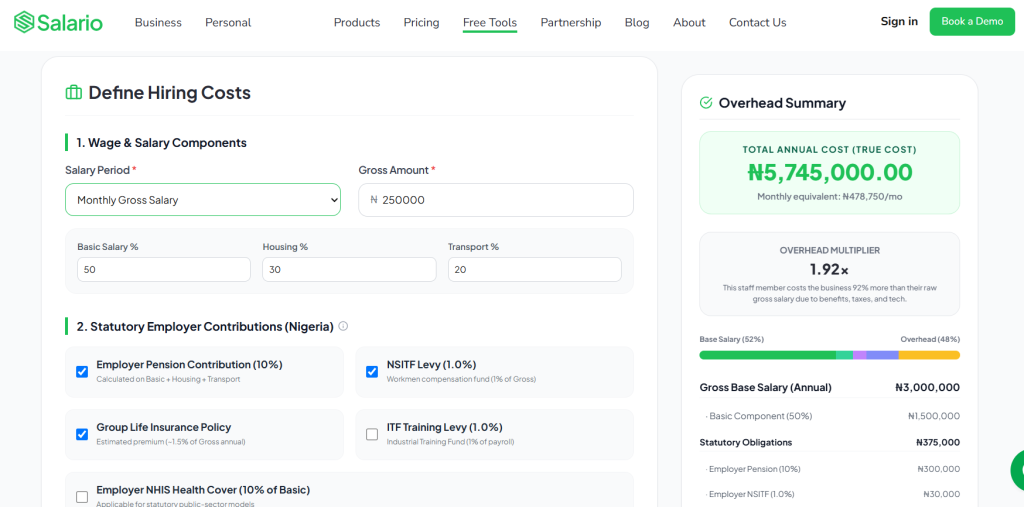
Before your next hire, add up four numbers: gross salary, employer pension contribution, applicable statutory levies (NSITF, ITF, NHIS, life insurance), and a realistic onboarding or turnover buffer. That total, not the salary alone, is what you should compare against your budget and revenue per employee.
A payroll calendar also helps you plan for these costs monthly instead of discovering them at year end. This guide on how to create a payroll calendar for your organization walks through building one that tracks PAYE, pension, and NHF deadlines alongside your salary run.
Turning Employee Cost Into a Manageable Number
Every Nigerian business owner eventually learns that salary is just the entry point to employee cost, not the full picture. Statutory contributions, hidden overheads, and turnover risk all add to the real number, and guessing at it is what leads to mid-year cash flow surprises.
Platforms like Salario automate pension, PAYE, NSITF, and other statutory deductions directly inside payroll runs, so the full employee cost is visible before you make an offer, not after. Ready to know exactly what your next hire will cost? Estimate your total employment cost with Salario’s free employee cost calculator, and budget with real numbers instead of guesswork. When you know the true cost upfront, every hiring decision gets easier.