
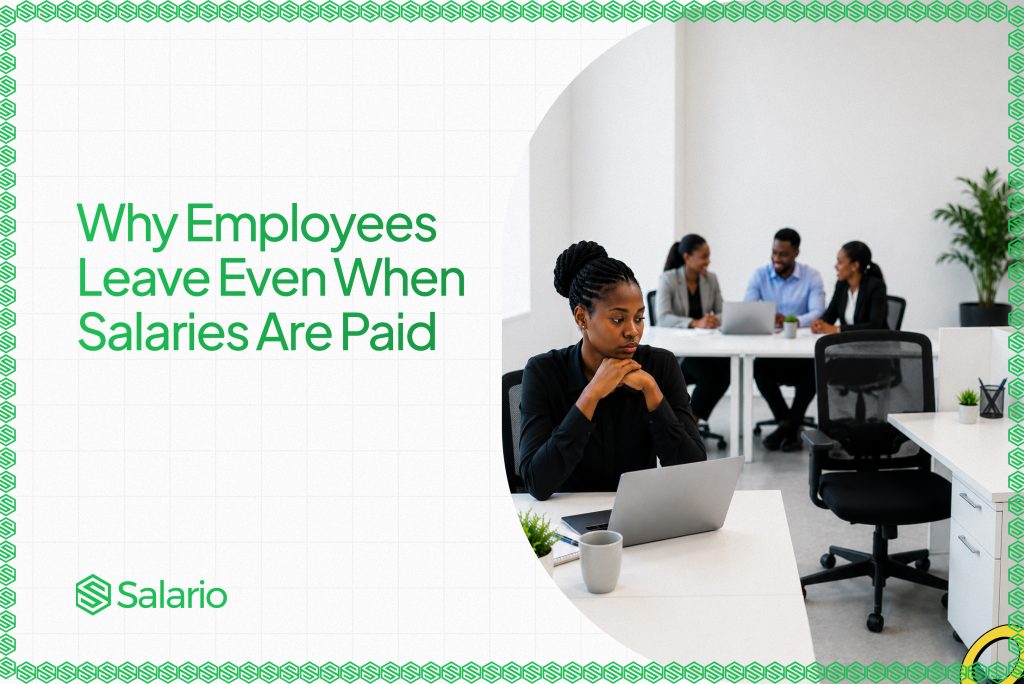
Adaeze ran payroll like clockwork. Every 25th of the month, salaries hit employee accounts without delay. No excuses, no bank queues, no awkward conversations about “next week.” Yet in six months, she lost three of her best staff. Each resignation letter said something polite about “new opportunities.” None mentioned money.
This is a pattern many Nigerian business owners recognize too late. They assume that if salary payments are consistent, retention is solved. But employees don’t just work for pay. They work for growth, respect, and a sense that their time matters. Understanding why employees leave even when salaries are paid requires looking past the payslip and into the daily experience of working at your company.
Why Employees Leave Even When Salaries Are Paid on Time
Getting paid on time removes a source of anxiety. It does not create loyalty. Employees who leave stable, well-paying roles are not being reckless. They are responding to something salaries alone cannot fix.

According to the Nigerian Workplace Report by Intel, better offers, lack of career advancement, and bad leadership rank as the top three reasons Nigerian employees resign. Notice that none of these are about salary payments being late or unpaid. A separate finding from Vanguard Insights shows that 71% of employees resign within their first 12 months on a job. That is not a compensation problem happening gradually. It is a fit and experience problem happening fast.
Salaries are the floor, not the ceiling. Once an employee’s basic financial needs are met, other factors start to carry more weight in the decision to stay or go. This is true globally too. Gallup’s 2025 State of the Global Workplace report found that only 21% of employees worldwide feel engaged at work, and about half say they are actively looking for a new job. Many of these workers are not underpaid. They are simply unconvinced that staying is worth it.
For a Nigerian SME owner, this is worth sitting with. You can run the most reliable salary payments in your industry and still watch good employees walk away. The reasons are rarely hidden. They usually show up in exit interviews, quiet resignations, and the slow disengagement that happens months before a formal notice letter arrives.
Career Growth Employees Can’t See
Ambitious employees want to know where they are headed, not just what they earn today. When a company cannot answer that question, staff start answering it elsewhere.
The same Nigerian Workplace Report found that employees who stay at a company for more than five years usually have a clear view of their career path within that organization. That clarity is rare in many Nigerian SMEs, where job titles stay fixed for years and promotions happen informally, if at all.
What Career Stagnation Looks Like
It rarely announces itself. An employee stops asking questions in meetings. They complete tasks without volunteering for more. They update their CV quietly on a Sunday evening. By the time an HR manager notices, the decision to leave has usually already been made.
Building a Path Employees Can Actually See
Businesses that build visible growth paths, even simple ones like skill-based pay bands or documented promotion criteria, give employees a reason to invest their long-term future in the company. This does not require an elaborate framework. A short conversation every quarter about where an employee wants to go, matched with honest feedback about what stands in the way, often does more for retention than an annual salary review. Employees who can answer the question “what does progress look like here” for themselves are far less likely to go looking for that answer at another company.
Trust and Leadership Break Before Salaries Do
Money can buy short-term compliance. It cannot buy trust. The Nigerian Workplace Report found that 45% of Nigerian employees have low trust in their management. That number should worry any business owner more than a competitor’s salary offer.
Low trust shows up in small ways first. Employees stop sharing honest feedback. They assume the worst about decisions they don’t understand. They stay quiet in meetings where they used to speak up. Left unaddressed, this erodes the working relationship long before an employee formally resigns.
Leadership that communicates clearly, admits mistakes, and follows through on promises builds the kind of trust that salaries alone cannot buy. This matters even more for growing Nigerian businesses, where founders often wear multiple hats and communication can slip during busy periods.
The Cost of Waiting Too Long
Trust does not break in a single incident, usually. It erodes through a series of small letdowns: a promised review that never happens, a complaint that goes unanswered, a policy that changes without explanation. Employees notice the pattern long before they say anything about it. This is part of why employees leave companies that seem, from the outside, to be doing everything right. The salary payments are consistent, the office is comfortable, but the trust underneath has quietly worn away.
The Weight of Feeling Unseen
Employees remember how they are treated long after they forget what was said in a meeting. Feeling unseen, whether through unclear payslips, delayed responses to HR requests, or a lack of basic recognition, chips away at morale gradually.
This is why employee experience matters well before payday, not just on it. Culture, hiring quality, and how a company handles the small daily moments all shape whether an employee feels valued. A business can pay salaries perfectly and still lose people because the experience around that payment feels transactional rather than respectful.
Simple gestures carry weight here. Acknowledging good work in front of the team, giving employees visibility into their own payroll and benefit records, and responding promptly to HR concerns all signal that a company sees its people as more than line items on a spreadsheet. Tools that give staff self-service access to their own payroll information can quietly reinforce this sense of transparency and respect.
Benefits Beyond the Basic Paycheck
Employees increasingly weigh what surrounds their salary, not just the figure itself. Health coverage, paid leave that is actually honored, flexible work arrangements, and support during personal emergencies all factor into whether someone feels their employer has their back.
A broader look at employee benefits beyond salary shows that Nigerian employees consistently rank these additions as major factors in job satisfaction, sometimes ahead of modest salary increases. A worker choosing between two similar salaries will often pick the employer offering better maternity leave, faster reimbursement of expenses, or more flexibility around remote work.
This does not mean businesses need lavish perks. It means paying attention to what employees actually value, which often costs less than a raise but delivers more loyalty.
Flexibility and Respect for Employees’ Time

Lagos traffic alone can turn an eight hour workday into a ten hour commitment before an employee has done a single task. Businesses that ignore this reality, insisting on rigid resumption times regardless of circumstances, quietly push employees toward companies that offer hybrid arrangements or flexible start times.
This is not about abandoning structure. It is about recognizing that an employee who spends three hours in traffic each way is not being lazy when they ask for flexibility. They are asking to be treated like an adult who can manage their own output. Companies that build in reasonable flexibility, even limited versions like flexible resumption windows or occasional remote days, often see loyalty increase without any change to salaries at all.
How Salario Helps Businesses Retain More Than Payroll
Consistent salary payments are still essential. Nothing on this list replaces the basic obligation to pay employees accurately and on time. Platforms like Salario automate Nigerian payroll compliance, from PAYE calculations to pension remittances, so businesses never fall into the trap of late or inconsistent salary payments in the first place.
But Salario also supports the factors that keep employees engaged beyond the paycheck. Its self-service portal gives employees direct visibility into their payslips, benefits, and deductions, reducing the friction that quietly damages trust. Automated compliance frees HR teams from repetitive administrative work, giving them time to focus on career development conversations, recognition programs, and the culture work that actually keeps people around. As Salario rolls out earned wage access, employees also gain more control over when they access money they have already earned, reducing financial stress between pay cycles.
Keep the Employees You’re Already Paying Well
Employees rarely leave companies that pay them fairly and treat them well. They leave companies that pay them fairly and stop there. Salaries buy compliance. Growth, trust, recognition, and thoughtful benefits buy loyalty.
If you want to understand why employees leave even when salaries are paid, look at what happens between paydays, not just on payday itself. Ready to build a workplace where accurate salaries are just the starting point? Book a free demo with Salario today and see how automated payroll compliance frees your HR team to focus on what actually keeps employees around. When payroll runs itself, people become your priority again.