
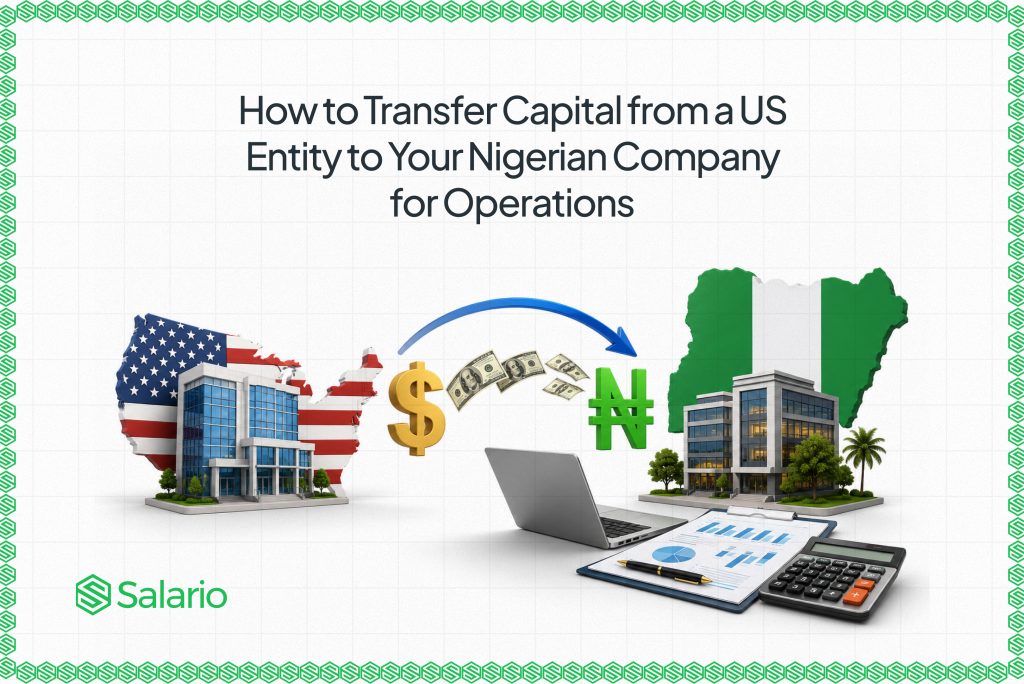
In the third quarter of 2025 alone, the United States sent $950.47 million into Nigeria, according to National Bureau of Statistics data. That single figure shows how much American capital already moves into Nigerian businesses every quarter. Yet many founders who run a US entity and a Nigerian subsidiary still struggle with the actual mechanics of getting money across. They know they need to transfer capital from a US entity to their Nigerian company for operations, but the how trips them up. Wire it wrong, skip a document, or pick the wrong structure, and you can end up with funds stuck in an account you cannot legally spend from or profits you cannot repatriate later. This guide walks through the practical steps for moving capital the right way, so your Nigerian team gets paid and your books stay clean on both sides of the Atlantic.
If you are still setting up your Nigerian entity or hiring your first employees there, it helps to read up on how US startups typically structure their entry into the Nigerian market before you commit to a transfer method.
Why the Transfer Method You Choose Matters
Before any dollar leaves your US account, decide how it will legally arrive in Nigeria. This is not a small detail. The structure you pick determines your tax exposure, how easily you can pull profits back out later, and how much paperwork your finance team deals with every month. Many founders wire money first and figure out the paperwork after. That approach almost always costs more in the long run, either in penalties, delayed access to funds, or a frustrating conversation with your bank when you try to repatriate a dividend two years down the line.
There are three common ways to move capital from a US entity into a Nigerian company. Each one suits a different stage of business.
Step 1: Choose Between Equity, Intercompany Loan, or Trade Credit
Equity investment means your US entity buys shares in the Nigerian company. This works well when you want the Nigerian entity to carry the capital on its balance sheet as owner funding, with no repayment obligation. It is the cleanest option for founders capitalizing a new subsidiary before it has any local revenue.
An intercompany loan is different. The US parent lends money to the Nigerian subsidiary, and the Nigerian company repays it with interest over time. This route gives you more flexibility to move money back out, since loan repayments are treated differently from dividends. But it also means you need a proper loan agreement, an interest rate that reflects market terms, and awareness of Nigeria’s transfer pricing rules, which the Federal Inland Revenue Service enforces closely on related-party transactions.
Trade credit applies when the US entity is technically paying for goods or services the Nigerian company will use, rather than funding it directly. This is less common for day-to-day operating costs like payroll, but it shows up often when a US parent covers software licenses or equipment on behalf of its Nigerian team.
Whichever option you pick, tell your accountant on both sides before you send a single wire. Mismatched books between the US and Nigerian entities create headaches that take months to unwind.
Step 2: Secure a Certificate of Capital Importation
This is the step most founders skip, and it is the one that causes the most pain later. A Certificate of Capital Importation, or CCI, is proof that foreign capital entered Nigeria through an authorized channel for investment purposes. Your Nigerian bank issues it, acting as an authorized dealer on behalf of the Central Bank of Nigeria.
Here is why it matters. Without a CCI, you cannot later repatriate profits, dividends, or loan repayments back to your US entity through Nigeria’s official foreign exchange market. The Central Bank treats the CCI as the official record that your money came in the front door, and it will not let you take money out the same way without that paper trail.
Getting one is straightforward if you plan ahead. Notify your Nigerian bank before you send the transfer, not after. Tell them the amount, the purpose of the funds, and whether it is equity or a loan. The bank will ask for a board resolution from the Nigerian company accepting the investment, your certificate of incorporation, and details of the US entity sending the funds. Once the money lands and the bank confirms receipt, it should issue the electronic CCI within one to two business days. Keep that certificate somewhere safe. You will need it again the day you want to move money the other way.
Step 3: Route the Transfer Through an Authorized Dealer Bank
Send the funds through a proper wire transfer from your US entity’s bank account to your Nigerian company’s account at an authorized dealer bank. Avoid personal accounts, informal remittance apps, or third-party wallets for this kind of transfer. Regulators and auditors want to see a clean, traceable line from one corporate account to another. If your Nigerian bank offers a dedicated wallet or sub-account for funding recurring costs like salaries, it is worth setting one up. Salario’s Payroll Wallet integration with SafeHaven is one example of how a funded wallet removes the risk of sending money from the wrong account or missing a transfer altogether, which matters once you are running monthly payroll and not just a one-time capital injection.

If your operating costs include recurring payments to a diaspora-run team, some founders also explore stablecoin rails for smaller, faster transfers between funding rounds. It is worth understanding how stablecoin payroll works if speed and lower fees matter more to you than the traditional banking timeline, though this should sit alongside your CCI-backed capital transfers, not replace them for larger sums.
Step 4: Document Everything for Nigerian Tax and Compliance
Once the capital lands, your Nigerian company’s finance team needs to record it correctly. Loans need a signed agreement with clear repayment terms. Equity injections need to reflect in the company’s share register and financial statements. Both need to tie back to the CCI issued by your bank.
This documentation matters for two reasons. FIRS reviews related-party transactions between foreign parents and Nigerian subsidiaries, and gaps in your paper trail invite closer scrutiny. Second, if you ever plan to sell the Nigerian business, bring in outside investors, or wind down operations, buyers and auditors will ask for this history. A folder of wire confirmations without the supporting agreements and CCI will not hold up.
Common Mistakes US Entities Make When Funding Nigerian Operations
The most frequent mistake is treating the transfer as a one-time task instead of an ongoing process. Founders send the first big capital injection carefully, get the CCI, and then start wiring smaller top-up amounts casually without repeating the paperwork. Every material inflow needs its own record, even if it is going to the same account.
The second mistake is funding payroll directly from a US account without routing it through the Nigerian entity’s books first. This confuses your compliance picture and makes it harder to track statutory obligations like PAYE and pension remittances, which must be calculated and paid in naira regardless of where the funding came from. If you are managing a distributed team across US and Nigerian offices, it helps to read through common pitfalls in remote team payroll management so funding decisions and payroll processing stay in sync.
The third mistake is underestimating exchange rate timing. Naira volatility means the same dollar amount can cover very different local costs depending on when you convert it. Founders who wire funds reactively, only when payroll is due, often end up converting at worse rates than founders who plan transfers a few weeks ahead and hold naira in an interest-bearing account until it is needed.
Where a Platform Like Salario Fits In
Getting the capital into Nigeria is only half the job. Once it lands, you still need to turn it into accurate, compliant salary payments for your team, on time, every month. This is where the operational side of running a Nigerian subsidiary from abroad gets heavier than most US founders expect. Platforms like Salario automate PAYE, pension, and other statutory deductions once funds are in the local account, so your finance team is not recalculating compliance rules by hand every payday. For diaspora founders and US entities juggling a remote Nigerian team, that automation closes the gap between sending money correctly and paying people correctly.
Ready to stop worrying about what happens to your capital once it lands in Nigeria? Book a free demo with Salario today and see how founders funding operations from abroad keep payroll compliant without micromanaging every naira. When the transfer and the payroll both run smoothly, distance stops being a liability.