
A Nigerian designer working remotely for a company in Canada gets paid on Friday. By Monday, part of the money is gone to bank charges, FX spreads, and conversion fees. Another employee waits three days before an international transfer reflects. Someone else receives less than expected because exchange rates changed between processing and settlement.
These experiences are becoming common in global work.
As remote teams grow and cross-border hiring becomes normal, businesses are rethinking how salaries move across countries. This is where stablecoins have entered the conversation.
Some people believe stablecoins represent the future of salary payments. Others see them as a temporary workaround for broken financial systems.
The truth sits somewhere in the middle.
Stablecoins are solving real payroll problems today, especially around speed, currency stability, and international transfers. But there are still questions around regulation, adoption, and infrastructure.
So, are stablecoins truly the future of salary payments, or are they simply filling a gap until traditional systems improve?
Let’s break it down.
What are stablecoins and why are businesses paying attention?
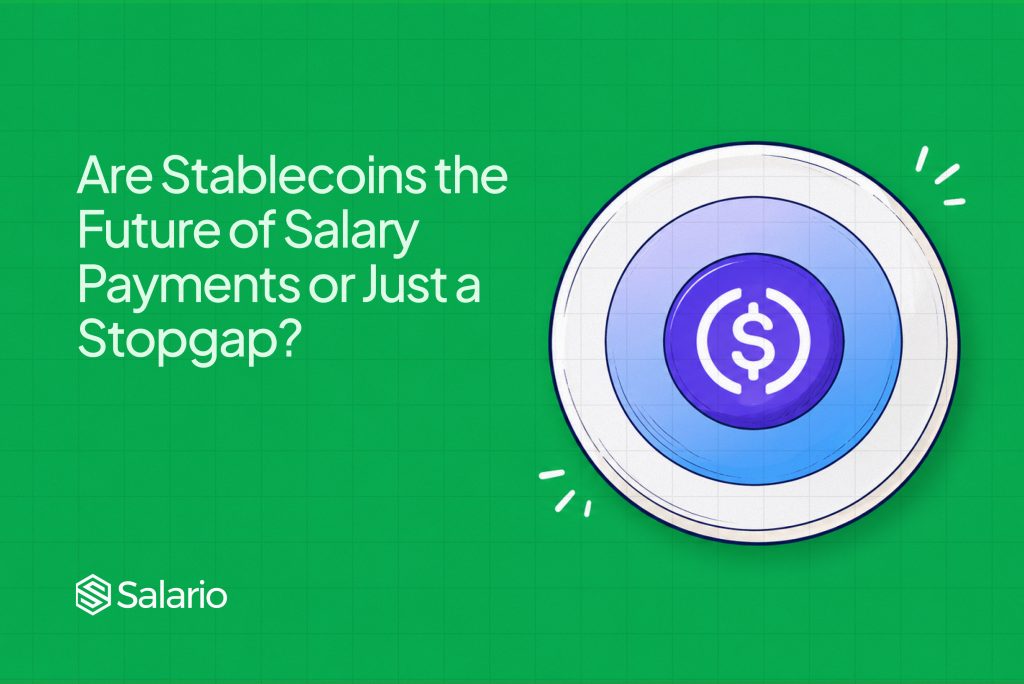
Stablecoins are digital currencies designed to maintain a stable value, usually by being tied to a reserve asset like the US dollar.
Unlike cryptocurrencies such as Bitcoin or Ethereum, stablecoins do not swing wildly in value every day. A stablecoin like USDC is designed to remain close to one US dollar.
This stability is what makes them attractive for payroll. Businesses are paying attention because traditional cross-border salary payments are often slow and expensive.
According to the World Bank, the global average remittance cost remains above 6% in many payment corridors. For companies paying international employees every month, those costs become significant.
Stablecoins offer a different approach.
Instead of routing money through multiple banks and intermediaries, businesses can send funds directly through blockchain networks. Transactions often settle within minutes.
This is one reason many people believe stablecoins could become part of the future of salary payments.
Why are stablecoins becoming more relevant for payroll?
Stablecoins are becoming more relevant because work itself has changed.
Ten years ago, most businesses hired locally. Today, companies hire globally by default.

A startup in London can employ developers in Lagos, marketers in Nairobi, and designers in Manila. Payroll systems built around local banking structures struggle in this environment.
Stablecoins solve several of these problems at once.
- First, they reduce transfer delays. International wire transfers can take days. Stablecoin payments can settle almost instantly.
- Second, they reduce fees. Traditional transfers often involve sending banks, intermediary banks, receiving banks, and FX markups.
- Third, they create easier access to stable currencies.
This matters in countries facing inflation or currency volatility. In Nigeria, for example, many employees already think about their earnings in dollar terms because the naira fluctuates heavily.
Stablecoins provide a way to hold value more predictably. This growing demand is why conversations about the future of salary payments increasingly include stablecoins.
Are stablecoins already being used for salaries?
Yes, stablecoins are already being used for salary payments in different parts of the world.
Remote-first companies, crypto firms, freelancers, and global contractors have started adopting them for cross-border compensation.
According to data from Chainalysis, stablecoins account for a large share of global crypto transaction activity, especially in emerging markets where currency instability exists.
Some businesses now offer employees the option to receive part of their salary in stablecoins like:
- USDC
- USDT
- DAI
This does not always replace local currency entirely. In many cases, employees receive a mix of fiat and digital payments.
The trend is still early, but adoption is no longer theoretical. Stablecoins are already functioning as part of the future of salary payments for specific industries and workforce models.
What problems do stablecoins solve in payroll?
Stablecoins solve several real payroll problems, especially for cross-border teams.

Faster payments
One of the biggest frustrations in payroll is delay. Employees expect salaries to arrive on time, but international banking systems often slow things down. Stablecoins reduce this friction because transactions happen directly on blockchain networks.
Lower transaction costs
Traditional international transfers are expensive. Between bank fees, FX spreads, and intermediary deductions, businesses lose money moving salaries across borders. Stablecoins reduce many of these costs. For companies managing large international teams, this creates meaningful savings over time.
Better currency stability
Employees in volatile economies often worry about currency depreciation. Stablecoins tied to the US dollar provide an alternative store of value. This is particularly important in countries experiencing inflation or FX instability.
Increased financial access
Not everyone has reliable access to international banking systems. Stablecoins create another pathway for receiving payments without depending entirely on traditional banking infrastructure.
These advantages explain why many businesses see stablecoins as part of the future of salary payments rather than just a temporary trend.
What are the risks of using stablecoins for salaries?
Despite the advantages, stablecoins are not perfect. There are still important concerns businesses must consider before adopting them widely.
Regulatory uncertainty
Governments around the world are still developing rules for digital assets. Some countries support stablecoin innovation. Others remain cautious. For employers, this creates uncertainty around taxation, reporting, and compliance. A system that works legally today may face new restrictions later.
Employee adoption and understanding
Not every employee wants to receive salaries in stablecoins. Some workers are unfamiliar with digital wallets or blockchain systems. Others simply prefer traditional bank accounts. Adoption depends heavily on education and trust.
Infrastructure challenges
Stablecoins require supporting infrastructure. Employees need wallets. Businesses need secure custody systems. Payroll platforms need integrations that support digital payments. Without reliable systems, complexity increases instead of decreasing.
Stability concerns
While stablecoins are designed to maintain value, not all stablecoins are equally reliable. Some have faced liquidity issues or reserve concerns in the past. Businesses must choose carefully and use trusted providers.
These challenges are why some critics argue stablecoins are not yet the full future of salary payments.
Could stablecoins replace banks entirely?
Probably not.
At least not anytime soon.

The future of salary payments is more likely to involve a combination of systems rather than one replacing the other completely.
Banks still provide critical services:
- Compliance infrastructure
- Payroll reporting
- Tax handling
- Consumer protections
- Access to local financial systems
Stablecoins solve specific problems, especially around speed and international transfers.
But traditional financial systems still play a major role in payroll operations.
What is more likely is a hybrid future.
Businesses may use stablecoins for funding or cross-border settlement while employees still receive local currency through integrated systems.
The future of salary payments will probably combine traditional banking with newer payment technologies.
Why does this matter for Nigerian businesses and employees?
Nigeria sits in a unique position within this conversation.
The country has:
- A large remote workforce
- High crypto adoption
- Significant FX challenges
- Growing cross-border employment
This makes stablecoins particularly relevant.
For diaspora founders paying Nigerian teams, stablecoins can reduce transfer costs and simplify international payroll.
For employees, they can provide quicker access to more stable value. At the same time, businesses still need to comply with Nigerian payroll regulations. PAYE, pensions, and statutory deductions still apply regardless of how salaries are funded.
This means stablecoins alone are not enough. Businesses also need compliant payroll systems. That is where modern payroll infrastructure becomes important.
The future of salary payments is not just about moving money faster. It is about combining speed with compliance and visibility.
Are stablecoins a stopgap or a long-term shift?
Stablecoins started as a solution to specific financial inefficiencies.
But they are gradually becoming part of a larger transformation in global payments.
That does not mean every company will suddenly pay salaries entirely in stablecoins.
It means payroll expectations are changing.
Employees increasingly expect:
- Faster payments
- Lower transfer friction
- Flexible payment options
- Better currency stability
Stablecoins align with these expectations.
Even if the technology evolves further, the underlying demand will remain.
This is why stablecoins feel less like a temporary stopgap and more like an early stage of the future of salary payments.
The exact tools may change over time, but the direction is becoming clearer.
How should businesses approach stablecoins today?
Businesses should approach stablecoins carefully but not ignore them.
The smartest approach is gradual exploration.
You do not need to replace your payroll system overnight.
Instead:
- Understand how stablecoins work
- Monitor regulatory developments
- Evaluate employee interest
- Explore payroll platforms building modern payment infrastructure
This gives your business flexibility without unnecessary risk.
Platforms like Salario are already thinking in this direction by exploring stablecoin payment capabilities for cross-border payroll.
The goal is not hype. The goal is solving real payroll challenges for modern teams.
Businesses that understand these trends early will adapt faster as payroll continues to evolve.
Conclusion
Stablecoins are solving real payroll problems today.
They reduce delays, lower cross-border costs, and provide more flexibility for global teams. That alone makes them important.
But they are not a perfect replacement for traditional payroll systems yet.
Regulation, infrastructure, and adoption still need time to mature.
So, are stablecoins the future of salary payments?
Possibly not by themselves.
But they are clearly shaping what the future of salary payments will look like. Faster, more flexible, and less dependent on outdated cross-border banking systems.
For Nigerian businesses managing global teams, understanding this shift early creates an advantage.
Ready to explore how modern payroll systems are evolving for cross-border teams? Discover more insights from Salario on payroll innovation, employee experience, and the future of global payments.