
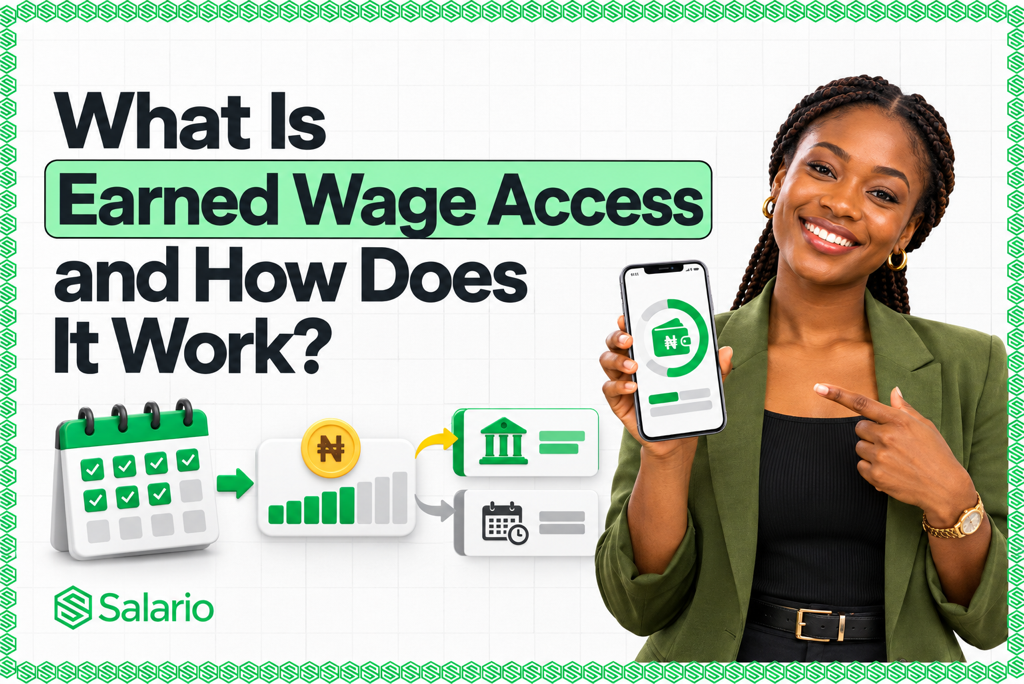
What is earned wage access and how does it work? Earned Wage Access, commonly shortened to EWA, allows an employee to receive part of the salary they have already earned before the organisation’s normal payday. The available amount is calculated from completed work, reduced by the employer’s access limit and any previous withdrawals, then reconciled when payroll is processed.
In simple terms, EWA changes when an employee can receive eligible earnings. It does not increase the employee’s salary. If an employee accesses ₦40,000 before payday, that amount is accounted for when the remaining salary is paid.
For employees, this can provide controlled access to money for transport, food, medical expenses, school fees, utility bills, or an unexpected emergency. For employers, it can replace informal salary requests with a structured process connected to attendance, payroll, approvals, payouts, and records.
This guide explains how earned wage access works, how it differs from a salary advance or loan, its advantages and risks, and how the process can operate through Salario.
What Is Earned Wage Access?
Let’s understand what is earned wage access and how does it work. Earned Wage Access, commonly shortened to EWA, allows an employee to receive part of the salary they have already earned before the organisation’s normal payday. The available amount is calculated from completed work, reduced by the employer’s access limit and any previous withdrawals, then reconciled when payroll is processed. Earned Wage Access is a workplace benefit that gives eligible employees access to a portion of accrued but unpaid wages before the scheduled pay date. It is also called on-demand pay, earned salary access, or early wage access.
Consider an employee who is paid monthly. By the middle of the month, that employee has completed part of the work for which the monthly salary will be paid. An EWA system estimates or verifies the value of the work already completed and makes a controlled portion available before month-end.
The employee is not receiving an additional salary payment. The early amount forms part of the same pay cycle and reduces the amount remaining for the normal payday.
A well-designed employer-integrated EWA programme normally has five characteristics:
- Access is based on wages already earned, not the employee’s full future salary.
- Eligibility is connected to verified employment, payroll, and sometimes attendance data.
- The employer sets limits, conditions, and frequency rules.
- Every request and payout is recorded.
- Amounts accessed early are reconciled in the next payroll.
The precise legal and financial treatment can depend on how a product is funded, what fees apply, whether the provider has recourse against the employee, and the rules in the relevant country. Employers should therefore evaluate the actual product structure rather than relying only on the EWA label.
Why Does Earned Wage Access Exist?
Traditional payroll pays employees weekly, fortnightly, or monthly for administrative convenience. Personal expenses do not follow the same schedule.
An employee may have earned part of a monthly salary but still face an urgent bill several days before payday. Without a structured option, the employee may request an informal advance from HR, borrow from friends, use an expensive loan application, delay an essential payment, or miss work while trying to solve the problem.
Earned wage access aims to reduce that timing mismatch. Instead of changing the full payroll cycle, it provides limited access to eligible accrued earnings while keeping the remaining salary inside the normal payroll process.
How Does Earned Wage Access Work?
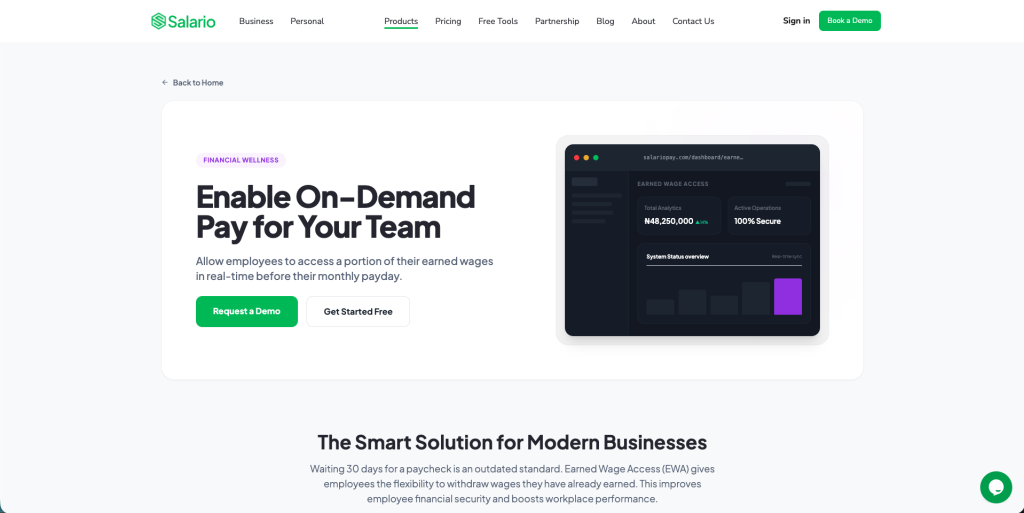
How does Earned Wage Access work? It begins when an employer creates an EWA policy that determines who can access earned wages, how much they can request and how each request will be funded.
With Salario, the complete process—from setting company rules to paying employees and reconciling payroll—takes place within one connected system.
1. The Employer Creates an EWA Policy
The employer first creates an Earned Wage Access policy in Salario.
During setup, the employer selects the disbursement source:
- Employer-funded: The company funds approved requests from its linked corporate account.
- Salario-funded: Salario pays approved requests on the employer’s behalf, and the amount is settled from the company’s payroll on payday.
The employer then selects the country, currency, bank and corporate account associated with the policy.
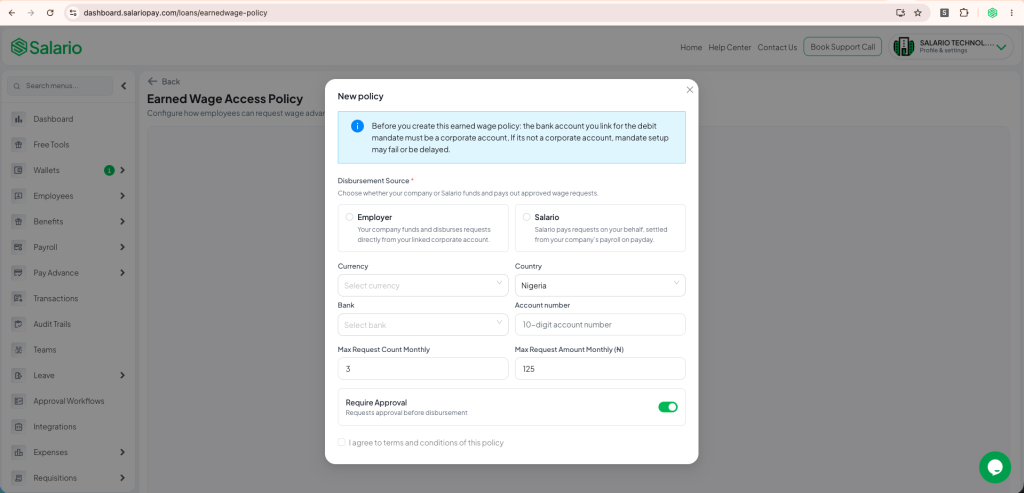
Image caption: Create an Earned Wage Access policy in Salario by selecting the funding source, corporate account and employee access rules.
2. The Company Sets Employee Access Limits
The employer decides how frequently employees can request earned wages and the maximum amount available each month.
Available policy controls include:
- Maximum requests per employee each month
- Maximum monthly request amount
- Employer or Salario-funded disbursement
- Eligible corporate bank account
- Manual approval requirement
- Country and currency
- Policy status
These controls allow the company to offer financial flexibility without giving employees unrestricted access to their entire salary.
For example, a company may permit each employee to submit up to three requests per month, subject to a fixed monthly limit.
3. Salario Calculates the Employee’s Earned Wages
As the employee works, Salario calculates the portion of salary already earned during the current payroll period.
The calculation can reflect information such as:
- Monthly salary
- Eligible working days
- Approved attendance
- Completed shifts
- Previous withdrawals
- Company access limits
- Existing payroll adjustments
Employees can only request an amount within their available earned-wage balance and the limits established by the employer.
This is what separates Earned Wage Access from a conventional loan. The employee accesses compensation linked to work already completed rather than borrowing an entirely new amount against future income.
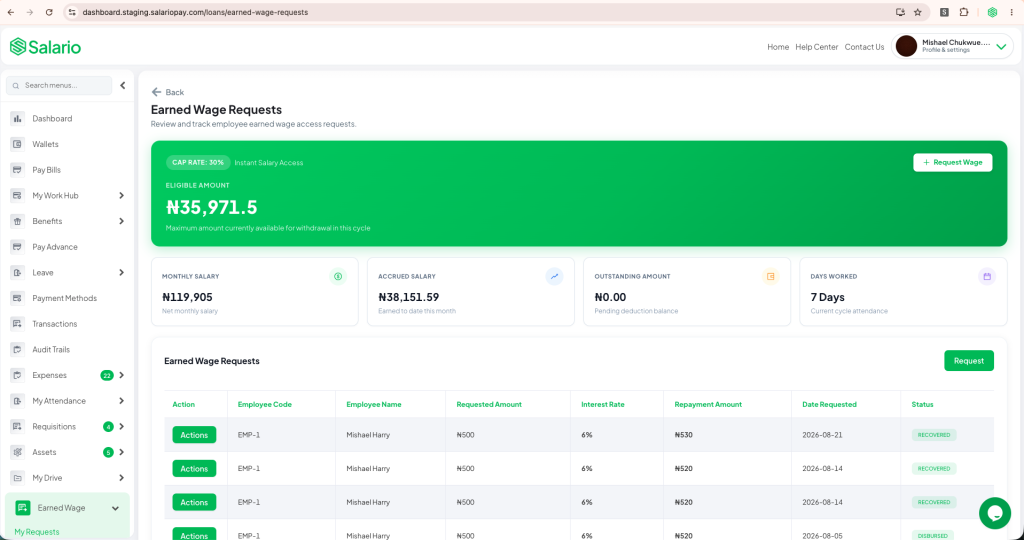
4. The Employee Submits a Request
An eligible employee signs in to Salario, views the amount currently available and selects how much they want to access.
Before submitting the request, the employee can see:
- Wages earned so far
- Amount available for withdrawal
- Previous EWA requests
- Remaining monthly limit
- Expected payday balance
The system checks the request against the company’s active EWA policy.
A request that exceeds the employee’s accrued balance, monthly amount or permitted request frequency cannot proceed under the policy.
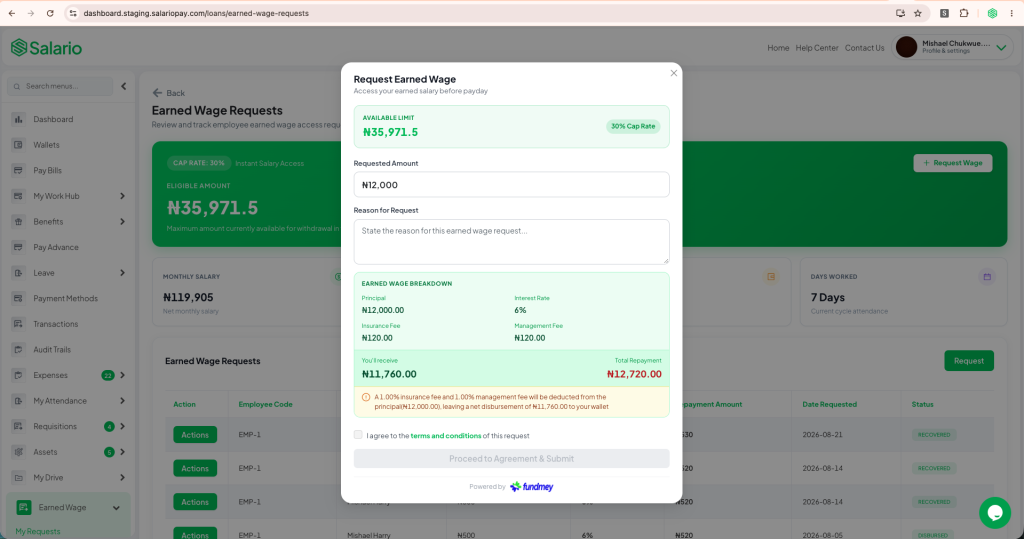
5. The Request Is Approved
If the company has enabled manual approval, the request is sent to the appropriate administrator for review before disbursement.
The employer can confirm that:
- The employee is eligible
- The amount is within the available balance
- The request follows company policy
- The monthly request limit has not been exceeded
- The payout account is valid
If approval is not required, eligible requests can move directly to the disbursement stage according to the company’s configuration.
6. The Employee Receives the Money
After approval, the requested amount is transferred to the employee’s bank account.
If the policy is employer-funded, the money comes from the company’s linked corporate account. If Salario is the selected funding source, Salario pays the employee on the company’s behalf and settles the amount through the agreed payroll process.
The payment is recorded automatically against the employee’s profile and current payroll period.
7. Salario Updates the Available Balance
Once the transaction is completed, Salario reduces the employee’s available EWA balance.
This prevents the same earned amount from being withdrawn more than once.
The employee and authorised administrators can review the request amount, payment status, transaction history and remaining availability.
8. The Employer Monitors the Active Policy
The EWA policy dashboard gives the employer a central view of how the programme is configured.
Administrators can review:
- Maximum requests allowed each month
- Maximum monthly request amount
- Policy status
- Funding source
- Linked bank account
- Approval requirement
- Policy creation date
- Supporting documents
The policy can also be edited or revoked when company requirements change.
Suggested image placement: Insert the second screenshot here.
Image caption: The Salario EWA policy dashboard shows request limits, funding information, approval requirements and the policy’s current status.
9. The Withdrawal Is Reconciled During Payroll
Earned Wage Access does not increase the employee’s salary. It changes when part of the employee’s existing earnings is received.
For example, assume an employee’s final net salary for the month is ₦300,000. If the employee accesses ₦50,000 before payday, the remaining payday payment would be:
₦300,000 − ₦50,000 = ₦250,000
The employee still receives ₦300,000 in total:
- ₦50,000 before payday
- ₦250,000 on the regular payday
Because the EWA transaction is connected to payroll, Salario records the early payment and updates the final amount automatically. HR and Finance do not need to maintain a separate spreadsheet or remember to enter the transaction manually.
The Complete Salario EWA Process
The complete Earned Wage Access workflow can be summarised as:
Employer creates policy → Employee works → Wages accrue → Employee requests access → Policy is applied → Request is approved → Money is paid → Payroll is reconciled
This connected process gives employees greater financial flexibility while helping employers maintain control over eligibility, request limits, approvals, payouts and payroll records.
A Simple Earned Wage Access Example
Assume an employee’s approved net monthly salary is ₦300,000 and the pay period contains 20 eligible workdays.
After 10 verified workdays:
- Estimated accrued net earnings: ₦150,000
- Employer access limit: 50% of eligible accrued earnings
- Maximum available EWA balance: ₦75,000
- Amount requested by employee: ₦40,000
- Amount remaining for payday before later adjustments: ₦260,000
If the employee works additional days, the accrued balance may continue to increase. However, the final payroll can still change because of attendance corrections, approved overtime, taxes, pension, benefits, unpaid leave, reimbursements, or other authorised items.
That is why an EWA platform should calculate eligibility conservatively and reconcile against the completed payroll rather than treating a mid-month estimate as the final payslip.
Earned Wage Access vs Salary Advance
Earned wage access and salary advances both provide money before payday, but they start from different points.
Earned Wage Access is based on compensation linked to work already completed. The employee accesses part of an accrued amount and receives the balance later.
A salary advance is usually based on salary expected in the future. The employer or provider supplies funds before the employee has earned the full amount, then recovers the advance through one or more payroll deductions.
A salary advance may therefore involve repayment terms, affordability checks, interest, or a longer recovery period. EWA is designed around a shorter cycle and verified accrued earnings.
The names alone do not determine the legal treatment. A product marketed as EWA may still create credit-like risks when it includes mandatory fees, direct bank-account debits, recourse against the worker, or access based mainly on expected future pay.
For a deeper Nigeria-focused comparison, read Salary Advance and Earned Wage Access in Nigeria.
Salario Earned Wage Access: A Practical Case Study
Salario’s Earned Wage Access platform shows how EWA can work when it is connected to the employer’s wider workforce and payroll process.
Accrued wages are calculated continuously
Salario calculates an employee’s earned wage balance as the pay period progresses. For fixed salaries, eligibility can follow the applicable accrual rule. For shift, hourly, or variable workers, approved attendance and timesheets can connect work performed to compensation earned.
This creates a clearer sequence:
Clock in → approve work → calculate earned compensation → apply access limit → show available EWA balance
Employees see a transparent balance
Where the employer enables the benefit, an eligible employee can view accrued salary, the amount available for access, days worked, outstanding access, previous requests, and the estimated amount remaining for payday.
This self-service approach reduces repeated messages to HR and helps the employee understand that the displayed balance is limited by work completed and company policy.
The employee requests only what is available
The employee selects an amount within the current eligible balance. The system applies the employer’s controls and records the request instead of relying on an informal email, chat message, or spreadsheet.
Approved funds are paid to the employee’s bank account
Salario supports bank payout after the request satisfies the configured process. Its product page describes an externally supported funding model, which means a company can offer the benefit without using operational cash for every employee withdrawal.
Employers should confirm the applicable commercial terms, payout partner, settlement structure, access fees, and service conditions during implementation.
Every withdrawal remains connected to payroll
The transaction is written to the accrued ledger and reflected in the final payroll calculation. On payday, Salario accounts for the amount already received and calculates the employee’s remaining salary.
This is the important operational difference between payroll-native EWA and a disconnected cash-advance application. Employee records, work performed, eligibility, payout, payslip, and reconciliation remain part of one controlled process.
Benefits of Earned Wage Access for Employees
When implemented responsibly, EWA can offer several advantages:
- Faster access to earned money: Employees can meet a legitimate short-term need without waiting for the full payroll date.
- Better cash-flow timing: A worker can align part of their earnings with transport, food, utilities, school, or emergency expenses.
- An alternative to some borrowing: Employer-integrated EWA may reduce the need to use high-cost short-term credit, depending on fees and programme design.
- More privacy than informal requests: Employees do not have to explain every personal emergency to a manager if the policy allows self-service access.
- Clear visibility: A well-designed portal shows the available amount, previous withdrawals, and expected payday impact before confirmation.
EWA does not solve low income, persistent budget shortfalls, or excessive debt. It changes payment timing and should sit alongside financial education, fair compensation, responsible benefits, and access to support.
Benefits of Earned Wage Access for Employers
Employers may also benefit from a controlled programme:
- Fewer informal advance requests for HR and Finance to manage
- A consistent eligibility and approval policy
- Automatic payroll reconciliation and a stronger audit trail
- A financial-wellness benefit that may support recruitment and retention
- Less risk of duplicate or forgotten manual deductions
- Better visibility into usage patterns and programme performance
Businesses can estimate possible workforce and replacement-cost effects with Salario’s free EWA ROI and savings calculator. Treat the result as a planning scenario, not a guaranteed return. Actual outcomes depend on employee adoption, turnover, programme cost, salary levels, access rules, and how responsibly the benefit is used.
Final Thoughts
So, what is earned wage access and how does it work? It is a structured way for eligible employees to receive part of the wages they have already accrued before the normal payday. The system calculates earned compensation, applies the employer’s limit, pays an approved amount, records the transaction, and reconciles it when payroll is completed.
The value of EWA depends on implementation. Clear limits, transparent costs, accurate attendance and payroll data, strong privacy controls, and understandable payslips can make it a useful financial-wellness benefit. Weak controls can simply replace one cash-flow problem with another.
Salario provides a payroll-native approach that connects accrued earnings, employer policy, employee self-service, bank payout, and payday reconciliation. Learn more about Earned Wage Access with Salario or book a product demonstration to evaluate how the workflow would fit your organisation.