
The accountant stared at the wire transfer receipt in disbelief. Five days after sending $10,000 to a London contractor, only $9,350 arrived. Between wire fees, intermediary charges, and forex markups, $650 disappeared into the system.
This isn’t rare. It happens daily.
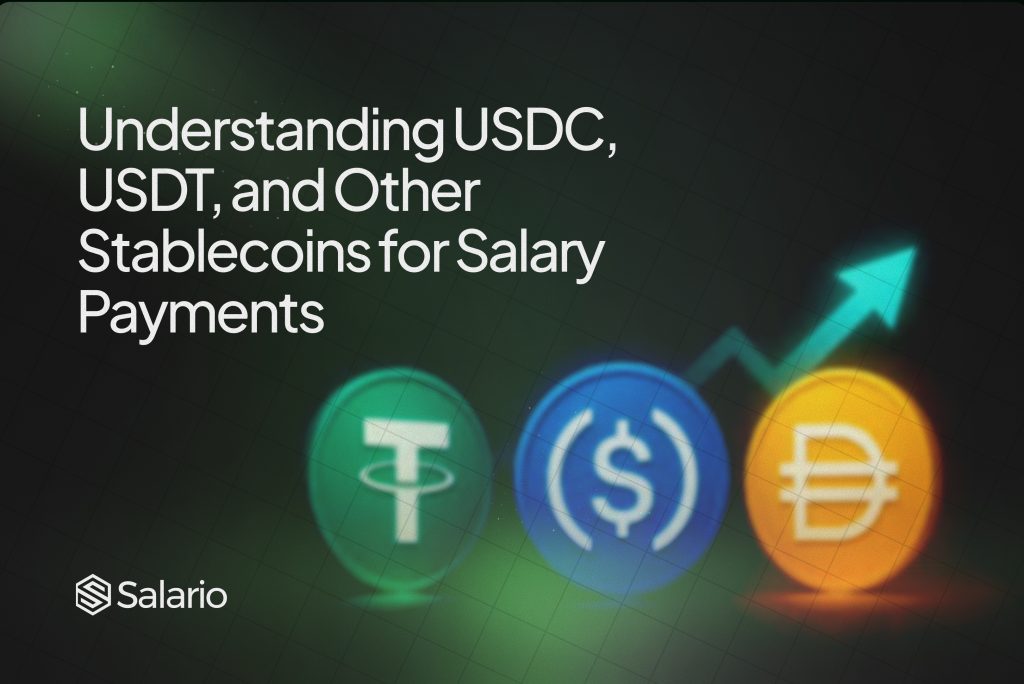
Stablecoins for salary payments eliminate this inefficiency entirely. Digital currencies like USDC and USDT allow businesses to pay employees and contractors globally in seconds, not days, with fees often under $1 instead of $50 plus hidden costs. These assets maintain a stable value by being pegged 1:1 to the US dollar, removing volatility from the equation.
Global payroll is fundamentally broken. Built for local transactions, traditional systems struggle with remote work realities: slow settlements, high fees, limited access, and fragmented compliance. Stablecoins for salary payments offer a modern alternative. This guide explains how USDC, USDT, and other stablecoins work, when to use them, and what to consider before adopting them.
What Are Stablecoins, and How Do They Work for Salary Payments?
Stablecoins are digital currencies designed to maintain a stable value by pegging to real-world assets like the US dollar. Unlike volatile cryptocurrencies such as Bitcoin or Ethereum, stablecoins hold steady, making them suitable for salary payments.
The mechanism is simple. For every token issued, an equivalent value is held in reserve. USDC, for example, is backed by US dollars and short-term US Treasury securities held in regulated institutions. These reserves are verified regularly, ensuring each token can be redeemed at a 1:1 ratio.
This structure builds trust. Employees receiving stablecoins for salary payments know they hold digital dollars that can be converted anytime. There is no exposure to price swings.
Transactions run on blockchain networks, which function as transparent digital ledgers. When a company sends a payment in USDC or USDT, the transaction is recorded instantly and permanently. Both sender and recipient can verify it.
Settlement happens in seconds or minutes, regardless of time or day. Blockchain networks operate 24/7, unlike banks restricted by working hours and holidays.
Costs are dramatically lower. While traditional wire transfers include multiple layers of fees and forex spreads, stablecoin transactions often cost less than $1. The fee remains the same whether sending $500 or $50,000.
Employees receive stablecoin salary payments directly into crypto wallets, which function like digital bank accounts without requiring traditional banking infrastructure. This opens access to workers in underbanked regions.
Recipients can:
- Hold stablecoins as digital dollars
- Convert to local currency when needed
- Use them directly for payments or savings
For businesses, stablecoins for salary payments enable seamless global operations. A developer in Serbia, a designer in Argentina, and an accountant in Nigeria can all be paid instantly using the same system.

The key advantage is stability. Unlike paying in Bitcoin, where value can fluctuate, stablecoin salary payments ensure a consistent dollar value.
Common Problems With Traditional Global Payroll
Traditional payroll systems create friction at every stage, especially across borders.
Speed is a major issue. International transfers take three to five business days due to intermediary routing and banking schedules.
Costs are equally problematic. Wire fees, intermediary charges, and forex spreads can consume 3% to 6% of total payroll value. Over time, this becomes a significant expense.
Currency volatility adds uncertainty. Exchange rate fluctuations make payroll costs unpredictable, while employees in weaker economies lose purchasing power.
Access limitations exclude talent. Many skilled workers lack international banking capabilities, making it difficult for companies to pay them.
Compliance complexity increases with each country. Different tax laws, reporting requirements, and labor regulations create administrative burdens.
Transparency is limited. Employees cannot easily track payments or verify deductions, leading to trust issues.
Manual processes slow everything down. Finance teams spend hours reconciling payments across systems and time zones.
Stablecoins for salary payments address these problems directly:
- Instant settlement replaces delays
- Minimal fees reduce costs
- Dollar stability protects value
- Wallet access removes banking barriers
- Blockchain records improve transparency
- Automation simplifies compliance
USDC vs USDT: Key Differences for Salary Payments
USDC and USDT dominate stablecoin salary payments, but they differ in important ways.
USDC focuses on transparency and regulatory compliance. It is backed by cash and US Treasury assets, with regular attestations verifying reserves. Its regulatory clarity makes it attractive for businesses prioritizing compliance.
USDC integrates seamlessly with major platforms, making conversion between crypto and fiat straightforward. This ease of use supports stablecoin salary payments in structured environments.

USDT, on the other hand, leads in liquidity and global availability. With a significantly larger market cap, it is more widely traded, especially in emerging markets.
This liquidity makes USDT practical where banking access is limited. Employees in such regions often find it easier to convert USDT into local currency.
However, USDT has historically faced more scrutiny around reserve transparency. While widely used, it does not match USDC’s level of regulatory clarity.
Both operate across multiple blockchains and offer similar performance: fast settlement, low fees, and stable value.
| Feature | USDC | USDT |
| Transparency | High | Moderate |
| Adoption | High | Very High |
| Regulation | Stronger | Weaker |
| Use in payroll | Growing | Widely used |
In practice:
- Choose USDC for compliance, transparency, and institutional use
- Choose USDT for liquidity and accessibility in emerging markets
Some companies offer both, allowing employees to select their preferred stablecoin salary payment option.
Benefits of Using USDC and USDT for Payroll
Stablecoins for salary payments provide tangible, immediate advantages.
Instant settlement eliminates waiting periods. Payments arrive within minutes, regardless of location or time.
Cost savings are substantial. Businesses reduce transaction fees and forex losses, often saving over 60% on international payroll expenses.
Currency stability benefits employees in volatile economies. Receiving dollar-pegged stablecoins protects purchasing power.
Financial inclusion expands hiring opportunities. Workers without bank accounts can receive payments through mobile wallets.
Transparency improves trust. Blockchain records provide verifiable proof of payment, reducing disputes.
Flexibility empowers employees. They can choose how and when to convert or use their funds.
Simplified compliance reduces operational burden. Platforms handling stablecoin salary payments often integrate tax and reporting features.
Global scalability allows companies to operate across borders without setting up local entities or managing multiple banking relationships.
Risks and Challenges of Stablecoin Salary Payments
Despite their advantages, stablecoins for salary payments come with considerations.
Regulatory uncertainty remains a factor. Different jurisdictions are still defining their frameworks, requiring businesses to stay compliant.
Depeg risk, while rare, exists. Major stablecoins like USDC and USDT have maintained stability, but temporary disruptions have occurred in the past.
Employee education is necessary. Not all workers are familiar with crypto wallets or blockchain systems.
Wallet security is critical. Lost credentials can result in permanent loss of funds, unlike traditional banking systems.
Tax complexity varies by jurisdiction. Some regions treat stablecoins as property, requiring additional reporting.
Adoption barriers may arise among less tech-savvy employees.
Liquidity challenges can occur if employees lack easy conversion options to local currency.
These challenges are manageable with proper infrastructure and support. The benefits of stablecoin salary payments typically outweigh the risks.
Other Stablecoins Used for Salary Payments
While USDC and USDT dominate, other options exist.
DAI is a decentralized stablecoin backed by crypto collateral. It appeals to organizations prioritizing decentralization but requires more active management.
PYUSD, issued by PayPal, integrates with existing PayPal systems, making it accessible to its user base. However, its global adoption is still growing.
Regional stablecoins pegged to currencies like the euro or pound also exist, serving localized needs.
For most businesses, USDC and USDT remain the primary choices for stablecoins for salary payments due to their liquidity, trust, and infrastructure.
When Should Businesses Use Stablecoins for Salaries?
Stablecoins for salary payments make sense in specific business contexts. Understanding when to implement them helps maximize benefits.
Companies paying international contractors and employees benefit most. If your team spans multiple countries, stablecoins eliminate cross-border payment friction entirely. Traditional wire transfers become unnecessary. Geography stops mattering for payroll operations.

Businesses operating in or hiring from unstable currency markets should consider stablecoins. Employees in high-inflation countries prefer receiving stable dollar-denominated payments. This improves recruitment and retention in challenging markets while protecting worker purchasing power.
Web3 and cryptocurrency companies naturally align with stablecoin salary payments. Teams already comfortable with crypto infrastructure adopt easily. Company treasuries holding crypto assets can pay salaries directly without converting to fiat first.
Companies frustrated with traditional payroll costs find immediate value. If wire fees and forex spreads consume 3% to 6% of your payroll budget, switching to stablecoins saves thousands to tens of thousands monthly. The ROI is immediate and measurable.
Businesses hiring talent in underbanked regions expand their candidate pools with stablecoins. Workers without access to traditional banking can receive salary payments via crypto wallets. This inclusion creates competitive hiring advantages.
Fast-growing companies scaling international teams benefit from stablecoin infrastructure that doesn’t require establishing local entities in every country. Pay workers in 50 countries through one system without 50 different compliance setups.
Organizations prioritizing transparency and employee trust leverage blockchain’s immutable records. Every payment is verifiable instantly. This transparency reduces disputes and support burden while building confidence.
Salario recognizes these benefits. That’s why we’re introducing stablecoin payment options for cross-border transactions. Nigerian businesses will soon be able to pay international contractors using USDC and USDT alongside domestic Nigerian payroll, all from one integrated platform. This brings global payroll capabilities to Nigerian companies without complexity.
Conclusion
Stablecoins for salary payments represent a fundamental shift in global payroll. By removing intermediaries, reducing costs, and enabling instant settlement, they solve long-standing inefficiencies in traditional systems.
USDC and USDT lead this transformation. USDC offers regulatory clarity and transparency, while USDT provides unmatched liquidity and accessibility. Both deliver the core benefits of stablecoin salary payments: speed, stability, and scalability.
The advantages are clear. Lower costs, faster payments, improved employee experience, and global reach position stablecoins as a competitive advantage for modern businesses.
Salario is building the future of payroll for Nigerian businesses. Our platform already automates Nigerian compliance perfectly, handling PAYE, pensions, and all statutory deductions effortlessly. Soon, we’ll add stablecoin payment capabilities using USDC and USDT for cross-border transactions. Pay your international contractors instantly while managing your Nigerian team’s local payroll from one dashboard. Everything integrated, fully compliant, completely automated.
Ready to prepare for borderless payroll? Book a free demo with Salario today and see how our platform handles Nigerian payroll compliance seamlessly. When we launch stablecoin payment options, you’ll be ready to pay anyone, anywhere, instantly using USDC and USDT. The future of global work demands global payroll infrastructure. Salario delivers both.