
Adaeze needed forty thousand naira before the end of the month. Her landlord wanted rent, her daughter’s school fees were due, and payday was still eleven days away. She had two options staring back at her from her phone: apply for a salary advance through her company’s HR portal, or download one of the loan apps she kept seeing on Instagram. She did not know the difference, and she is not alone.
Millions of Nigerian workers face this same choice every month. Naira volatility and rising living costs mean payday often feels further away than the calendar suggests. A salary advance and a payday loan can both put cash in your account within hours. But they work differently, cost differently, and carry different risks. Understanding the difference matters, especially with earned wage access now changing how Nigerian employees get paid. This article breaks down both options so you can choose the one that actually protects your finances.
What Is a Salary Advance?
A salary advance is money your employer gives you early, pulled from wages you have already earned but not yet received. If your payday is the 28th and you need cash on the 15th, a salary advance lets you access part of that pending salary now. Your employer simply deducts the amount from your next paycheck.

Most salary advances carry no interest, or a very small administrative fee, because the money already belongs to you. Your company is not lending you new funds. It is releasing pay you earned through work already done. This is why salary advances feel less risky than borrowing from a third party.
The catch is that not every employer offers this. Traditional payroll systems process salary once a month, with no built-in way to release partial pay early. Employees who need cash mid-month are often forced toward external lenders instead, even when their own earned wages could have covered the gap.
What Is a Payday Loan?
A payday loan is a short-term loan from a bank or lending app, meant to be repaid on your next payday. Unlike a salary advance, this money does not come from your employer. It comes from a lender who expects repayment with interest, sometimes a steep amount of interest.
Payday loan apps market themselves as fast and convenient. You apply on your phone, get approved in minutes, and receive funds without collateral or paperwork. But that convenience has a price. Monthly interest rates on Nigerian loan apps can range from roughly 3 percent to 30 percent depending on the lender and your credit profile, and when converted to an annual percentage rate, some products land between 30 percent and 260 percent according to TechCabal’s 2025 review of Nigerian loan apps. Miss a repayment date and penalties stack quickly, sometimes trapping borrowers in a cycle of new loans taken to cover old ones.
Payday loans are not inherently bad. For genuine emergencies with no other option, they can help. But because they are marketed so aggressively, many Nigerians reach for a payday loan when a cheaper, safer alternative already existed in their own paycheck.
Key Differences Between Salary Advance and Payday Loans
Ownership
The clearest difference is ownership. A salary advance releases money you already earned. A payday loan gives you money you have not earned yet, borrowed against future income. This single distinction explains most of the other differences.

Cost
Cost is the second major gap. A salary advance typically costs little to nothing, since your employer is not profiting from lending to you. A payday loan almost always carries interest, and that interest compounds fast if repayment slips.
Risk
Risk works the same way. With a salary advance, there is no debt trap, because you are simply receiving your own wages sooner. With a payday loan, missed payments can spiral into additional loans, damaged credit standing, and in some cases, aggressive recovery calls from lenders.
Approval
Approval also differs. A salary advance depends on your employer’s policy and how much of your earned wages remain unpaid for the month. A payday loan depends on a lender’s credit check, income verification, and sometimes access to your phone contacts or bank statements, which raises its own privacy concerns.
Speed
Speed varies. Payday loan apps often disburse within minutes. Salary advances depend on how quickly HR or payroll can process the request, which used to take days under manual systems but is now much faster with automated tools.
Repayment structure
Repayment structure matters too. A salary advance is repaid automatically through payroll deduction, so employees rarely miss the date. A payday loan often requires the borrower to remember and initiate repayment themselves, which is where many defaults and penalty charges begin. For someone already stretched thin financially, that difference alone can decide whether a short-term cash need turns into a longer-term debt problem.
Salario’s Earned Wage Access Module
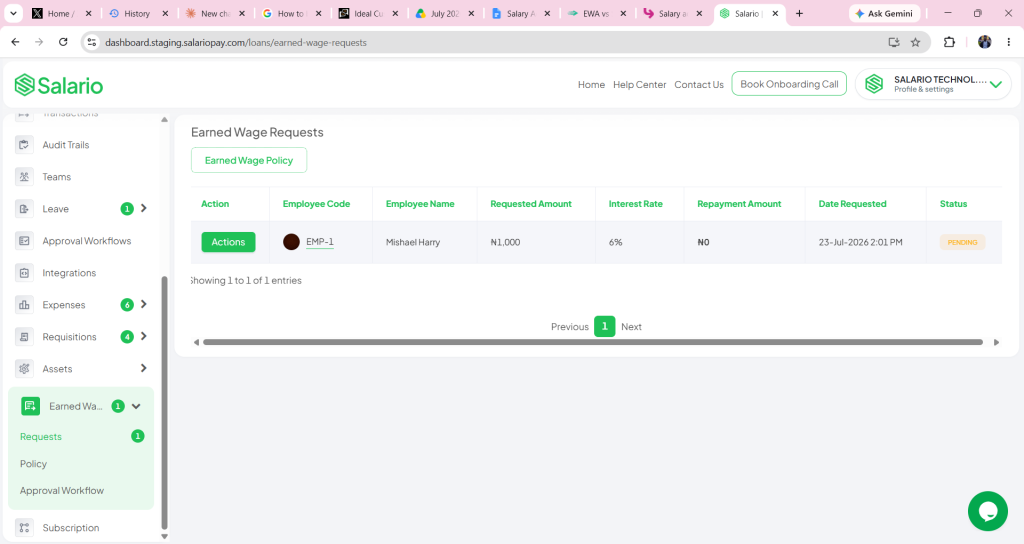
This is exactly the gap Salario’s Earned Wage Access module was built to close. Instead of employees turning to payday loan apps mid-month, they can request part of their already-earned salary directly through Salario’s employee portal.
The process is simple. An employee logs in, submits a request for a specific amount against wages already worked, and the request enters an approval workflow. In one recent example on the Salario dashboard, an employee requested a payout of 1,000 naira, shown clearly with the requested amount, a set interest rate, and the repayment amount calculated automatically. The request sits in a pending queue until HR or a finance manager reviews and approves it, giving employers full visibility and control over every disbursement.
Because the module tracks employee codes, request dates, and status in one place, HR teams avoid the manual back-and-forth that usually comes with off-cycle pay requests. Employers also set their own policy for how much of an employee’s earned wages can be accessed early, so companies stay in control of cash flow while still supporting staff.
Employees get faster access to money they already earned, without navigating a loan app, without a hard credit check, and without the compounding interest that comes with a typical payday loan. It turns earned wage access from a nice idea into a practical, auditable process built into everyday payroll operations, one that gives Nigerian employees a genuine alternative the next time an unexpected expense lands before payday.
Conclusion
A salary advance and a payday loan can both solve the same short-term cash gap, but they are not equal. A salary advance draws on wages you already earned, usually at little or no cost. A payday loan borrows against your future income, often at a steep price. Knowing this difference can save Nigerian workers real money and real stress.
Ready to give your team a safer way to access their pay before payday? Book a free demo with Salario today and see how earned wage access can replace risky loan apps with a transparent, employer-approved process. When employees can reach their own earnings without debt, payday stops being a source of dread.