
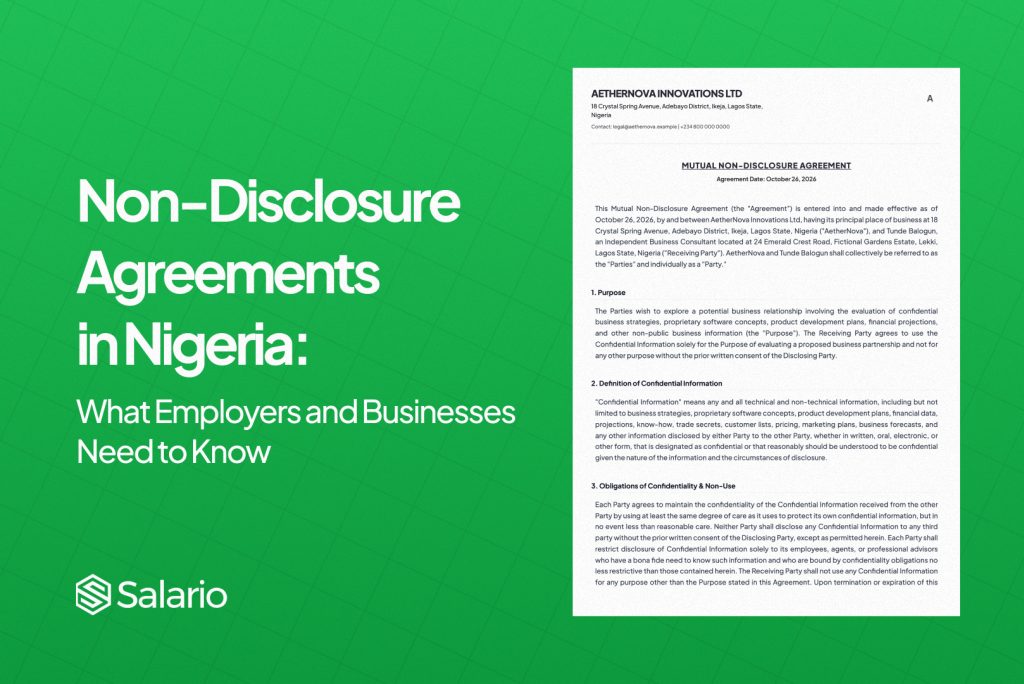
Non-Disclosure Agreements are among the cheapest ways to protect a business, yet many are badly drafted. In 2024, a Lagos High Court ordered Sterling Bank to pay ₦75 million in damages after it breached confidentiality and non-disclosure agreements. The case shows that Nigerian courts treat confidentiality promises seriously.
But courts only enforce what is written clearly and fairly. This guide explains how non-disclosure agreements in Nigeria work, what the law expects, and which clauses to include. It also shows where NDA’s in Nigeria tend to fail, so you can put a sound agreement in place before sensitive information changes hands.
What Non-Disclosure Agreements Are and Why Businesses Use Them
A non-disclosure agreement, or NDA, is a contract that keeps shared information private. It can stand alone or sit as a clause inside a larger contract. Some people call it a confidentiality agreement or a secrecy agreement. The name matters less than the promises inside it.
Nigerian businesses use Non-Disclosure Agreements in many places. Employers use them with staff who see client lists, pricing and payroll records. Founders use them before investor meetings. Companies use them with vendors, freelancers and developers who touch internal systems. Every hire adds cost beyond salary, as our breakdown of the true cost of hiring an employee in Nigeria shows. Protecting what that employee learns is part of the same cost.
There are two main types. A unilateral NDA binds one party, usually the person receiving information. Most employee agreements work this way. A mutual NDA binds both sides, and it suits partnerships and deal talks where each party shares secrets.
Are NDA’s in Nigeria Legally Enforceable?
Yes, if they meet the rules for a valid contract. No single statute governs every NDA. Enforceability rests on general contract law, common law duties of confidence, and the Evidence Act 2011, which governs how written agreements are admitted in court. For workers covered by the Labour Act, the employment contract can also carry confidentiality terms.

The Labour Act requires covered employers to give a written contract within three months of the start date. So the best time to sign an employee NDA is at the offer stage, not months after resumption. Early signing removes arguments about when the duty began.
Courts ask for evidence, not suspicion. A business that sues must show the information was confidential, that the other side received it under the agreement, and that a breach happened. Proof of harm helps when you claim damages. In the Sterling Bank matter, the court found the breaches unlawful and awarded money for the loss shown.
Claimants in Nigerian NDA disputes commonly ask for three things. They want an order stopping further breaches, an account of profits made from the breach, and damages. A well drafted agreement makes each of these easier to argue.
What a Strong Non-Disclosure Agreement Should Contain
Vague agreements lose in court. A strong one names the parties, defines the information and sets clear limits. Write each element in plain language.
Start with a precise definition of confidential information. List real categories, such as client lists, pricing models, source code, financial records and payroll data. A clause that covers everything you ever said invites a challenge.
Next, state the exclusions. Information that is already public, was known before disclosure, was developed independently, or must be disclosed by law is normally excluded. These carve outs keep the agreement fair and realistic.
Then set the duties of the receiving party. They should use the information only for the stated purpose, share it only with people who need it, protect it with reasonable care, and return or destroy it on request.
Add a fixed duration. Many agreements run for the life of the relationship and for a set number of years after it ends. Choose a period that matches how long the information stays valuable.
Finish with governing law and dispute resolution. State that Nigerian law applies and name the courts or the arbitration process. Add signatures and dates, since signed written records are far easier to prove.
Employee NDAs, Non-Competes and Restraint of Trade
Employers often fold competition limits into the NDA. This is where agreements break. A confidentiality clause protects information. A restraint of trade clause limits where a person can work after leaving. Nigerian courts treat the second kind with suspicion.
The Supreme Court set the guide in Koumoulis v Leventis Motors in 1973. Restraint clauses are generally unenforceable unless they are reasonable, with regard to the parties and the public. The employer carries the burden of proving reasonableness. The Federal Competition and Consumer Protection Act 2018 also now regulates this area, so check current rules with a lawyer.

A National Industrial Court case shows the practical line. A one year restriction within Nigeria was held reasonable. But a clause barring the employee from joining any other company in Nigeria was too wide, and it failed.
The lesson is simple. Keep the NDA narrow and tie it to real secrets. If you also need a non-compete, draft it separately and limit it by time, location and line of business. Be clear about which roles carry risk. A precise job description helps here, and our guide on how to write a job description shows how to state duties and access levels before the offer goes out.
NDA’s in Nigeria and the Nigeria Data Protection Act 2023
An NDA does not replace data protection compliance. The Nigeria Data Protection Act 2023 was signed on 12 June 2023 and set up the Nigeria Data Protection Commission. It requires data controllers and processors to use technical and organisational measures that protect the security, integrity and confidentiality of personal data. It also requires breach notification within 72 hours when people’s rights may be at risk.
For employers, this matters most with staff records. Payslips carry names, bank details, PAYE and pension figures. Our guide on what information should appear on an employee payslip shows how much personal data sits in one document. Anyone who handles payroll, HR files or customer records should sign an NDA that also commits them to your data handling policy.
Physical access supports the agreement too. Staff ID cards with role details and QR codes, covered in our guide to what should be on an employee ID card, help you control who enters areas where records are kept. Pair these controls with training so staff know what counts as confidential.
Common Mistakes That Make NDA’s in Nigeria Fail
Most failed agreements share the same few flaws. The first is a definition so broad that a court sees it as a gag on ordinary work. The second is no end date, which makes the duty look unreasonable.
Another mistake is signing after the secrets have already been shared. If a founder pitches an investor on Monday and sends the NDA on Friday, the protection starts late. Sign first, then disclose.
Copying a foreign template is a further trap. Clauses written for another country may ignore Nigerian law, courts and employment rules. Always check that the governing law and forum fit your business.
Finally, many businesses keep no record of what they shared. Without a log of documents, dates and recipients, proving a breach becomes guesswork. Keep a simple register, and store signed copies where you can find them quickly.
How to Create a Non-Disclosure Agreement Quickly
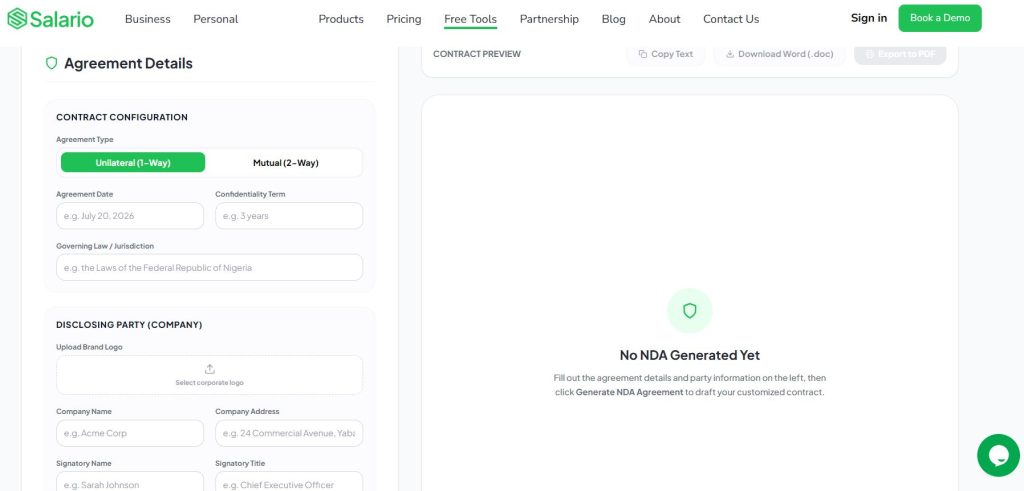
You do not need to start from a blank page. Salario built a free NDA contract generator for Nigerian businesses that need a clear agreement fast. You can create a Non-Disclosure Agreement for the people who will see your sensitive information, then review and sign it. For high value or complex deals, have a Nigerian lawyer review the final text.
This fits how Salario supports HR teams. The platform handles payroll compliance and employee records, so confidential staff data sits in one controlled system. A good NDA covers the promise. Good systems protect the data behind it.
Protect Your Business With Non-Disclosure Agreements in Nigeria
Non-Disclosure Agreements work when they are specific, fair and signed on time. Define the information, set sensible limits, keep restraint clauses narrow, and respect the Nigeria Data Protection Act 2023. Courts reward clear paper and punish vague drafting.
Ready to protect your business information? Create a Non-disclosure agreement with Salario’s free NDA generator today, and put clear terms in place before your next hire, vendor or investor meeting. When confidentiality is written down properly, trust becomes easier to keep.