
Payroll used to be predictable. You ran salaries at the end of the month, processed payments through the bank, and moved on.
That model is starting to break.
Today, teams are global. Employees work across borders. Payments move through multiple currencies. And delays that once felt normal now create real friction.
The future of payroll is shifting toward speed, flexibility, and global access. Businesses are exploring multi-currency systems, stablecoins, and real-time payments to keep up with how work now happens.
In this guide, you will see how these changes are shaping payroll, what they mean for Nigerian businesses, and why this shift is happening faster than many expect.
Why is the future of payroll moving beyond traditional banking systems?
The future of payroll is moving beyond traditional banking because the old system cannot keep up with global work. Bank transfers still take 2 to 5 business days for cross-border payments on most popular platforms, and while there are strides to shorten this time frame, other reliable and faster options are still welcome. Fees often range between 3% and 6% per transaction. These delays affect employees directly, especially when they depend on their income coming in on time.
According to World Bank data, the global average cost of sending remittances remains above 6% in many corridors. For businesses paying teams across countries, this cost adds up quickly.

Traditional systems also struggle with transparency. You send funds, but you cannot always track when they arrive or what fees were deducted along the way. This is why the future of payroll is shifting toward systems that are faster, cheaper, and more transparent.
What role do multi-currency systems play in the future of payroll?
The future of payroll relies heavily on multi-currency systems because businesses now operate across borders.
A company based in the UK may pay developers in Nigeria, designers in Kenya, and marketers in South Africa. Paying everyone in a single currency creates friction.
Multi-currency payroll allows businesses to:
- Pay employees in their local currency
- Reduce FX conversion losses
- Improve employee satisfaction
- Simplify financial planning
Without this flexibility, companies face constant FX exposure. Exchange rates fluctuate daily. This makes payroll costs unpredictable.
In Nigeria, where the naira has experienced significant volatility in recent years, this becomes even more critical. The future of payroll depends on systems that can handle multiple currencies seamlessly without forcing businesses into inefficient conversions.
How do stablecoins fit into the future of payroll?
Stablecoins are becoming a key part of the future of payroll because they solve the problem of unstable currencies and slow transfers.

Stablecoins are digital currencies tied to stable assets like the US dollar. Examples include USDC and USDT. Unlike traditional cryptocurrencies, their value does not fluctuate wildly. This stability makes them useful for payroll.
According to Chainalysis reports, stablecoins now account for a significant share of global crypto transaction volume, especially in emerging markets. In countries facing currency instability, adoption has grown rapidly.
Stablecoins allow businesses to:
- Send payments instantly across borders
- Avoid high bank transfer fees
- Reduce FX uncertainty
- Maintain value in a stable currency
For Nigerian employees, this creates a new option. Instead of waiting days for international transfers, payments can arrive almost instantly. For employers, stablecoins simplify cross-border payroll operations.
The future of payroll is not about replacing traditional systems entirely. It is about adding faster, more flexible options alongside them.
Are stablecoins safe and practical for payroll use?
Yes, stablecoins are increasingly safe and practical for payroll, especially when used through regulated platforms and proper processes.
The future of payroll includes stablecoins because they offer a balance between speed and stability. Major stablecoins like USDC are backed by reserves and audited regularly. This builds trust for businesses using them for payments.
However, adoption still depends on infrastructure. Employees need access to wallets. Businesses need systems that integrate stablecoin payments into payroll workflows.
There are also regulatory considerations. Governments are still developing frameworks for digital assets. This means businesses must stay informed and compliant.
Despite these challenges, stablecoins are already being used in real-world payroll scenarios, especially for remote teams.
The direction is clear. Stablecoins are becoming a practical layer in the future of payroll.
What are real-time payments and why do they matter for payroll?
Real-time payments allow money to move instantly between accounts, without waiting hours or days. The future of payroll is moving toward real-time payments because employees expect faster access to their earnings.

Globally, real-time payment systems are expanding. According to ACI Worldwide, real-time transactions are projected to exceed 500 billion annually by 2027.
In Nigeria, instant bank transfers already exist, but cross-border payments still lag behind, especially with regard to bulk payment of salaries and benefits.
Real-time payments improve payroll by:
- Eliminating delays in salary disbursement
- Reducing dependency on banking hours
- Improving employee trust
- Supporting flexible pay models
When employees receive payments instantly, financial stress reduces. This ties directly into broader conversations about employee wellness.
The future of payroll is not just about paying people. It is about paying them on time, every time.
How will the future of payroll impact Nigerian businesses?
The future of payroll will significantly impact Nigerian businesses, especially those working with global teams or diaspora founders.
First, businesses will need to adapt to multi-currency operations. This means handling salaries in naira, dollars, or other currencies depending on employee needs.
Second, stablecoins will become more relevant for cross-border payments. This is particularly useful where traditional banking systems are slow or expensive.
Third, real-time payments will set new expectations. Employees will expect faster, more reliable salary access.
For Nigerian SMEs, this shift creates both opportunity and pressure. Opportunity comes from access to global talent and smoother payment systems. Pressure comes from the need to modernize payroll processes quickly.
The future of payroll will reward businesses that adopt flexible systems early.
What challenges come with adopting the future of payroll?
The future of payroll brings clear benefits, but it also comes with challenges that businesses must address.
Adopting stablecoins, multi-currency systems, and real-time payments requires:
- Proper financial controls
- Clear compliance processes
- Employee education
- Reliable technology infrastructure
There is also the issue of regulation. Laws around digital currencies are still evolving. Businesses must ensure they operate within legal frameworks.
Another challenge is integration. Payroll systems must connect with banking, accounting, and compliance tools.
Without proper integration, complexity increases instead of reducing. The future of payroll is not just about new technology. It is about building systems that work together smoothly.
How can businesses prepare for the future of payroll today?
Businesses can prepare for the future of payroll by focusing on flexibility, automation, and visibility.
- First, move away from manual payroll systems. Spreadsheets cannot handle multi-currency calculations or complex compliance requirements efficiently.
- Second, adopt platforms that support modern payroll needs. This includes automation, compliance tracking, and integration with payment systems.
- Third, stay informed about stablecoins and real-time payments. You do not need to adopt everything immediately, but you need to understand where the industry is heading.
- Finally, prioritize employee experience. Faster payments, transparent deductions, and reliable systems build trust.
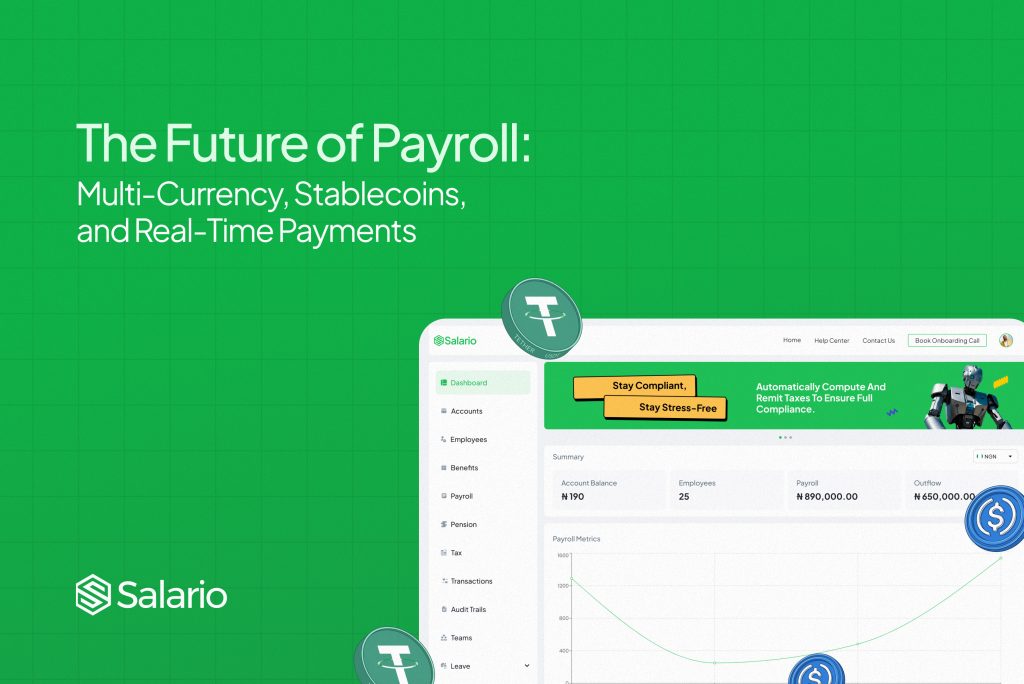
Platforms like Salario are already building toward this future. By supporting compliant payroll today and exploring innovations like stablecoin payments, businesses can stay ahead without taking unnecessary risks.
Conclusion
The future of payroll is already taking shape. Multi-currency systems, stablecoins, and real-time payments are changing how businesses pay employees.
For Nigerian companies, this shift is especially important. It affects how you manage global teams, handle FX challenges, and meet employee expectations.
The goal is not just faster payments. It is smarter, more flexible payroll that works in a global economy.
Ready to prepare your business for the future of payroll? Book a free demo with Salario today and see how modern payroll systems help you stay compliant while adapting to global payment trends. When your payroll evolves, your business moves faster.