
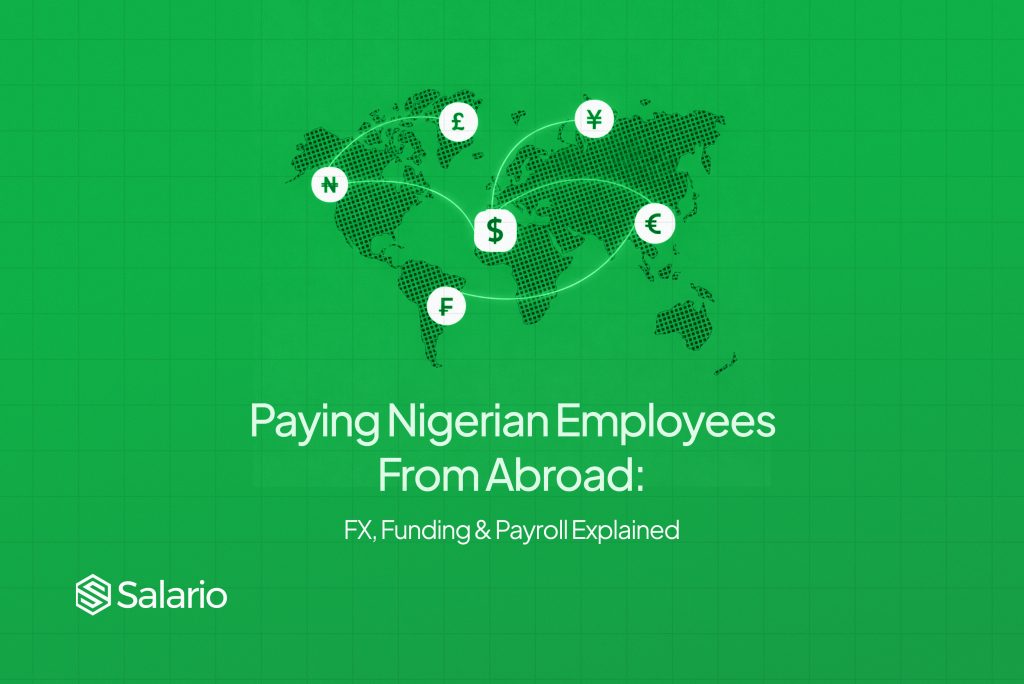
Many founders running Nigerian teams from the UK, US, or Canada face the same problem. You want to pay your employees on time, but FX rates keep shifting, bank transfers take days, and payroll compliance sits in the background like a silent risk.
Paying Nigerian employees from abroad is not just about sending money. It involves foreign exchange, funding structures, and compliance with local payroll laws.
This guide breaks it down simply. You will understand how FX affects your payroll, how to fund salaries efficiently, and how to stay compliant while managing your team remotely.
The real challenge of paying Nigerian employees from abroad
At first, it looks simple. You hire talent in Nigeria, agree on salaries, and send payments monthly.
Then reality sets in.
Exchange rates move almost daily. A salary you budgeted at ₦800,000 may cost more in dollars next month. Inflation adds pressure on employees, so expectations shift. Banks delay transfers, especially when intermediary banks are involved.
You also have to deal with visibility issues. Did everyone get paid on time? Were deductions handled correctly? Is your local team compliant with regulations?
For many diaspora founders, the biggest problem is not sending money. It is managing uncertainty across FX, timing, and compliance.
Understanding FX and how it affects your payroll
Foreign exchange is the first layer of complexity when paying Nigerian employees.
If your revenue is in dollars or pounds and your payroll is in naira, you are exposed to exchange rate risk every month.
Here is how it plays out.
You budget salaries using a specific rate. By the time you convert funds, the naira may have weakened. This means you either spend more foreign currency or your employees receive less value.
There is also the issue of rate differences. The official rate, bank rate, and parallel market rate may not match. This creates confusion when calculating payroll costs.

So what can you do?
- First, set a clear FX policy. Decide whether salaries are fixed in naira or indexed to a foreign currency. This move eliminates constant renegotiation. You and your employees enjoy peace of mind on this front.
- Second, fund payroll early. Converting funds a few days before payday reduces last-minute surprises. It also helps you organize any accompanying documents such as payslips et al before they are needed.
- Third, track FX trends. Even a simple monthly review helps you adjust your budget before it becomes a problem.
Ignoring FX is one of the fastest ways to lose control of payroll costs.
Funding your Nigerian payroll efficiently
Once you understand FX, the next question is how to move money into Nigeria.
Most founders start with international bank transfers. It works, but it comes with issues. Transfers can take 2 to 5 business days. Fees stack up across sending, intermediary, and receiving banks. In some cases, total costs reach 3-7 percent of the amount sent.
This affects both you and your employees.
Late funding leads to delayed salaries. Inconsistent timing creates trust issues with your team.

There are better approaches.
- You can maintain a local Nigerian account dedicated to payroll. This allows you to fund salaries in batches and pay employees quickly.
- Some founders also work with fintech platforms that support faster conversions and lower fees.
- Another emerging option is stablecoins like USDC and USDT. These allow near-instant transfers across borders with minimal fees. While adoption is still growing, they are becoming a practical option for cross-border payroll.
The key is consistency. Your team should know when salaries will arrive every month, regardless of where you are managing from.
Payroll compliance you cannot ignore
Sending salaries is only one part of paying Nigerian employees. Compliance is just as important.
Every employer in Nigeria must handle statutory deductions correctly. This includes PAYE tax, pensions, NHF, NSITF, and ITF, where applicable.
Even if you are managing your business from abroad, these rules still apply.
Here are a few key points to keep in mind.
PAYE must be calculated based on Nigerian tax laws and remitted to the relevant state authority before the 10th of the following month.
Pension contributions total 18 percent of an employee’s monthly emolument. The employer contributes 10 percent, while the employee contributes 8 percent. Payments must be made within seven days of salary payment.
NHF requires a 2.5 percent deduction from basic salary for eligible employees.
NSITF and ITF contributions are paid by the employer based on payroll size and company structure.
Missing these obligations can lead to penalties, audits, and reputational risk.
The challenge for diaspora founders is visibility. You may not know if your local team is handling these correctly until there is a problem.
How to simplify paying Nigerian employees from abroad
Managing FX, funding, and compliance manually creates room for errors.
Spreadsheets break. Communication gaps happen. Deadlines get missed.
This is where structured payroll systems become essential.
Platforms like Salario are built to handle Nigerian payroll end-to-end. You can run payroll, calculate statutory deductions, and track compliance from anywhere in the world.
Instead of guessing FX impact, you get clearer visibility into payroll costs. You can see who has been paid and when without having to keep track of updates.
For your employees, this process creates trust. Salaries arrive on time, deductions are transparent, and records are accessible.
For you, it removes the stress of managing payroll across borders.
As cross-border teams become more common, having the right system in place is no longer optional.
Conclusion
Paying Nigerian employees from abroad involves more than sending money each month. You are managing FX risk, funding logistics, and strict compliance requirements at the same time.
When any of these fail, your team feels it immediately.
The good news is that you can simplify the process with the right structure and tools. Ready to pay your Nigerian team confidently from anywhere in the world? Book a free demo with Salario today and see how seamless payroll, compliance, and cross-border visibility can work for your business. When payroll runs smoothly, your team stays focused and your business grows without friction.