
Sales commission software helps businesses calculate what salespeople earn, apply commission rules consistently, and track payouts without relying on spreadsheets. For Nigerian businesses, the right platform should also fit the way the company manages sales, finance, employee compensation, and payroll.
As a sales team grows, commission management can become harder to handle manually. One salesperson may earn a flat fee per sale, another may receive a percentage of revenue, while a team lead earns a bonus after the team reaches its target. If commissions depend on customer payments, deal milestones, or different product margins, finance teams must verify more than the number of deals closed.
Spreadsheets can handle simple commission plans, but they become harder to maintain when several people update records, rates change, or sales data comes from different systems. A missed transaction or outdated formula can lead to incorrect payments and disputes between sales, finance, and HR.
Sales commission management software reduces this manual work by bringing sales data, commission rules, calculations, approvals, and reporting into a more structured process. Some platforms focus exclusively on sales compensation, while others offer commission-related capabilities within a wider business management system.
This guide compares five options for Nigerian businesses: Salario, Everstage, CaptivateIQ, QCommission, and Carrotsuite Cloud ERP. Each serves a different type of business, so the best choice depends on your commission structure, existing software, reporting needs, and how you process approved commissions.
What is sales commission management software?
Sales commission management software automates some or all of the process of calculating and administering commissions paid to salespeople, account managers, agents, and other eligible employees.
Depending on the platform, it can import sales transactions from a CRM or accounting system, apply commission rules, calculate earnings, generate statements, route results for approval, and share information with finance or payroll.
For example, a Nigerian company may pay sales representatives 5% of eligible revenue, increase the rate after they reach a monthly target, and release the commission only after the customer pays. Commission software can apply those rules consistently and help the business identify which earnings are pending, approved, or ready for payment.
The most useful platforms do more than calculate a figure. They help businesses explain how that figure was reached and create a reliable process for getting it approved and paid.
5 best sales commission management software in Nigeria
Here is a quick comparison of the five platforms and the needs each may suit.
| Software | Best for | Main strength | Consider before choosing |
| Salario | Nigerian businesses connecting sales commissions to payroll | CRM synchronization, approval workflows, employee compensation records, and payroll processing | Confirm that your preferred CRM and commission rules fit the workflow |
| Everstage | Growing and enterprise sales teams with sophisticated compensation plans | Sales compensation automation, forecasting, and earnings visibility | Assess implementation requirements and local payroll compatibility |
| CaptivateIQ | Businesses with complex incentive plans and changing commission structures | Flexible plan modelling, automated calculations, and rep transparency | Confirm pricing, implementation, and Nigerian payroll integration requirements |
| QCommission | Businesses with complex commission calculations and varied transaction sources | Flexible rules, integrations, statements, and reporting | Check which features are included in the specific edition |
| Carrotsuite Cloud ERP | Businesses seeking a wider system for sales and business operations | Integrated ERP, CRM, finance, and operational workflows | Verify whether its available commission functionality covers your specific requirements |
These platforms are not identical. Salario, Everstage, CaptivateIQ, and QCommission have documented commission-management capabilities. Carrotsuite is primarily a broader ERP platform, so businesses should verify its commission-specific features before treating it as a direct substitute for dedicated commission software.
1. Salario: Best for connecting sales commissions to Nigerian payroll
Best for: Nigerian businesses that want to manage commissions from CRM deal data through approval and payroll.
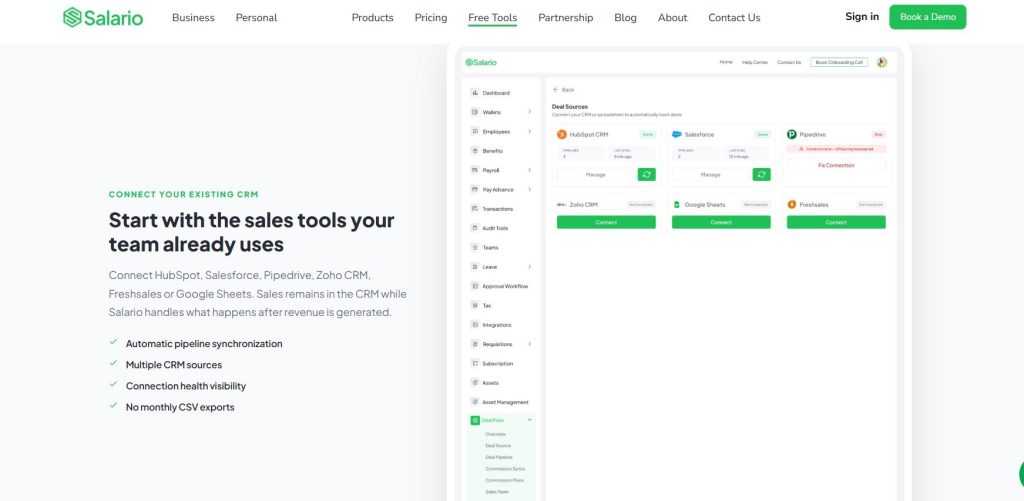
Salario is a strong option for businesses that want to connect sales performance with employee compensation and payroll instead of managing commissions in a separate system. Its sales commission workflow is designed to connect existing CRM records to calculations, approvals, and payroll processing.
Rather than asking sales teams to abandon their current CRM, Salario can connect to tools such as HubSpot, Salesforce, Pipedrive, Zoho CRM, Freshsales, and Google Sheets. It synchronizes sales pipeline information, including deal names, owners, values, currencies, stages, close dates, and CRM sources. The aim is to reduce repeated data entry and avoid monthly CSV exports. Salario’s sales commission guide outlines these integrations and workflows.
Key features
- CRM synchronization: Import deal information from connected sales systems and track the status of those connections.
- Flexible commission plans: Configure flat-rate, percentage-based, tiered, capped, milestone-based, and team commission structures.
- Eligibility rules: Set conditions that must be met before a commission becomes payable, such as customer payment or completion of a milestone.
- Approval workflows: Route commission calculations through Sales, Finance, HR, and Payroll, with an audit trail.
- Payroll integration: Add approved commissions to employee compensation so they can be processed alongside salaries, bonuses, allowances, and other eligible payments.
- Commission reporting: Track earnings, paid and pending commissions, at-risk amounts, and performance by salesperson or team.
- Employee records and transparency: Map CRM owners to employee records and give employees visibility into deals and calculations associated with their earnings.
Why choose Salario?
The key differentiator is the connection between commission management and payroll. Calculating commission is only one part of the process. Someone still needs to verify the result, obtain approval, record it against the correct employee, and ensure it is paid.
Salario brings these steps into a connected workflow. For Nigerian businesses already using CRM software, this can help reduce the manual handoffs between Sales, Finance, HR, and Payroll.
Its flexible plans can also accommodate different commission arrangements across roles, teams, products, and sales scenarios. That matters for businesses where sales representatives, managers, and team leads do not all earn commission under the same rules.
What should you consider?
Before choosing Salario, map your current commission plan to the available configuration options. Confirm the conditions that determine when commission is earned, the approval stages you need, and how the final amount should enter payroll. You should also verify that your specific CRM setup and any unusual commission rules are supported.
Verdict: Salario is worth considering if your priority is not just calculating commissions, but connecting sales records, approvals, employee compensation, and payroll in one process.
2. Everstage: Best for sophisticated sales compensation management
Best for: Growing and enterprise sales organisations with complex compensation plans and forecasting requirements.
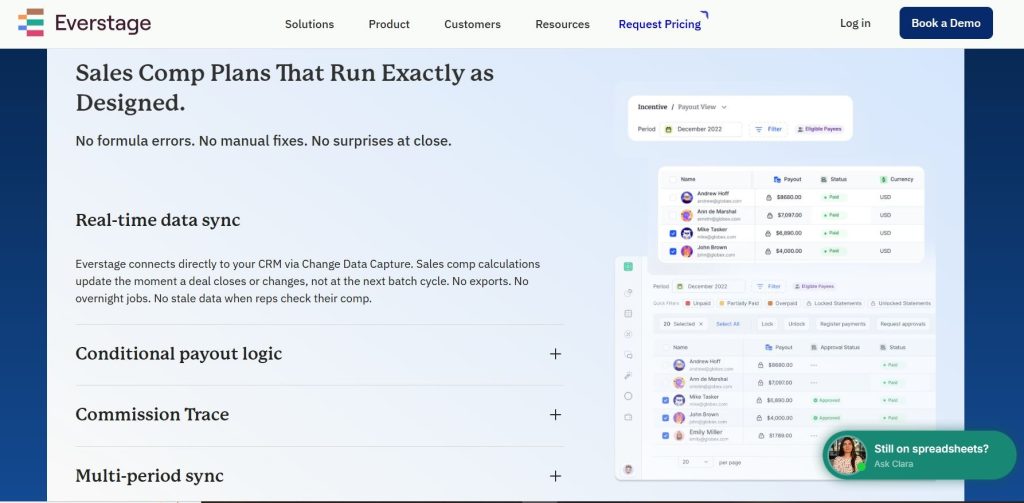
Everstage is a dedicated sales compensation platform for organisations that need to manage commission plans, quota attainment, payouts, and sales performance visibility. It is particularly relevant to businesses whose incentive structures have become too complicated to administer reliably in spreadsheets.
Its platform supports compensation structures such as tiered rates, accelerators, multi-role splits, overlays, and short-term sales incentives known as SPIFFs. It also offers real-time CRM data synchronization, earnings dashboards, automated statements, approval workflows, and tools for resolving commission disputes. Everstage’s official product information describes these capabilities.
Key features
- Flexible compensation plans: Configure complex rules without relying on manually maintained spreadsheet formulas.
- Real-time earnings visibility: Give sales representatives a breakdown of earnings by deal, compensation component, and quota attainment.
- Commission forecasting: Help representatives estimate potential earnings against their current pipeline and active plan rules.
- Automated statements: Generate commission statements for individual representatives and reporting periods.
- Approvals and dispute management: Route plan changes, payout approvals, and commission queries through structured workflows.
- Audit records: Track changes, approvals, and adjustments to support financial review.
Why choose Everstage?
Everstage is particularly useful when commission management is part of a wider sales performance strategy. Finance teams can use it to manage compensation rules, while sales leaders and representatives gain a clearer view of how performance connects to earnings.
Its forecasting capabilities can also help salespeople understand how specific deals might affect their earnings or move them into a higher commission tier. For leaders, that visibility can support better incentive planning.
What should you consider?
Everstage is built for sales compensation management rather than specifically for Nigerian payroll. Before committing, check the integrations available for your current systems, the implementation requirements, and how approved commissions will reach your payroll process. Do not assume that an available payroll integration automatically supports your exact Nigerian payroll workflow.
Verdict: Choose Everstage if your business needs a dedicated sales compensation platform with advanced plan logic, forecasting, and representative-facing earnings dashboards.
3. CaptivateIQ: Best for flexible commission plans and scenario modelling
Best for: Mid-sized and enterprise businesses that need to model, automate, and adapt complex incentive plans.
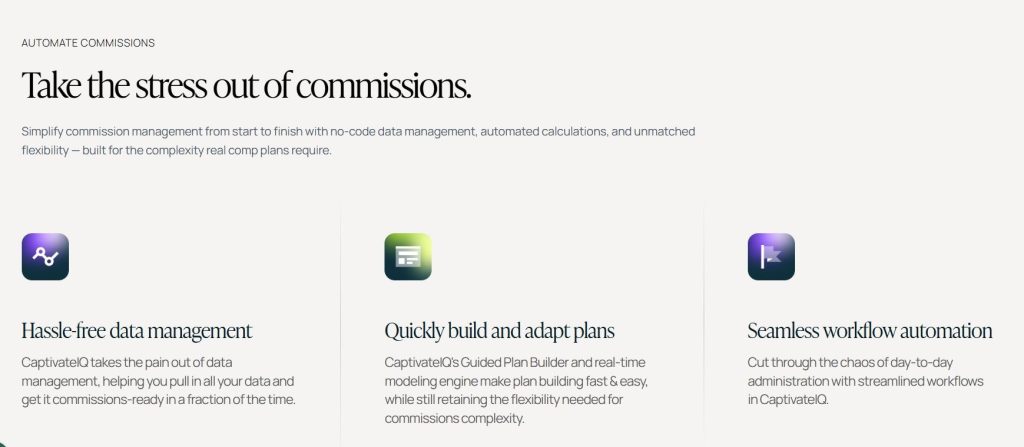
CaptivateIQ is a dedicated incentive compensation platform that helps businesses automate commission calculations and adapt compensation plans as their sales organisations change. It is a more direct comparison with Everstage than options like Payvo, whose published product offering is oriented towards businesses managing installment sales and sales agents.
CaptivateIQ emphasises flexible plan design, data preparation, automated calculations, workflow management, and visibility into past and projected earnings. Its guided plan-building and modelling capabilities are designed to help compensation teams adjust plans without rebuilding the entire process every time a rate, target, or sales structure changes. CaptivateIQ’s official product information outlines these features.
Key features
- Flexible plan design: Build and update compensation plans to accommodate different roles, products, targets, and commission rules.
- Automated calculations: Bring data together from connected systems and calculate commissions using configured logic.
- Scenario modelling: Test changes to compensation plans and estimate their potential effect before rolling them out.
- commission calculations were reached.
- Workflow automation: Structure recurring commission administration and approval tasks.
- Representative visibility: Provide salespeople with clearer explanations of earnings and how Integrations: Connect data from CRM, ERP, HRIS, and other systems through available connectors and APIs.
Why choose CaptivateIQ?
CaptivateIQ is a useful option for businesses where commission plans change frequently or contain many exceptions. A company might have different rates for new business and renewals, additional incentives for specific products, or separate rules for representatives and managers. Flexible modelling can make those arrangements easier to administer and review.
The platform also places emphasis on explaining commission results to salespeople. When representatives can trace earnings back to deals and plan rules, finance teams may spend less time answering repetitive questions about calculations.
What should you consider?
CaptivateIQ’s breadth may be more than a small business needs if it only pays a straightforward percentage on completed sales. Businesses should assess the total cost, onboarding requirements, supported integrations, and how commission outputs will be incorporated into their existing payroll process.
Its product documentation describes broad CRM, ERP, and HRIS connectivity, but this does not by itself establish that every Nigerian payroll system is supported directly. Confirm the intended workflow before purchase.
Verdict: Consider CaptivateIQ if commission rules change regularly and you need flexibility, modelling, and greater visibility across a growing sales organisation.
4. QCommission: Best for complex calculations and varied transaction sources
Best for: Businesses with customised commission rules, multiple transaction types, and established accounting or CRM systems.
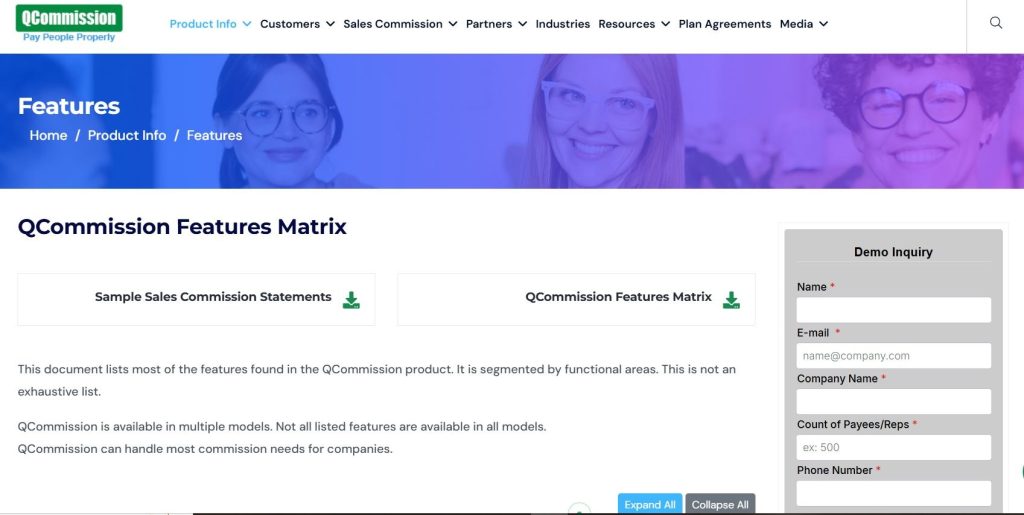
QCommission is a commission management platform designed to calculate sales compensation across a wide range of business models. It can operate as a standalone system or connect to other business applications, making it relevant to organisations that need a dedicated calculation engine without necessarily replacing their existing CRM or accounting software.
Its documented capabilities include commissions based on sales orders, recognised revenue, contracts, projects, recurring transactions, quotas, and other performance measures. Businesses can also configure tiered rates, bonuses, pooled commissions, adjustments, and other rules depending on the product edition. QCommission’s feature matrix explains its calculation and integration capabilities.
Key features
- Complex commission calculations: Support different rates, thresholds, tiers, recurring transactions, and performance-based incentives.
- Multiple transaction sources: Import relevant information from supported CRM, accounting, ERP, and other systems.
- Flexible integration: Work with structured files and databases as well as supported application integrations.
- Commission statements: Produce statements and reports for employees, agents, and other payees.
- Adjustments and clawbacks: Account for corrections or changes that affect previously calculated commissions, where supported by the selected setup.
- Modelling and reporting: Review commission scenarios and analyse compensation results.
Why choose QCommission?
QCommission is worth evaluating when commission rules depend on more than the headline value of a closed deal. For example, a business may calculate commission from recognised revenue, distinguish between different transaction types, or pay separate rates to employees and external agents.
Its broad integration options can also be useful if commissionable data is distributed across CRM, accounting, and operational systems. Instead of requiring the business to replace all those tools, QCommission can bring data into a dedicated commission workflow.
What should you consider?
QCommission offers multiple editions, and its documentation notes that not every feature is available in every model. Ask the vendor to demonstrate your actual commission rules using your expected data sources.
Also confirm how commission statements will be approved and transferred into your Nigerian payroll process. Integrations with accounting or payroll products elsewhere do not automatically mean that your exact local workflow is available out of the box.
Verdict: QCommission is a strong candidate for businesses that need flexible calculation rules and broad data integration, particularly where commission logic is too complicated for basic tools.
5. Carrotsuite Cloud ERP: Best for businesses seeking broader operational software
Best for: Nigerian businesses looking to connect sales operations with wider ERP and business management processes.
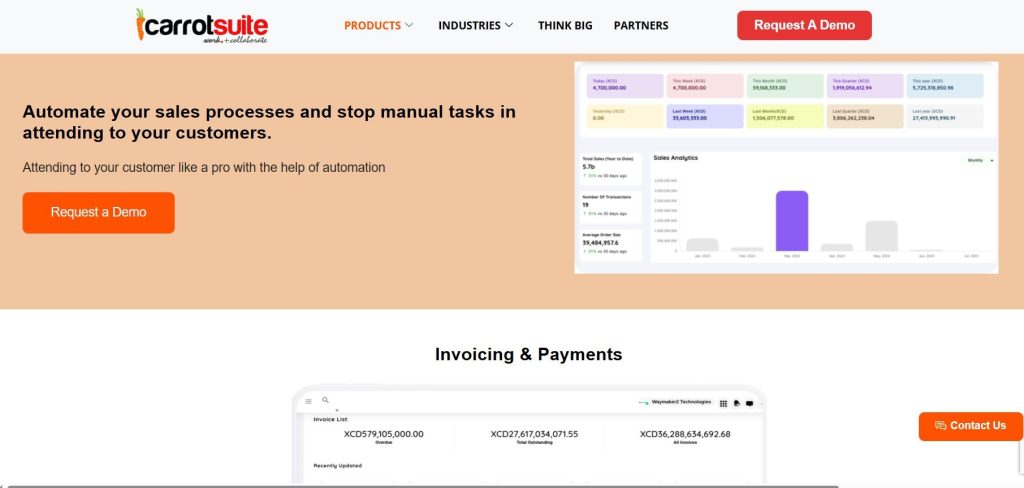
Carrotsuite is a cloud-based ERP platform that brings together business functions such as sales, CRM, accounting, HR, procurement, and operational workflows. Rather than focusing exclusively on sales compensation, it is designed to help businesses manage several parts of their operations through a connected system. Carrotsuite’s official website describes its broader ERP offering.
Key features
- Connected business operations: Manage sales and customer information alongside other business processes.
- Accounting and finance: Keep financial records and operational transactions within a broader business system.
- Workflow management: Use configured workflows and approvals for relevant business processes.
- Reporting: Review business activity across the modules the organisation uses.
- Broader ERP coverage: Reduce the need to maintain separate applications for every operational function.
Why consider Carrotsuite?
Carrotsuite may be a good fit if your business is already reviewing its ERP or wants to reduce fragmentation across sales, accounting, HR, and operations. A connected business system can make it easier to maintain consistent records and follow transactions across departments.
For a business that has outgrown separate spreadsheets and disconnected software, this broader approach may be more valuable than introducing another standalone tool.
What should you consider?
There is an important distinction between managing sales operations in an ERP and using a dedicated sales commission management platform. Carrotsuite’s public product information establishes its broader ERP focus, but does not provide enough evidence to confirm that it offers all the specialised commission features covered in this comparison.
Before choosing it for commission management, ask for a demonstration of commission plan configuration, tiered calculations, individual earnings statements, dispute handling, and the process for transferring approved commissions into payroll. If those features are not available in the required form, you may need a dedicated commission tool alongside your ERP.
Verdict: Carrotsuite is worth considering as part of a wider ERP decision, but verify its commission-specific capabilities before selecting it as a replacement for dedicated commission software.
Sales commission software feature comparison
The table below summarises the main differences based on publicly documented product information. It is not a substitute for checking your specific plan, integrations, and subscription tier with each vendor.
| Feature | Salario | Everstage | CaptivateIQ | QCommission | Carrotsuite |
| Primary focus | Commission-to-payroll workflow | Sales compensation | Incentive compensation | Commission calculations | Broader ERP |
| CRM data integration | Yes, including HubSpot, Salesforce, Pipedrive, Zoho CRM, and others | Yes | Yes, through connectors and APIs | Yes, with supported systems | CRM is part of wider offering |
| Flexible commission rules | Yes | Yes | Yes | Yes | Verify specific capabilities |
| Earnings visibility | Deal and commission tracking | Live dashboards and forecasts | Earnings visibility and explanations | Statements and reports | Verify commission-specific reporting |
| Approval workflows | Commission approval workflow | Yes | Workflow automation | Depends on configuration | General operational workflows |
| Payroll connection | Approved commissions feed into employee compensation and payroll | Via supported integrations | Confirm the required payroll connection | Payroll-related integrations and exports are available for supported systems | Verify the required workflow |
| Best fit | Nigerian payroll and commission administration | Advanced compensation management | Complex, evolving incentive plans | Custom calculations and varied data sources | Connected business operations |
How to choose the right sales commission management software
The best platform depends on how your business earns revenue, calculates commission, and pays its sales team. Before making a decision, assess these five areas.
1. Check whether it supports your commission structure
Start by documenting your current commission rules. Do you pay a flat amount per sale, a percentage of revenue, or a higher rate after a representative reaches a target? Do you pay team bonuses, split commissions, or incentives for renewals?
Ask each vendor to demonstrate those exact rules. A platform that handles straightforward percentages may not be suitable for complex tiered plans or commissions involving several people on one deal.
2. Look at where your sales data comes from
If your team already uses a CRM, choose software that can work with it. Direct synchronization can reduce duplicate entry and make it easier to identify missing or updated transactions.
Check how frequently the software synchronizes data, what happens when a deal changes after the initial calculation, and whether it can distinguish between closed deals and transactions that qualify for commission.
3. Understand the full path from calculation to payment
Calculating commission is not the same as paying it. Find out whether the platform supports approvals, employee records, payroll integration, and the reporting your finance team needs.
For Nigerian businesses, it is particularly important to confirm how approved commissions will be reflected in payroll, including any applicable deductions and the correct pay period. Ask the vendor to demonstrate the complete workflow rather than assuming that an integration covers every step.
4. Give salespeople a way to understand their earnings
A good system should make it easier for representatives to understand what they have earned, which transactions count, and why an amount is pending or has changed.
Earnings statements and deal-level explanations can reduce disputes and help employees see the relationship between their performance and compensation.
5. Evaluate the total cost, not just the subscription
Consider subscription fees, onboarding, integrations, customisation, ongoing support, and the time your team will spend administering the platform.
A dedicated compensation tool may be worthwhile for a large team with complex plans. A smaller business with simple commission rules may need a more straightforward workflow. Ask vendors to demonstrate the system using realistic sales data before committing.
Which sales commission software should you choose?
- Choose Salario if you want to connect CRM deal data, commission calculations, approval workflows, employee compensation, and Nigerian payroll.
- Choose Everstage if your sales organisation needs sophisticated compensation plans, live earnings visibility, and forecasting.
- Choose CaptivateIQ if you need flexible incentive plan design, scenario modelling, and commission automation as your business grows.
- Choose QCommission if you have complex calculation rules and need to bring data together from multiple business systems.
- Consider Carrotsuite Cloud ERP if your priority is broader business management, but confirm that its commission-specific capabilities meet your requirements before selecting it for that purpose.
For many Nigerian businesses, the deciding factor will be what happens after a commission has been calculated. If your team spends too much time reconciling spreadsheets, chasing approvals, and transferring figures into payroll, prioritise a platform that connects those steps instead of solving only the calculation problem.
Frequently asked questions
What is the best sales commission management software in Nigeria?
The best option depends on your needs. Salario is worth considering if you want commission management connected to Nigerian payroll. Everstage and CaptivateIQ are suited to sophisticated compensation plans, while QCommission supports complex calculations and varied data sources. Carrotsuite is a broader ERP option whose commission-specific functionality should be verified.
Can sales commission software integrate with a CRM?
Yes. Several platforms in this comparison offer CRM integrations. Salario supports connections including HubSpot, Salesforce, Pipedrive, Zoho CRM, Freshsales, and Google Sheets. Everstage, CaptivateIQ, and QCommission also document integrations with supported CRM systems. Always confirm that your specific configuration is supported.
Can commission software automate payroll?
Some platforms can connect commission calculations to payroll, but the workflow differs by product. Salario is designed to move approved commissions into employee compensation and payroll. With other platforms, confirm whether your payroll system is supported directly or whether you will need an export, integration, or additional configuration.
Is sales commission software suitable for small businesses?
Yes. It can be useful for a small business once manual calculations become difficult to maintain or verify. However, the right level of functionality depends on the number of salespeople, the complexity of the commission rules, and the time spent administering payouts. Businesses with simple plans should avoid paying for features they do not need.
What should I check before buying commission management software?
Test your actual commission rules, verify CRM and payroll compatibility, review the approval process, check employee earnings visibility, and calculate the total cost of implementation and ongoing use. Ask the vendor to demonstrate how it handles corrections, disputed transactions, and changes to commission plans.
Final thoughts
Sales commission management is about more than calculating what a salesperson earns. The process must connect reliable sales data to the right commission rules, approvals, employee records, and payments.
Everstage, CaptivateIQ, and QCommission offer dedicated capabilities for businesses with more demanding commission requirements. Carrotsuite may suit organisations looking for broader operational software, provided its commission features meet their needs. For businesses that want to connect commission management directly with employee compensation and Nigerian payroll, Salario offers a workflow designed around that connection.
Want to reduce manual commission calculations and connect approved sales commissions to payroll? Book a demo with Salario to explore how it could fit your sales and payroll process.