

Tunde runs finance at a Lagos logistics company. On Friday evening, a driver sent him a photo of a crumpled fuel receipt and asked when he would be paid back. Tunde could not tell whether the trip was approved, who approved it, or which account should cover it. He searched three WhatsApp groups, found nothing, and paid from his own pocket to end the argument.
Many Nigerian businesses face this same confusion when they weigh expense management vs corporate cards. They treat the two as one thing, then wonder why spending still feels out of control. They are different tools that solve different problems. This article explains how each one works, so you fix the right problem first.
What Is Expense Management?
Expense management is the process of requesting, approving, paying, and recording what your staff spend on the business. It covers the full journey. A driver asks for fuel money. A manager approves it. Finance checks the receipt. The cost lands in the right account. That whole chain is expense management.
Good expense management tells you four things about every naira spent: who spent it, why, who approved it, and where it was recorded. It is not a card or a bank product. It is a set of rules and records that you can run on paper, in spreadsheets, or in software.
Most businesses start with spreadsheets and chat messages. That works for a team of five. It breaks at fifty, because receipts go missing, approvals hide inside chat threads, and nobody can say what a project really cost. Our guide on why employee expense management is broken in most businesses shows how these failures build up quietly.
The cost of a weak process is real. The GBTA Foundation found that it costs an average of $58 to process one expense report. A finance team that handles hundreds of claims feels that cost every month.
Expense management also sets policy. It defines spending limits by category, decides who approves what, and explains how staff get paid back. This is where corporate reimbursement fits in. Reimbursement is one outcome of expense management, not the whole of it.
What Are Corporate Cards?
Corporate cards are payment cards that a business issues to employees for work spending. The company owns the account and settles the bill. Staff pay with the card instead of their own money. Some cards are naira cards for local vendors. Others are dollar cards for software subscriptions, flights, and ad platforms.

The main promise of corporate cards is speed. An employee does not wait for cash or a transfer. A team lead can renew a design tool before it expires, even at midnight. The money moves at the moment of purchase, and nobody uses personal funds.
Cards also give you some built-in control. Many providers let you set a limit per card, freeze a card, or restrict where it works. Every transaction creates a record with an amount, a date, and a merchant name. That record helps, but it is only a bank record. It shows that ₦85,000 left your account at a vendor. It does not show what the spend was for, whether anyone approved it, or which budget it belongs to.
Nigeria adds practical limits. Card payments depend on bank networks, and those networks fail at bad moments. Many vendors, from fuel stations to market suppliers, still prefer cash or transfer. Dollar cards depend on how your bank handles foreign exchange and what limits it sets. So corporate cards rarely cover every expense a Nigerian team has.
Expense Management vs Corporate Cards: Key Differences
The easiest way to see the gap is this. Expense management is the system that governs spending. Corporate cards are one way to make the payment. One decides the rules. The other moves the money.
The first difference is purpose.
Expense management exists to control, document, and account for spending. Corporate cards exist to pay quickly without personal funds. A card can sit inside an expense management process. An expense management process does not need a card at all.
The second difference is timing.
Corporate cards control spending at the point of payment, through limits and blocks. Expense management controls spending before and after payment, through requests, approvals, receipt checks, and review. Pre-approval is the part cards cannot do alone. A card does not ask a manager whether a trip makes sense. It only checks that the limit has not been reached.
The third difference is coverage.
A card handles only what you can pay by card. Expense management also covers cash advances, transfers, petty cash, and staff who paid out of pocket. For many Nigerian teams, those non-card expenses make up a large part of daily spending.
The fourth difference is the quality of the record.
A card statement shows a payment. An expense report shows the payment, the reason, the receipt, the approver, and the budget line. When an auditor or a tax officer asks you to support a business cost, a bank line alone is weak evidence.
The fifth difference is setup.
Corporate cards come from a bank or fintech and may carry fees, funding requirements, or limits tied to your account. Expense management starts as a process. You can begin with a clear policy and a simple request form, then add software when volume grows.
Corporate Reimbursement: How It Works With Each Option
Corporate reimbursement is what happens when an employee pays with personal money and the company pays them back. It is common in Nigeria, because cards do not work everywhere and staff often cover urgent costs themselves.

With corporate cards alone, reimbursement becomes less frequent, but it does not disappear. An employee still pays personally when a vendor refuses cards or when the card limit runs out. Without a process, those claims drift back into chat messages and delayed transfers.
With expense management, corporate reimbursement follows a clear path. The employee submits a request with a receipt. The line manager approves it. Finance checks it against policy. The payment goes out by direct transfer, or it joins the next payroll run. The employee sees the status at each step. Staff stop chasing, and Finance stops guessing.
Cash advances need the same care. When a company hands out money before the spend happens, someone must track what was spent, what was returned, and what is still owed. Spreadsheets handle this badly. Our article on the common risks of manual pay advance tracking explains how errors and gaps appear when advances live in notebooks and chat threads.
Reimbursement also touches your books. Every payment must land in the right account. If your finance team uses accounting software, connecting expense records to it saves hours of re-entry. Our roundup of the best accounting tools for Nigerian businesses shows what to look for.
Do You Need Both?
Most growing businesses end up using both, but the order matters. Start with expense management, because cards without a process only move the mess faster. If you hand out cards before you have approval rules, you simply create a quicker way to overspend.
Choose corporate cards first only in narrow cases. A small team with a few predictable online subscriptions can use a single card with a firm limit. Even then, someone must collect receipts and match them each month.
Choose expense management first if staff often pay out of pocket, if you hand out cash advances, if approvals run through chat, or if you cannot say what a project cost last quarter. That describes most Nigerian SMEs.
Add corporate cards once the process is stable. At that point, cards plug into a system that already knows who may spend what. Each card transaction gets a receipt and a category, and the process catches anything that does not fit policy. You get speed and control together.
Untracked spending also quietly raises what each employee costs you. Our piece on why salary is not your only employee cost explains how these hidden costs add up. When you are ready to compare tools, our guide to the best expense management software in Nigeria sets out seven options and their strengths.
How Salario Supports Expense Management
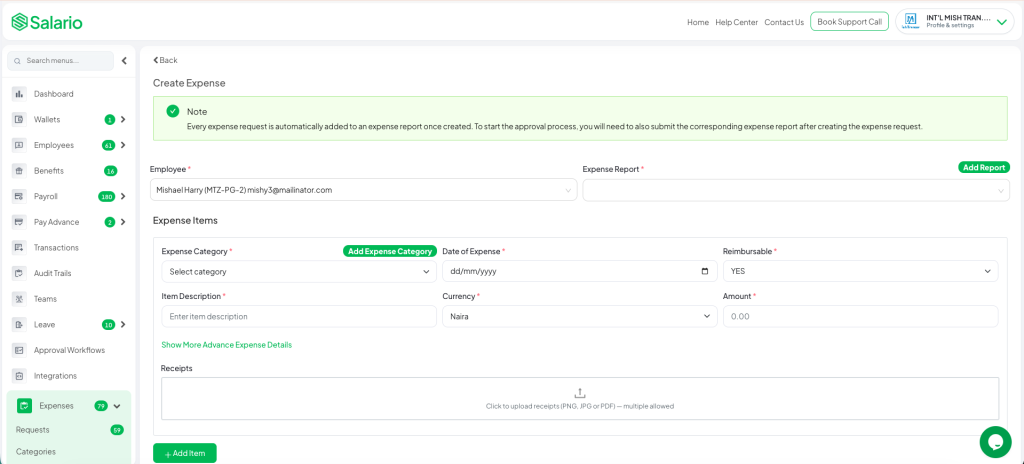
Salario Expense connects the full expense journey in one place. Employees submit requests and attach receipts. Requests route through line managers, department heads, Finance, and payment approvers. Categories and spending limits keep claims inside policy. Approved reimbursements can go out as direct payouts or join payroll, and the records stay linked to accounting workflows. Every request leaves an audit trail.
Salario already handles payroll compliance for Nigerian employers, so expense data sits beside employee records. HR and Finance stop passing spreadsheets back and forth. Salario works alongside the payment methods you already use, including cards, and gives them a process that holds everything together.
Choosing Between Expense Management and Corporate Cards
Expense management vs corporate cards is not a contest. Expense management sets the rules and keeps the records. Corporate cards move the money. Fix the process first, then add cards where they save time.
Ready to bring order to every expense request, approval, and reimbursement? Book a free demo with Salario today and see how expense management connects to your payroll and accounting. When every naira has a name and a reason, month-end stops being a hunt.