

Ngozi runs a 40-person logistics firm in Lagos. It is the 18th, payday is twelve days away, and three staff have already asked for advances. She approves one, declines two, and feels bad either way. This happens every month. Her staff are not careless. Rent, transport and food bills always arrive before salary does. Earned wages access promises to end that loop by letting staff draw pay they have already earned. But does it pay for itself? This guide shows you how to calculate your earned wage access ROI, what the numbers can look like, and when the answer is no.
What Earned Wages Access Does for a Business
Most employers already run a messy version of this. Staff ask, you approve or refuse, and someone tracks it in a notebook. Salary advances can improve workplace productivity, but the admin and the risk of favouritism stay with you.

Earned wages access, or EWA, replaces that with a rule. Employees withdraw part of the salary they have already earned. You still pay on the normal date, and the amount is deducted automatically. Unlike a loan, it builds no interest and no new debt.
Staff are asking for it. Headline inflation was about 15% in August 2026, so pay stretches thin by week three.
How to Calculate Earned Wages Access ROI
The formula is simple: total gains minus total cost, divided by total cost. You need two gains and one cost, and an EWA calculator can handle the arithmetic.
Gain one is retention. Gallup puts the cost of replacing an employee at half to two times annual salary. Use the low end so your estimate stays honest. Gallup also found that 52% of employees who leave voluntarily say their employer could have prevented it. Pay timing is one cause you can fix without raising salaries. To see what sits behind each salary, read how much an employee really costs a Nigerian business.
Gain two is HR time. Manual advances eat hours and invite errors, as the common risks of manual pay advance tracking show. The cost side is your platform fee plus admin time.
Here is an example. Your firm has 40 staff on an average ₦250,000 a month, or ₦3,000,000 a year. Replacing one person at 50% costs ₦1,500,000. If EWA helps you keep two people a year, you save ₦3,000,000. Your HR officer spends six hours a month on advance requests at about ₦2,500 an hour. That is ₦180,000 a year. Say the programme costs ₦600,000 a year. Gains total ₦3,180,000, so net gain is ₦2,580,000. Divide that by ₦600,000 and your ROI is 430%.
These figures are examples, not promises. Your turnover, salaries and fees will change the result. The earned wage access ROI calculator runs the same maths with your own numbers.
When Earned Wages Access Is Not Worth It
EWA does not suit every business. With five staff, low turnover and few advance requests, the gains stay small. An EWA calculator will show you that fast.
The bigger risk is overuse. Techpoint reports that financial literacy gaps and over-reliance on early withdrawals are real concerns in Nigeria. So cap withdrawals at a fixed share of earned pay, and teach basic budgeting alongside the benefit.
Check who pays the fees too. Some providers charge staff per withdrawal, which can quietly shift the cost to your team. Staff who find no help at work may turn to payday lenders. The costs differ sharply, as our salary advance vs payday loan comparison explains.
Is Earned Wages Access Worth It? Run Your Own Numbers
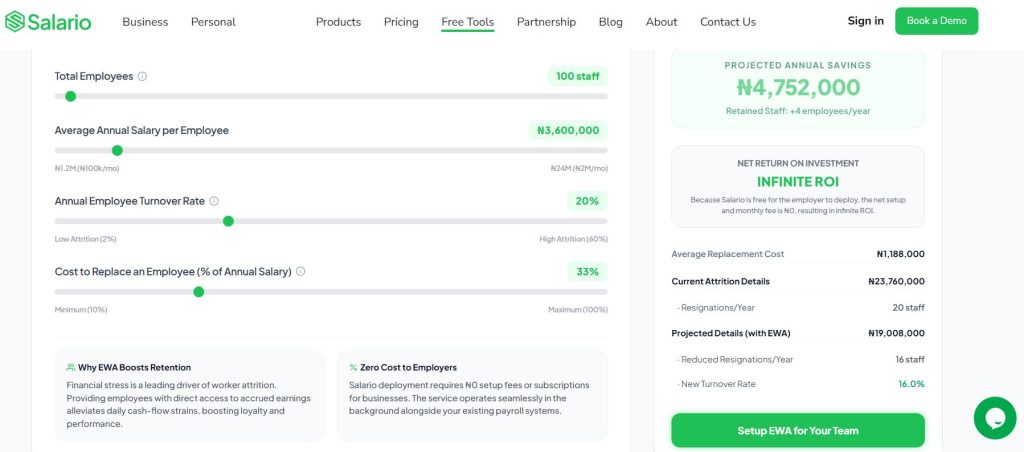
The answer comes down to your turnover and your advance volume. If early pay keeps even one or two good people each year, earned wages access can cover its cost several times over. If it does not, the numbers will say so. Platforms like Salario let you offer earned wages access without changing your payroll date, so the decision rests on your data.
Ready to see your real return? Use the Salario earned wage access ROI calculator, enter your own figures, and find out if early pay makes sense for your business. No demo call needed. When you know what early pay is worth, the decision stops being a guess.