
Employee benefits have become an important part of how businesses attract, retain, and support their workforce.
Salary is still one of the biggest factors employees consider when evaluating a job. However, benefits can also influence how employees perceive their employer and the overall value of their compensation package.
For Nigerian businesses, employee benefits can include much more than health insurance or pension contributions. Depending on the organization, employees may receive data and airtime allowances, transport support, meal allowances, pension contributions, paid leave, financial benefits, and other forms of employee support.
The challenge is managing these benefits as the business grows.
When HR teams manage benefits through spreadsheets, emails, and separate vendors, it can become difficult to know which employees are eligible, what they receive, how much the business spends, and whether benefits are being processed correctly.
Employee benefits management platforms help bring some or all of these processes into a central system. Depending on the platform, employees may be able to access benefits themselves, while HR and finance teams can manage approvals, contributions, records, and reporting.
However, not every platform offers the same type of benefits.
Some are dedicated employee rewards and benefits platforms. Others provide benefits as part of a broader HR system. Some focus primarily on financial benefits and employee wellbeing.
In this guide, we compare five platforms Nigerian businesses can consider in 2026:
- RibiRewards
- Douxra
- Workpay
- SeamlessHR
- Salario
We evaluate them based on benefits management, employee self-service, administration, payroll and HR integration, reporting, and overall suitability for Nigerian businesses.
At a Glance: Best Employee Benefits Management Platforms.
| Platform | Best For | Employee Self-Service | HR Integration | Payroll Integration |
| RibiRewards | Flexible employee benefits and rewards | Yes | Varies | Varies |
| Douxra | Employee benefits and financial wellbeing | Yes | Yes | Yes |
| Workpay | HR, payroll, and employee management | Yes | Native | Native |
| SeamlessHR | Benefits and wellbeing within a broader HR platform | Yes | Native | Native |
| Salario | Core benefits integrated with HR and payroll | Yes | Native | Native |
The best platform for your organization depends on the type and complexity of benefits you want to provide.
How We Evaluated These Employee Benefits Platforms
Employee benefits management can mean different things to different businesses. A company looking for employee rewards may have very different requirements from an HR team looking to manage pensions and allowances alongside payroll.
We therefore looked at the platforms using several practical criteria.
Benefits Offered
What types of employee benefits can the platform help businesses provide or manage?
Employee Self-Service
Can employees access or manage their benefits without relying entirely on HR?
Benefits Administration
Can HR teams create and manage benefits for different groups of employees?
Approval Workflows
Can businesses establish processes for requesting and approving benefits or related employee expenses?
Payroll Integration
Can benefits and allowances connect directly with payroll?
HR Integration
Can employee information and benefits be managed within the same HR ecosystem?
Reporting
Can HR and management track benefits and related spending?
Employee Experience
How easy is it for employees to understand, access, and use their benefits?
Suitability for Nigerian Businesses
Finally, we considered how well each platform fits the needs of businesses operating in Nigeria.
1. RibiRewards
Best for: Businesses looking for a broad range of employee benefits, rewards, and lifestyle perks
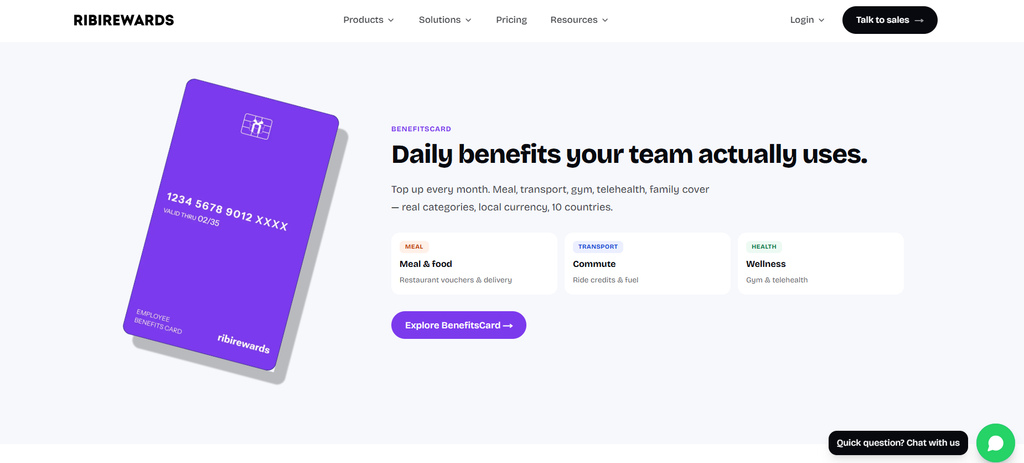
RibiRewards takes a benefits-first approach to employee management.
Rather than treating benefits as a small feature within an HR platform, RibiRewards focuses specifically on helping businesses provide employees with a range of benefits and rewards.
Its offering covers areas such as health, meals, transportation, learning, family support, and lifestyle benefits.
This makes RibiRewards particularly interesting for companies that want to build a more extensive employee benefits package beyond traditional salary and statutory benefits.
Key Features
- Employee benefits
- Lifestyle benefits
- Health-related benefits
- Meal benefits
- Transport benefits
- Learning benefits
- Family benefits
- Employee rewards
- Employee access to benefits
Pros
- Strong focus on employee benefits
- Wide variety of potential employee perks
- Useful for companies looking to improve their employee value proposition
- More benefits-focused than traditional HR platforms
Cons
- Businesses primarily looking for payroll and HR administration may need another platform
- The breadth of available benefits may be more than smaller businesses need
- Integration requirements should be considered when building a broader HR and payroll workflow
Pricing
Pricing depends on the benefits and services selected. Businesses should confirm current pricing and available plans directly with RibiRewards.
Why Choose RibiRewards?
RibiRewards is a strong option if your main objective is to give employees access to a broad selection of benefits and rewards.
It is particularly suited to employers who view benefits as an important part of their employee experience and employer-brand strategy.
2. Douxra
Best for: Businesses looking to provide employee benefits and financial support
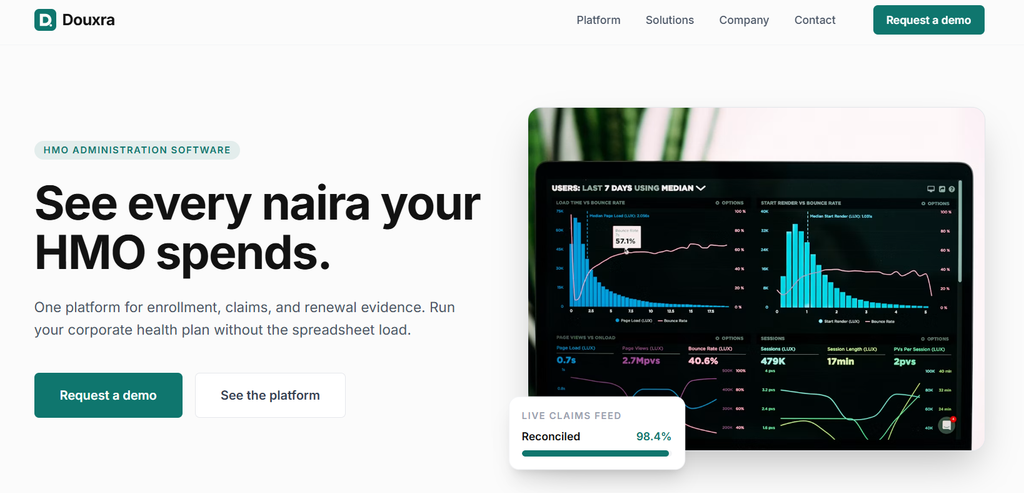
Douxra approaches employee benefits from a financial wellbeing perspective.
For employers, financial benefits can become an important part of the overall employee value proposition. This is particularly relevant in Nigeria, where employees may value benefits that help them manage everyday financial needs alongside their regular salary.
Douxra provides businesses with tools designed to help employees access financial services and benefits through their employer.
Key Features
- Employee financial benefits
- Employee access to financial services
- Employer-managed benefits
- Employee self-service
- Financial support tools
- HR integration
Pros
- Focuses on financial wellbeing
- Relevant to employees looking for additional financial support
- Can complement traditional employee compensation
- Designed with employee access in mind
Cons
- More focused on financial benefits than general benefits administration
- Businesses looking for a broad benefits catalogue may need additional providers
- Employers should evaluate how the platform fits with their existing HR and payroll systems
Pricing
Pricing and available benefits depend on the current Douxra offering, and this has to be confirmed via a demo call, as no fixed pricing system is available on their website.
Why Choose Douxra?
Douxra can be useful for businesses that want to supplement salary with financial benefits and support.
For employers interested in improving financial wellbeing rather than simply administering traditional benefits, this type of platform can provide additional value.
3. Workpay
Best for: Businesses looking for employee benefits within a broader HR and payroll platform

Workpay takes a broader HR technology approach. Instead of focusing exclusively on employee benefits, it combines HR management, payroll, employee administration, and other workforce functions.
This can make it useful for companies that want benefits to form part of a larger employee management system.
Key Features
- Employee management
- Payroll
- HR administration
- Employee self-service
- Leave management
- Benefits administration
- Employee records
- Reporting
- Payroll-related workflows
Pros
- Broader HR and payroll capabilities
- Employee self-service
- Benefits can sit within a wider employee management workflow
- Useful for businesses that want fewer disconnected HR systems
Cons
- Benefits are part of a broader HR proposition rather than the platform’s sole focus
- Businesses looking for extensive employee rewards may need additional solutions
- Advanced functionality may depend on the plan or product configuration
Pricing
Workpay uses subscription-based pricing, with available features depending on the selected plan.
Why Choose Workpay?
Workpay makes sense for businesses that don’t want a standalone benefits platform. If your company is already looking for HR and payroll software, having benefits within the same environment can reduce the need to manage multiple systems.
4. SeamlessHR
Best for: Growing businesses that want benefits and employee wellbeing within a broader HR platform
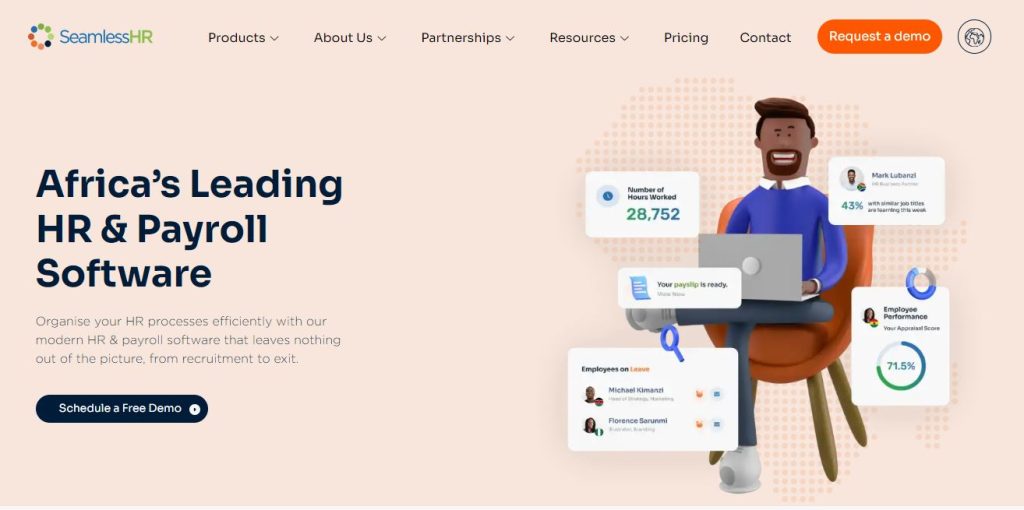
SeamlessHR is a broader human resources management platform designed to help businesses manage multiple aspects of the employee lifecycle.
Rather than positioning benefits as a standalone product, SeamlessHR incorporates employee benefits and financial wellbeing into its wider HR ecosystem.
Its employee benefits proposition includes financial wellbeing solutions such as earned wage access and other employee financial products.
Key Features
- Employee management
- Payroll
- Employee self-service
- Leave management
- Employee benefits
- Financial wellbeing
- HR reporting
- Employee records
- HR workflows
Pros
- Comprehensive HR platform
- Benefits sit alongside other employee management processes
- Strong employee self-service capabilities
- Useful for growing organizations
- Broad HR automation capabilities
Cons
- Businesses looking specifically for a dedicated benefits marketplace may require another solution
- Broader HR functionality can mean more complexity than a simple benefits platform
- Specific benefits depend on the available product offering
Pricing
SeamlessHR offers different solutions for businesses depending on their requirements. Pricing and available benefits should be confirmed directly with the provider.
Why Choose SeamlessHR?
SeamlessHR is a good fit for businesses that want to manage employee benefits as part of a wider HR operation.
Instead of introducing another standalone tool, businesses can use their HR platform to manage employee information, payroll, leave, and related employee benefits.
5. Salario
Best for: Businesses that want core employee benefits integrated with HR and payroll
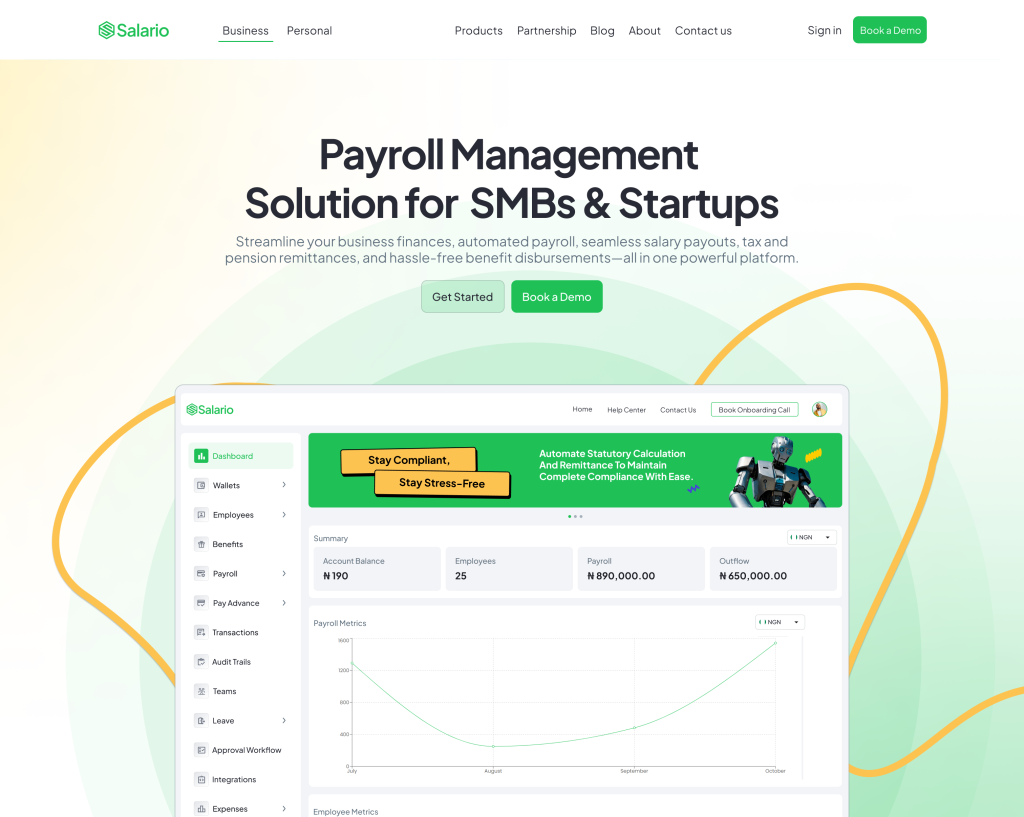
Salario takes an integrated approach to employee benefits.
Rather than trying to provide the largest possible catalogue of employee perks, Salario currently focuses on core employee benefits and allowances that can be managed alongside HR and payroll.
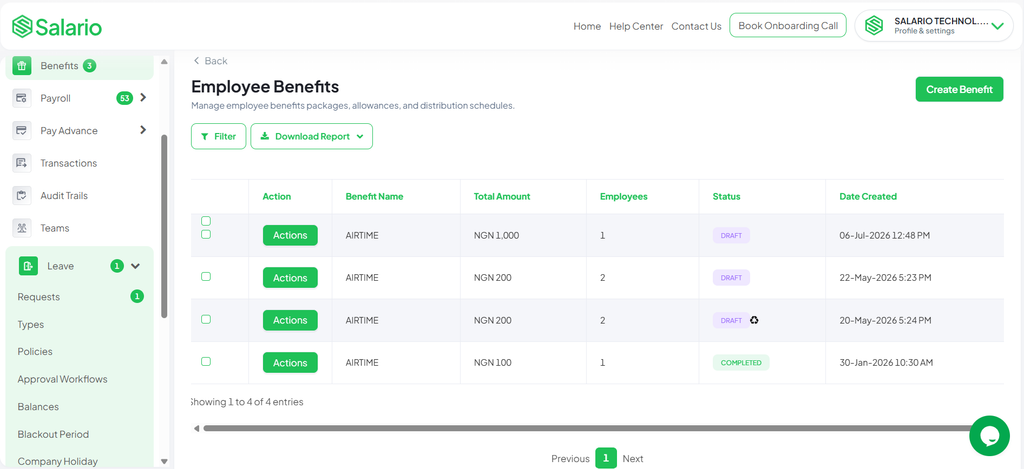
At present, these include leave, data, airtime, and pensions, with additional benefits in development.
The advantage of this approach is integration.
Benefits can be managed alongside employee records, payroll, reporting, and other HR processes instead of requiring HR teams to maintain separate systems.
Key Features
- Leave management
- Data benefits
- Airtime benefits
- Pension management
- Employee self-service
- Benefits approval workflows
- Benefits reporting
- Payroll integration
- HR and employee-record integration
- Accounting integration
- Benefits package management
- Department and role-based benefit assignment
HR teams can create and manage different benefit packages and assign them according to factors such as department, role, location, or grade.
Employees can also access benefits through the employee self-service experience.
For benefits that require approval, Salario provides straightforward approval workflows that allow HR and management to review requests.
Pros
- Integrated with HR and payroll
- Employee self-service
- Core benefits managed in one platform
- Data and airtime benefits
- Pension management
- Leave management
- Benefits approval workflows
- Reporting and analytics
- Accounting integration
- Benefit packages can be managed by employee groups
- Included in Salario’s standard plans
Cons
- Benefits offering is currently more limited than dedicated employee rewards platforms
- Employees cannot currently choose from a flexible benefits marketplace
- No current benefits eligibility rules
- HR cannot currently track benefit utilization
- Additional benefits are still in development
Pricing
Employee benefits management is included within Salario’s standard plans rather than being sold as a separate module.
Why Choose Salario?
Salario is best suited to businesses that want to manage core employee benefits as part of their existing HR and payroll workflows.
This is an important distinction.
If your priority is providing employees with dozens of lifestyle perks, discounts, and rewards, a dedicated benefits platform may offer a broader selection.
But if your priority is making sure benefits are connected to the people who receive them, their employee records, approvals, and payroll, Salario offers a more integrated approach.
For Nigerian businesses already using payroll and HR software, this can reduce the administrative burden of managing benefits across separate systems.
Feature Comparison: Employee Benefits Platforms
| Feature | RibiRewards | Douxra | Workpay | SeamlessHR | Salario |
| Employee Self-Service | ✓ | ✓ | ✓ | ✓ | ✓ |
| Benefits Management | ✓ | ✓ | ✓ | ✓ | ✓ |
| Employee Rewards | ✓ | ✓ | Limited | Limited | — |
| Financial Benefits | ✓ | ✓ | ✓ | ✓ | Limited |
| Health Benefits | ✓ | — | — | — | — |
| Data/Airtime Benefits | ✓ | — | — | — | ✓ |
| Pension Management | — | — | ✓ | ✓ | ✓ |
| Leave Management | — | — | ✓ | ✓ | ✓ |
| Benefits Approval | ✓ | ✓ | ✓ | ✓ | ✓ |
| Benefits Packages | ✓ | ✓ | ✓ | ✓ | ✓ |
| HR Integration | Varies | ✓ | ✓ | ✓ | ✓ |
| Payroll Integration | Varies | ✓ | ✓ | ✓ | ✓ |
| Accounting Integration | Varies | — | ✓ | ✓ | ✓ |
| Benefits Reporting | ✓ | ✓ | ✓ | ✓ | ✓ |
| Flexible Benefits Selection | ✓ | ✓ | Varies | Varies | — |
Note: Feature availability can vary by plan, product configuration, integration, or implementation. Businesses should confirm current functionality and pricing with each provider before making a purchasing decision.
Which Employee Benefits Platform Should You Choose?
The right platform depends on what you want your employee benefits program to accomplish.
Choose RibiRewards if…
Your main priority is providing employees with a broad range of rewards, lifestyle benefits, and employee perks.
It is particularly suitable for businesses that want benefits to play a major role in their employee experience and employer-brand strategy.
Choose Douxra if…
You want to provide employees with financial benefits and support as part of their overall compensation package.
Douxra can be particularly relevant to organizations interested in employee financial wellbeing.
Choose Workpay if…
You want benefits to sit alongside your HR and payroll operations.
Workpay is worth considering if your business is looking for a broader workforce management platform rather than a dedicated benefits marketplace.
Choose SeamlessHR if…
You want employee benefits and wellbeing features within a broader HR management platform.
It can make sense for growing businesses that want to consolidate multiple HR processes into one system.
Choose Salario if…
You want to manage core employee benefits alongside HR, employee records, and payroll.
Salario is particularly suited to businesses that want a straightforward way to manage leave, data, airtime, and pensions without introducing another standalone benefits system.
Frequently Asked Questions
What is employee benefits management?
Employee benefits management is the process of administering the additional benefits employees receive alongside their salaries.
These can include pensions, healthcare, leave, allowances, financial benefits, rewards, insurance, wellness programs, and other employee perks.
A benefits management platform helps HR teams organize these benefits, manage employee access, process requests, and maintain accurate records.
What is the best employee benefits platform for Nigerian businesses?
There is no single platform that is best for every business.
Companies looking for a broad selection of employee rewards and lifestyle benefits may prefer a dedicated platform such as RibiRewards. Businesses looking for financial benefits may consider Douxra, while organizations wanting benefits within a broader HR platform can consider Workpay or SeamlessHR.
For businesses that want core benefits integrated with HR and payroll, Salario is a strong option.
What employee benefits do Nigerian employees value?
Employee preferences vary by industry, income, age, and individual circumstances. Common benefits can include healthcare, pensions, paid leave, data and airtime allowances, transport support, meal allowances, financial benefits, and flexible work-related benefits.
The most effective benefits strategy is usually one based on what employees actually need rather than simply offering the largest number of perks.
Why should businesses automate employee benefits management?
Managing benefits manually can create administrative work and make it difficult to maintain accurate employee records.
Automation can help HR teams manage requests, approvals, employee information, payroll connections, and reporting from a central system.
Can employee benefits be integrated with payroll?
Yes. Some benefits platforms integrate directly with payroll, while others connect through broader HR or accounting ecosystems.
Payroll integration can be particularly useful for benefits that affect employee compensation, deductions, allowances, or reimbursements.
Can employees manage their own benefits?
Many modern benefits platforms provide employee self-service. This allows employees to access benefit information, submit requests, and monitor certain benefits without relying entirely on HR.
However, the level of employee choice varies significantly between platforms.
Does Salario offer a flexible employee benefits marketplace?
Not currently.
Salario currently focuses on core benefits and employee support, including leave, data, airtime, and pensions. Employees cannot currently select from a flexible marketplace of benefits, although additional benefits are in development.
Final Thoughts
Employee benefits are becoming an increasingly important part of the employee experience. But managing benefits effectively is about more than offering employees a long list of perks.
Businesses need to consider what employees actually value, how benefits will be administered, how much work they create for HR, and how easily they can connect with payroll and employee records.
RibiRewards is a strong option for businesses looking for a broader range of employee rewards and lifestyle benefits. Douxra is worth considering for organizations focused on financial benefits and employee support. Workpay and SeamlessHR provide benefits within broader HR and payroll ecosystems.
Salario takes a more focused approach.
Rather than trying to become a marketplace for every possible employee perk, Salario currently focuses on core benefits that can be managed alongside HR and payroll, including leave, data, airtime, and pensions.
For Nigerian businesses that want a straightforward way to administer these benefits, connect them to employee records, and manage related processes alongside payroll, this integrated approach can reduce administrative complexity.
As Salario continues to develop its benefits offering, businesses can use the platform to manage core employee benefits today while building toward a broader benefits management experience.
Want to simplify employee benefits alongside your HR and payroll processes? Book a demo with Salario to see how the platform can support your business.