


Funmi posted a job opening for an operations assistant three times in two months. Each time, dozens of applications came in, and each time, almost none of them fit. The role was clear in her head, but the job description she wrote was vague, generic, and copied loosely from a template she found online. Candidates could not tell what the job actually involved, so the wrong people applied and the right ones scrolled past.
This happens more often than most business owners admit. A weak job description does not just slow down hiring. It wastes interview time, frustrates your team, and can push away the exact candidates you need most. Learning how to write a job description that actually works is one of the highest leverage skills in hiring, whether you run a five-person startup or a growing HR department. If you are hiring your first employees in Nigeria, getting this right from the start saves you months of trial and error.
This guide covers everything you need: why a strong job description matters, the formats to choose from, what to include, a ready to use template, real samples, common mistakes, and a step by step process you can repeat for every role.
In this guide:
- Why a strong job description matters more than you think
- Job description formats: choosing the right structure
- What every job description should include
- A job description template you can copy and adapt
- Job description samples for two common roles
- Common mistakes that push good candidates away
- How to write a job description step by step
Why a Strong Job Description Matters More Than You Think
A job description is often the first real interaction a candidate has with your company. Before an interview, before a phone call, the job description is doing the talking. If it is vague, generic, or poorly structured, qualified people assume the role is poorly managed too, and they move on.
A strong job description also saves internal time. When responsibilities and requirements are spelled out clearly, your team spends less time filtering through unqualified applications. Interviews focus on genuine fit instead of basic clarification about what the job even involves.
There is a cost dimension here too. According to the Society for Human Resource Management, a bad hire can cost up to 30 percent of that employee’s first year salary once you account for recruiting, onboarding, and lost productivity. A clear job description reduces that risk by attracting candidates who already understand and want the actual work, not just any job that pays.
Job descriptions also protect you later. They set the baseline for performance reviews, promotions, and even difficult conversations about underperformance. Without one, every disagreement about what someone was “supposed to do” becomes a matter of opinion instead of a documented expectation.
Job Description Formats: Choosing the Right Structure
Not every role needs the same job description format. The right structure depends on the role, the industry, and how your company communicates internally.
The traditional narrative format writes responsibilities and expectations in full sentences and short paragraphs. This format works well for leadership roles or positions where context and tone matter, such as a brand manager or an executive assistant. It reads more like a story of the role than a checklist.
The bullet point format breaks responsibilities, qualifications, and benefits into short scannable lists. This is the most common job description format today, especially for job boards like Jobberman or LinkedIn, because busy candidates can scan it in under a minute. Most operational, technical, and entry level roles work best in this format.
The competency based format organizes the job description around specific skills and outcomes rather than daily tasks. Instead of listing “answers customer emails,” it might state “resolves customer complaints within 24 hours while maintaining a 90 percent satisfaction score.” This format suits sales, customer success, and performance driven roles where measurable output matters more than a task list.
Most growing businesses benefit from a hybrid: a short narrative summary at the top, followed by bulleted responsibilities and qualifications. This gives candidates both the feel of the role and the specifics they need to decide whether to apply.
What Every Job Description Should Include

Regardless of format, a complete job description needs several core components to do its job properly.
Job Title
Keep the job title specific and searchable. “Customer Support Representative” performs far better in search and job board listings than a vague internal title like “Client Happiness Hero.”
Job Summary
A two to three sentence overview of the role’s purpose. This section tells candidates why the role exists and how it fits into the bigger picture of the company.
Key Responsibilities
List the core duties in order of importance, using active verbs. “Reconciles bank statements monthly” is clearer than “responsible for reconciliation tasks.” Keep this section to six or eight bullet points. Longer lists overwhelm candidates and bury the responsibilities that matter most.
Required Qualifications
State the actual requirements for the role: education level, years of experience, technical skills, and any certifications. Separate “required” from “preferred” qualifications so candidates without every single preference still feel encouraged to apply.
Reporting Structure and Location
Note who the person reports to and where they will work, whether that is a Lagos office, remote, or hybrid. This detail shapes expectations before the interview stage, saving time for both sides.
Compensation and Benefits
Where possible, include a salary range or band. Job postings with visible pay ranges generally attract more applications, since candidates can self select based on fit rather than guessing.
Company Overview
A short paragraph about your business, its mission, and what makes it a good place to work. Keep this brief. Candidates want to understand the role first and the company second.
A Job Description Template You Can Copy and Adapt
Here is a simple job description template you can adapt for almost any role. Fill in the brackets with details specific to your position.
[Job Title]
About the Role: [Two to three sentences describing the purpose of the role and how it fits into the team or company.]
Key Responsibilities:
- [Responsibility one, written with an active verb]
- [Responsibility two]
- [Responsibility three]
- [Responsibility four]
- [Responsibility five]
Required Qualifications:
- [Education level]
- [Years of relevant experience]
- [Technical skill or certification]
- [Soft skill relevant to the role]
Preferred Qualifications:
- [Nice to have skill or experience]
Reporting To: [Manager or department] Location: [Office, remote, or hybrid, with city if relevant] Compensation: [Salary range or band, if disclosed]
About [Company Name]: [Two to three sentences about the company and its mission.]
This job description template works across industries. Swap out the responsibilities and qualifications, and the overall structure stays strong whether you are hiring a sales executive or a finance officer.
Job Description Samples for Two Common Roles

Seeing a few job description samples in context makes the template easier to apply. Here are two short examples for roles that come up often in growing Nigerian businesses.
Sample: Customer Service Representative
About the Role: We are looking for a Customer Service Representative to handle customer inquiries, resolve complaints, and support our growing user base across phone, email, and chat.
Key Responsibilities:
- Responds to customer inquiries within 24 hours across all channels
- Resolves billing and account issues in collaboration with the finance team
- Logs recurring complaints to help improve products and processes
- Maintains a customer satisfaction score of 85 percent or higher
Required Qualifications: A degree or diploma, at least one year in a customer facing role, and strong written communication skills.
Sample: Accounts Officer
About the Role: We are hiring an Accounts Officer to manage day to day bookkeeping, reconcile accounts, and support monthly financial reporting.
Key Responsibilities:
- Reconciles bank statements and company accounts monthly
- Processes vendor invoices and staff reimbursements
- Prepares monthly financial summaries for management review
- Maintains accurate records for audit and compliance purposes
Required Qualifications: A degree in accounting or finance, at least two years of relevant experience, and familiarity with accounting software.
Notice how both samples separate the role’s purpose from its specific duties and requirements. This structure applies whether you are drafting a job description from scratch or calculating what the role will actually cost your business before posting it.
Common Mistakes That Push Good Candidates Away
Even experienced hiring managers repeat a few avoidable mistakes when writing job descriptions.
The first is vague language. Phrases like “wears many hats” or “fast paced environment” tell candidates almost nothing concrete. Replace vague phrases with specific tasks and outcomes.
The second is an overloaded requirements list. Asking for ten years of experience, three certifications, and five software tools for a mid level role discourages strong candidates who meet most but not all of the criteria. Keep requirements realistic for the seniority of the role.
The third is skipping compensation details entirely. Candidates increasingly expect at least a salary range, and leaving it out often means your posting gets passed over for one that includes it.
The fourth mistake is copying a generic template word for word without adjusting it to your actual company and role. Candidates can usually tell when a description feels recycled, and it signals low effort on your part.
How to Write a Job Description Step by Step
- Start with the purpose. Write one sentence explaining why this role exists and what problem it solves for the business.
- List every actual task. Before editing for length, write down everything the person will realistically do in a typical month.
- Prioritize and trim. Keep the six to eight responsibilities that matter most, and cut anything that happens rarely or belongs to another role.
- Separate required from preferred qualifications. This keeps your candidate pool wide enough without lowering your real standards.
- Add the practical details. Reporting line, location, and compensation range all belong here, not buried in an interview later.
- Review the format. Choose narrative, bullet point, or a hybrid structure based on the role and where you plan to post it.
- Get a second read. Ask someone outside the hiring team to read the description and tell you what the job actually involves. If they can summarize it accurately, candidates can too.
This process works whether you are hiring your first employee or building out a hiring pipeline through a structured requisition process for multiple roles at once.
Skip the Blank Page
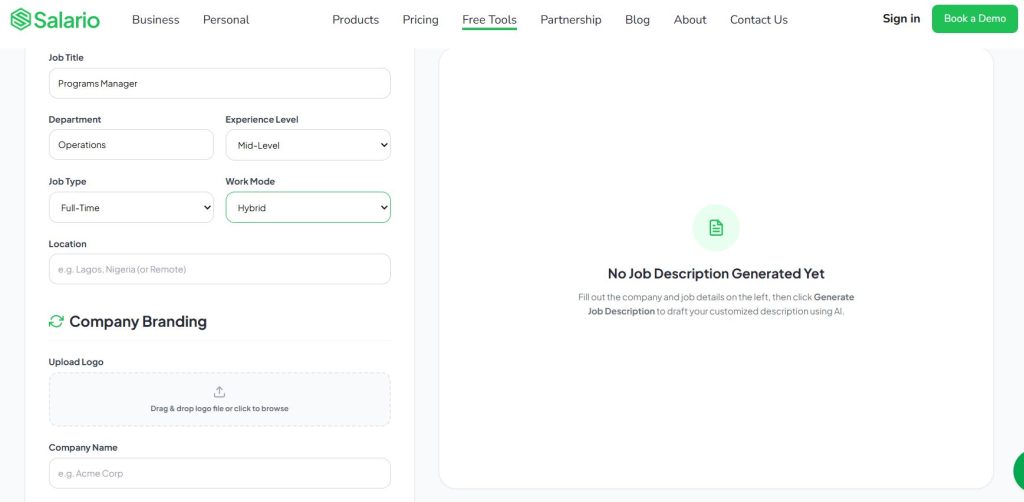
Writing a strong job description from scratch takes time most hiring managers do not have, especially when you are filling several roles at once. Many businesses end up reusing outdated templates or copying postings from competitors, which rarely reflects what the role actually needs.
Salario’s job description generator removes that friction. Instead of starting from a blank page, you answer a few quick prompts about the role, and the tool builds a structured, ready to edit job description using the format and components covered in this guide.
Ready to post a role that attracts the right candidates instead of a flood of the wrong ones? Generate a job description with Salario today and get a clear, professional posting in minutes, not hours. When your job description does the filtering for you, your interviews finally start with candidates worth talking to.