

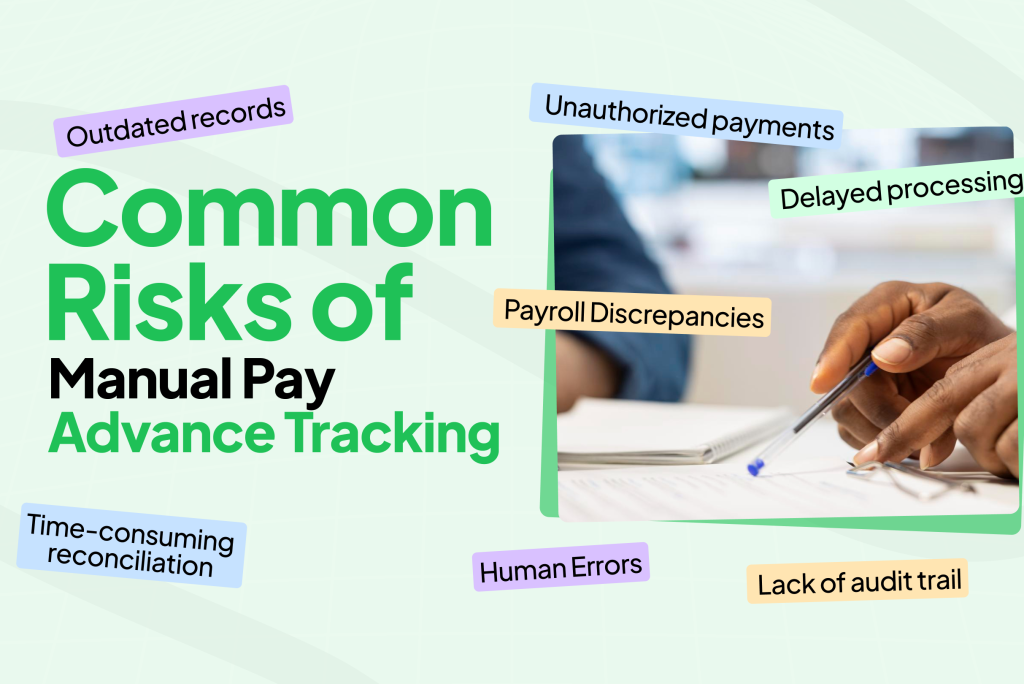
In 2025, Nigeria’s Independent Corrupt Practices and Other Related Offences Commission recovered over ₦20 billion linked to payroll fraud schemes across federal agencies. A separate audit in Katsina State uncovered 3,488 ghost workers, saving the state roughly ₦453 million a month once they were removed from the payroll. These numbers come from government payrolls, but the underlying problem is not unique to government. Any business that moves money outside its normal salary cycle, especially through a pay advance, faces the same exposure on a smaller scale i.e the risks of manual pay advance tracking. Pay advance tracking often happens in a side spreadsheet, a notebook, or a WhatsApp message to the finance team. That gap between the official payroll system and the informal advance record is where most of the risk sits. This article breaks down what can go wrong with manual pay advance and what a safer process looks like.
What Manual Pay Advance Tracking Actually Involves
Manual pay advance tracking usually starts with an employee sending a request by email or verbal ask. An HR or finance officer approves it, sometimes without a formal sign-off step. The amount gets noted in a spreadsheet, then subtracted from the employee’s next salary. Every step depends on someone remembering to update the record correctly and on time.
This works fine for a business with five employees and one or two advance requests a month. It breaks down fast once headcount grows or the person managing the spreadsheet goes on leave. A manual pay advance process has no built-in checks. If a number gets typed wrong or a deduction gets missed, nothing flags it until payday, and sometimes not even then.
Risk 1: Errors in Repayment Deductions
The most common problem with pay advance tracking done by hand is simple arithmetic. Someone approves a ₦50,000 advance in one spreadsheet tab, then runs payroll from a different file weeks later. If the two files are not cross-checked line by line, the deduction gets missed, applied twice, or applied at the wrong amount.
These errors are rarely caught early. An employee who gets overpaid because their deduction was skipped may not report it. A business that later notices the gap has to claw back money from a paycheck weeks after the fact, which creates friction between HR and staff.
Common repayment errors include:
- Deducting the wrong amount because two spreadsheet versions were out of sync
- Forgetting to deduct at all when an advance was recorded in a separate file from the main payroll sheet
- Applying a deduction twice after a correction was made without removing the original entry
- Miscalculating partial repayments when an advance is split across two or three pay cycles
Risk 2: Duplicate or Overlapping Advances
Without a live, single source of truth, nothing stops an employee from requesting a second advance before the first one clears. This happens more often than most HR teams expect, especially where different managers can approve requests independently.
Manual pay advance tracking rarely gives one person full visibility into every outstanding request across departments. A manager in operations might approve a request without knowing the same employee already has one pending with finance. By the time both advances land on the same payslip, the deduction can wipe out most of that employee’s take-home pay, creating a real financial problem for the worker and an awkward conversation for HR.
Risk 3: No Reliable Audit Trail
This is where manual pay advance tracking creates the most serious exposure. A spreadsheet has no built-in log of who approved a request, when, or whether the terms changed afterward. Entries can be edited or deleted with no record that anything happened.

Nigeria’s public sector ghost worker cases show what happens when payroll records lack a verifiable trail. Investigations into the Integrated Personnel and Payroll Information System have repeatedly uncovered thousands of fictitious or duplicate entries that persisted because no automated system flagged inconsistencies early. Private businesses are not immune to the same pattern on a smaller scale. A dishonest employee with spreadsheet access could record a fake advance for a “ghost” staff member or quietly inflate a real one, with no timestamp to catch it.
An audit trail matters for compliance too. Nigerian labour law requires businesses to keep payroll records for a minimum of six years. A spreadsheet with no version history and no approval log does not meet that bar in any meaningful way, even if the file is saved somewhere.
Risk 4: Delayed Processing and Cash Flow Blind Spots
A manual pay advance process slows everyone down. An employee facing an emergency has to wait for approval, then wait again while finance processes the transfer, sometimes across multiple bank accounts and confirmation steps. Reconciling disbursements across accounts is already one of the biggest sources of payday stress for HR and finance teams, and advances add another layer to the same problem outside the normal cycle.
On the employer side, tracking pay advances by hand makes it hard to see the full picture. If requests are scattered across spreadsheets, emails, and verbal approvals, finance has no easy way to answer a basic question: how much money is currently out on advance across the whole company? That blind spot makes cash flow planning harder, particularly during periods of naira volatility and inflation.
Risk 5: Compliance and Statutory Deduction Conflicts
Pay advances interact with statutory deductions in ways that manual pay advance tracking often misses. PAYE tax is calculated on gross pay for the period, not on the amount an employee receives after an advance deduction. Pension contributions, calculated at 18% of qualifying salary components, follow the same rule. If a spreadsheet nets out the advance before applying these calculations, the business ends up under-remitting to FIRS or PenCom without realizing it.
Common compliance gaps tied to manual tracking include:
- Calculating PAYE or pension on net pay after a deduction instead of gross pay
- Missing the six-year record retention requirement when files get overwritten or lost
- Failing to reconcile repayments with the PenCom PCRS system, which validates RSA PINs against consistent salary data
- No documentation trail to show regulators how an advance was approved and repaid if a dispute arises
None of these gaps are intentional. They happen because tracking pay advances manually depends on someone remembering every rule, every time, for every employee.
How Businesses Can Reduce These Risks
A few practical changes lower the risk of a manual pay advance process, even before a business is ready to automate:
- Keep one master file for all advances instead of letting different managers keep separate records
- Require written approval from a single designated person before any advance is disbursed
- Reconcile the advance log against the payroll file before every pay run, not after
- Set a policy limit on how much of an employee’s salary can go toward an outstanding advance at once
- Review outstanding advances monthly so nothing carries over unnoticed for multiple cycles
These steps help, but they still rely on discipline holding up every single month. For a growing business, that is a fragile foundation for pay advance tracking.
Why Automated Pay Advance Tracking Is the Safer Bet

Platforms like Salario remove the guesswork by logging every advance request, approval, and repayment in one system tied directly to payroll. When an advance is approved, the deduction calculates automatically against the correct gross salary figures, so PAYE and pension contributions stay accurate. Every action carries a timestamp and an approval record, closing the audit trail gap that a manual process cannot fill on its own.
This is the same principle behind earned wage access, where employees draw down pay they have already earned without the employer losing visibility into who has requested what. Salario’s employee wallet and self-service portal give staff a transparent view of their own advance history, which cuts down on repeat requests and disputes. For finance teams that have outgrown spreadsheet-based payroll altogether, moving advance tracking into the same system Salario uses for salary disbursement removes one more manual process that used to eat hours every month.
Key Takeaways
Manual pay advance tracking exposes businesses to repayment errors, duplicate approvals, weak audit trails, and compliance gaps with PAYE and pension remittances. These risks grow with headcount and rarely surface until money has already gone missing or a regulator asks for records the business cannot produce. Moving pay advance tracking into an automated system closes most of these gaps at once.
Ready to stop chasing spreadsheet errors on every advance? Book a free demo with Salario today and see how automated pay advance tracking keeps every request, approval, and deduction accurate and auditable. When advances are tracked properly, payday stops being a source of financial surprises for anyone.