
Tunde had hired eight people in eighteen months. His Lagos logistics business was growing, and his team structure lived only in his head. Then a new sales hire asked who approved her leave. Three people said the operations manager. Two said Tunde. She waited four days for an answer.
That delay is a structure problem, not a people problem. Without a clear organizational chart, reporting lines blur, approvals stall, and small questions turn into big ones. A free organizational chart generator solves this in minutes. This guide shows what a good chart includes, why hand drawn versions fail, and how to build an organizational chart free of charge with Salario.
What an Organizational Chart Does for Your Business
An organizational chart is a diagram of who works where and who reports to whom. Each box is a role. Each line is a reporting relationship. It looks simple, and that is the point.
A good chart tells a new hire who approves leave. It tells your finance lead who signs off on expenses. It shows you where one manager carries too many direct reports, and where a department has no owner at all.

Clear roles also drive results. McKinsey research found that role clarity and accountability rank among the strongest drivers of organizational health and performance. A chart puts that clarity on one page. If your roles are still vague, start with our guide on how to write a job description, then place each role on your organizational chart.
Who Needs an Organizational Chart Right Now
You need one sooner than you think. Most owners wait until the team hits twenty people. By then, confusion has already cost them time and good staff.
Build one if you have more than five employees. Build one if new hires keep asking who their manager is. Build one if you run your Nigerian business from London, Houston, or Toronto, because you cannot walk the office floor to see who does what. A shared chart gives diaspora founders a clear picture of the team without a single call.
It also helps when you plan. Before you hire, you can see which department is stretched and which one has room. Cost is no longer a reason to wait, since you can get an organizational chart free from Salario.
Why Nigerian Teams Struggle to Keep an Organizational Chart
Nigerian businesses are mostly small. The NBS and SMEDAN 2021 survey, cited by PwC, found that MSMEs account for 87.9% of employment in Nigeria. Small teams grow fast, and structure rarely keeps up. The founder knows who does what, so nobody writes it down.
When someone finally tries, the options are poor. A PowerPoint slide takes an hour to line up and goes stale at the next resignation. A spreadsheet lists names but shows no lines. A chart sent on WhatsApp gets forwarded until nobody knows which version is current.
The cost shows up in hiring too. If you cannot see your current structure, you cannot decide where the next role belongs. Before you add a box, know what it will cost. Our guide to the true cost of hiring an employee in Nigeria helps you work that out, so each new line on your chart is a planned decision.
What to Look for in an Organizational Chart Generator
Not every organizational chart generator deserves your time. Check four things.
First, speed. You should have a usable chart in minutes, not an afternoon. Second, simplicity. Your office manager should use it without training or design skills. Third, cost. A tool that locks the chart behind a paywall defeats the purpose for a growing business. Fourth, easy updates. Your structure will change, and your chart must change with it.
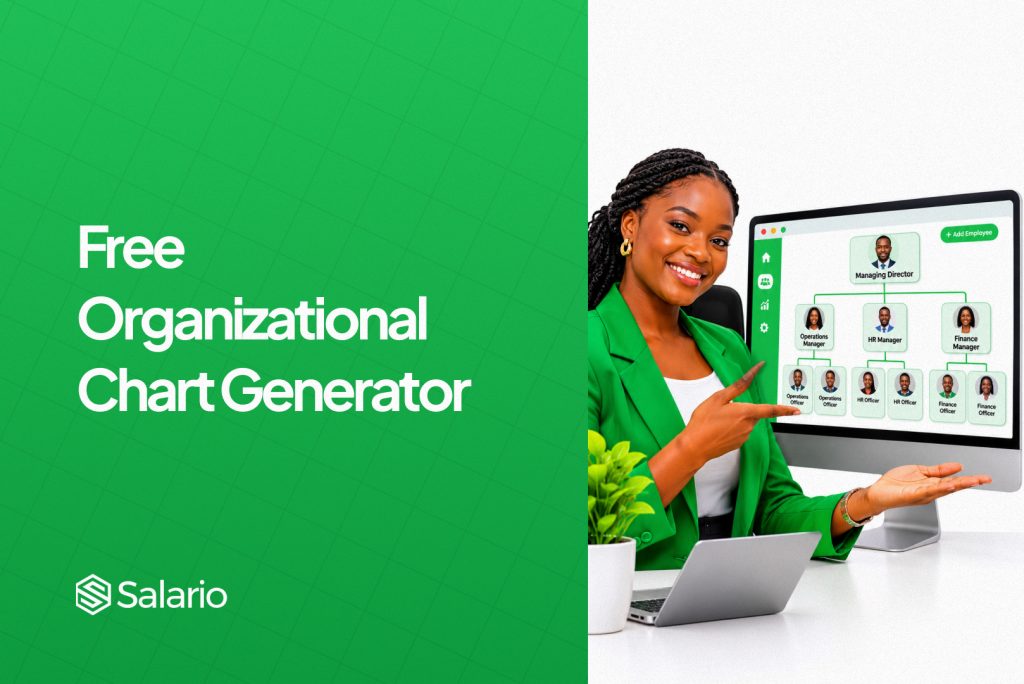
Salario built its free organizational chart generator for Nigerian and African teams that want clarity without buying design software. You do not need design skills or software licences. You need your team list and a few minutes.

Whatever tool you pick, the chart itself should show names, job titles, departments, and reporting lines. Keep it to one page. If it grows too crowded to read, split it by department and link the pages together.
Good records help too. A chart works best when every person has a clear identity in your system. If you have not set that up, see how to generate employee codes for free and give each box on your chart a matching ID.
How to Build an Organizational Chart Free With Salario
Start with data, not design. List every employee’s full name, job title, department, and direct manager. Include yourself. Include contractors who run a function.
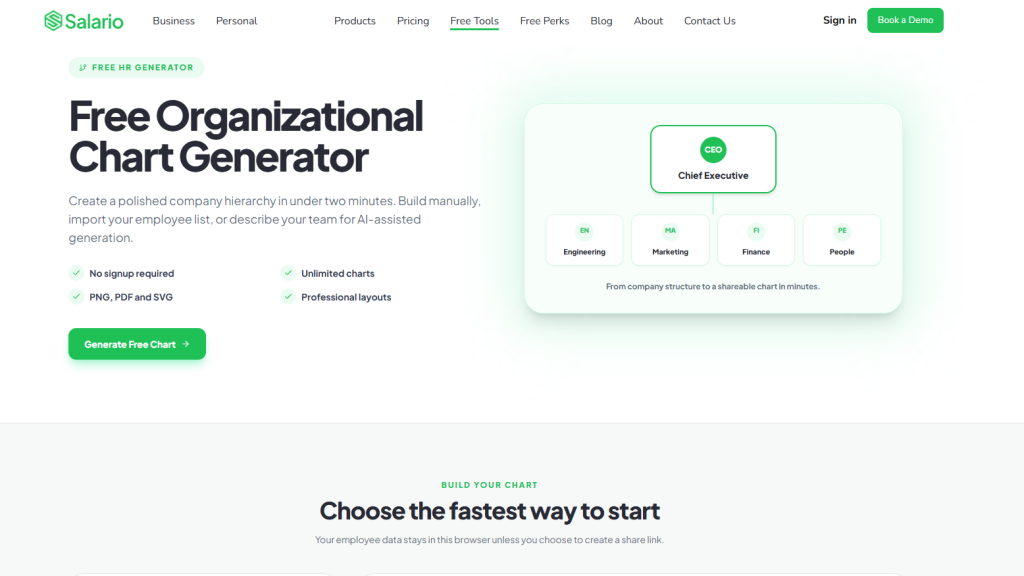
Next, choose your shape. Most small Nigerian businesses suit a hierarchical chart, with the managing director at the top, department heads below, and teams under them. If you run a lean team of ten or fewer, a flatter layout may fit better.
Then add your roles and reporting lines to the Salario organizational chart generator and generate your chart. Check that every person has one clear manager. Look for managers who carry too many direct reports. Look for roles that report to nobody.
Finally, share it. Send it to your team, add it to your onboarding pack, and show it to every new hire on day one. A chart nobody sees solves nothing.
Do not wait for a perfect version. A rough chart your team can see today beats a polished one that never gets finished. You can edit it later, and you should.
Keep Your Chart Accurate After You Generate It
An organizational chart is a living document. Update it after every hire, exit, and promotion. When someone leaves, check who inherits their direct reports. Gaps like that cause the same approval delays Tunde saw. When a role changes, update its job description too. Our guide on job description vs job specification explains how the two documents work together.
Your chart should also match your payroll. Compare the two once a month. A short review is enough for most small teams. A name on payroll with no place on the chart and no manager is a red flag for ghost workers. Catching one early protects your payroll budget.
Platforms like Salario automate PAYE, pension, and other statutory deductions, but automation only works when your people data is right. A clean chart is the first step to clean payroll.
Generate Your Organizational Chart Free Today
A clear organizational chart speeds up approvals, shortens onboarding, and shows you where to hire next. Tunde did not need a bigger budget. He needed one page his whole team could see. You can build that page today, and the organizational chart generator costs you nothing.
Ready to stop explaining your structure out loud? Generate your organizational chart for free. When everyone knows where they stand, work moves faster.