
Nigeria changed how payroll tax works on 1 January 2026. The Nigeria Tax Act 2025 replaced the old Personal Income Tax Act. It brought in new PAYE bands and removed the Consolidated Relief Allowance. Any payroll set up before then now calculates tax under a repealed law. That is why the Salario vs Tyms question matters this year. Both tools can help you run payroll, but they start from very different places. Tyms is an accounting platform with a payroll module. Salario is a payroll platform built around Nigerian compliance. This guide compares them on features, compliance, cost, and fit. It also helps you decide if you need a Tyms payroll alternative in Nigeria or if Tyms already does the job.
Salario vs Tyms at a Glance: Two Different Starting Points
Tyms describes its payroll as software that keeps payroll and accounting in one system. The pitch is simple. You run the pay, and the salary, tax, and pension entries land in your ledger automatically.
Salario starts from the opposite side. It treats payroll as the main job and statutory compliance as the hard part to get right. Neither approach is wrong. The better pick depends on which problem hurts more today: messy books or messy payroll compliance. Keep that in mind through the rest of this Salario vs Tyms comparison.
What Tyms Payroll Offers
Tyms is an AI assisted accounting platform. Its payroll page lists employee records, pay runs, approvals, cost reports, and automatic ledger posting. You keep each person’s department and pay in one place. You prepare a pay run as a batch, review it, and send it for approval before anything is paid. Tyms then posts salaries, income tax payable, and pension payable to the right accounts.
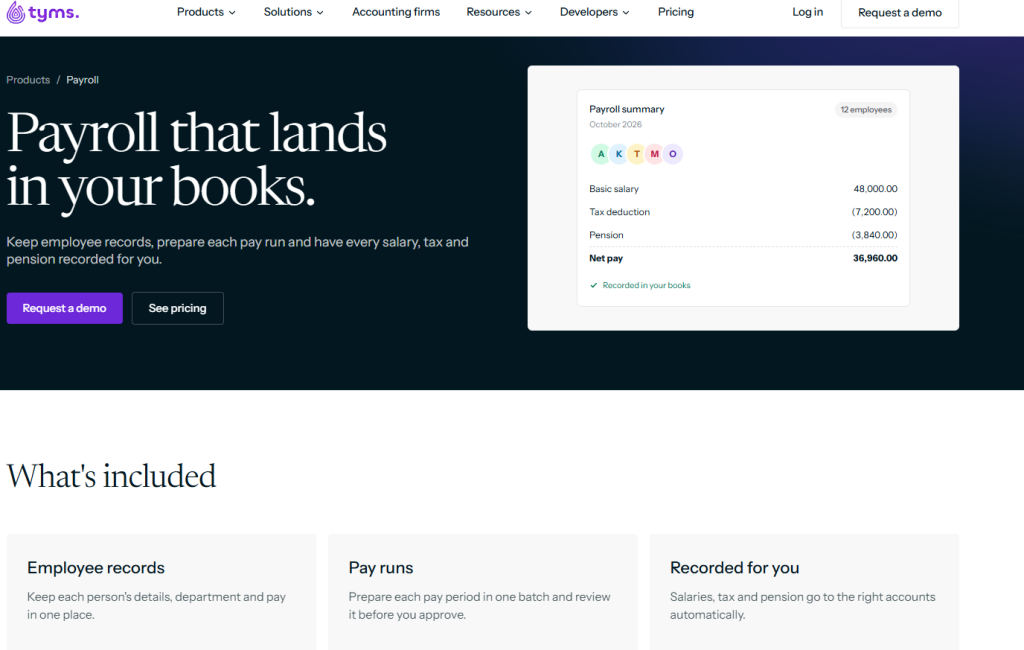
There is also an assistant called Adam. You can ask it what payroll cost last month and how that compares with earlier months. For a business that wants payroll to feed straight into the books, that is a real strength.
Some details are missing from the page. It does not describe pension schedules by PFA, PAYE remittance reports, or an employee self-service portal. Those features may exist elsewhere in the product, so ask about them in a demo. Third party coverage points the same way. A Nigerian tech outlet says Tyms strengthens the accounting base that tax compliance depends on, rather than handling tax compliance directly. A software review site lists limited depth on tax compliance as a drawback.
What Salario Offers
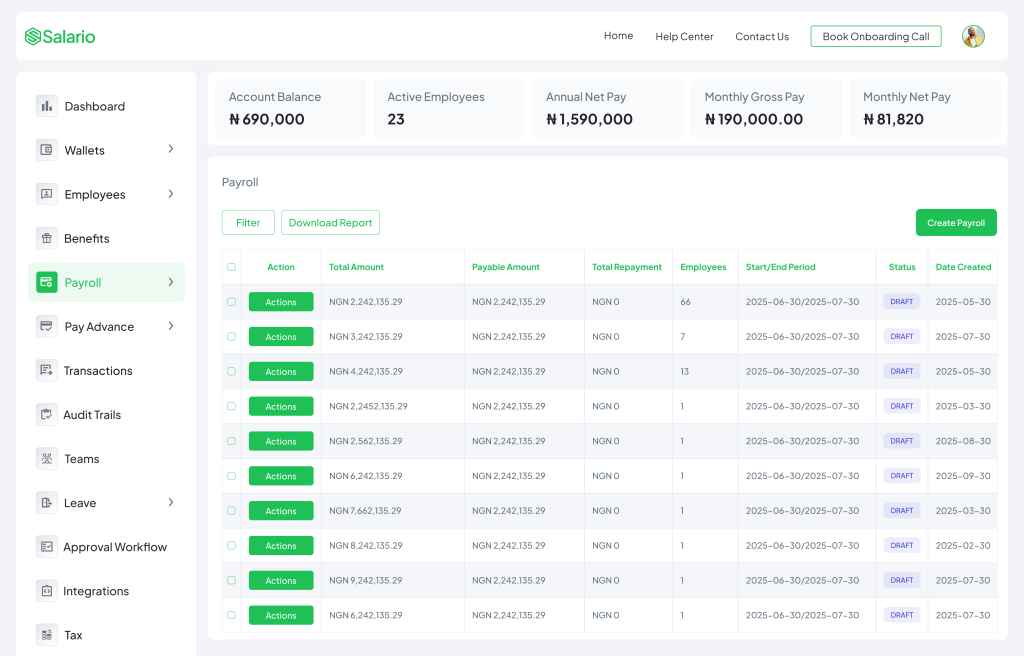
Salario is a Nigerian payroll platform built for local rules. It automates PAYE, pension, NHF, NSITF and ITF, the deductions that trip up most spreadsheets. Salario boasts about its bulk employee onboarding, one-click payroll, customizable payment methods, detailed audit trails and data security measures.
Employees get a self-service portal, so they can check payslips without calling HR. Salario also keeps a payroll history you can search, which makes audits less painful. The platform scales from a team of 5 to a team of 500.
In March 2026, Salario launched a free payroll solution for Nigerian SMEs, with no upfront software licence cost. Earned wage access is part of the offer. Stablecoin payments in USDC and USDT are coming for businesses that pay people across borders.
Salario vs Tyms: Feature Comparison
Here is how the two compare on the features that matter most to a Nigerian employer.
| Feature | Salario | Tyms |
| Core focus | Nigerian payroll and HR automation | AI accounting with a payroll module |
| PAYE, pension, NHF, NSITF, ITF automation | Core feature | Not described on its payroll page |
| Employee self-service portal | Yes | Not described on its payroll page |
| Audit trail | Detailed audit trails | Approvals and a record of changes |
| Books and ledger | Works with your existing tools | Posts payroll to its own ledger |
| Earned wage access | Yes | Not described |
| Stablecoin payroll (USDC, USDT) | Coming soon | Not described |
| Cost | Free option for Nigerian SMEs with paid tiers | Paid plans |
Do note, “not described” does not mean not available. It means the vendor’s own payroll page does not say. Ask Tyms directly before you rule anything in or out.
Nigerian Compliance: Where Payroll Software Earns Its Keep
The new tax law is the first test. Under the Nigeria Tax Act 2025, the first ₦800,000 of annual income is taxed at 0%. There are six bands, and the top rate is 25% on income above ₦50 million. Rent relief replaced the old allowance, at 20% of rent paid, capped at ₦500,000.
Pension is the second test. The Pension Reform Act 2014 sets a minimum of 18% of monthly emoluments. The employer pays 10% and the employee pays 8%. You must remit within seven working days of paying salaries. Late payment costs at least 2% of the unpaid amount for every month it stays late. Leadership reports that defaulting employers paid at least ₦14.3 billion in penalties between 2014 and 2025.
PAYE is the third test. You remit it to the state revenue service by the 10th of the following month. Business Day reports that administrative penalties under the PAYE system can now reach 40%.
A general ledger can record all of these numbers. It does not always prepare the schedules your PFA and state tax office ask for. That gap is where a payroll first tool helps. Salario handles these rules inside the payroll run, so the deduction, the schedule and the record come from one place. In any Salario vs Tyms decision, ask each vendor to run a test demo. Then check the pension schedule and PAYE report it produces.
Control and Fraud Prevention: Salario vs Tyms on Approvals
Getting the numbers right is half the job. The other half is stopping the wrong people from changing them.
Tyms handles this well on paper. A pay run goes for approval before money moves. Roles and permissions limit who can view, create or edit records, and the platform keeps a record of every change. For a small team, that is a solid base.
Salario adds controls built around common Nigerian risks. Ghost workers and salary padding are real problems when pay data lives in spreadsheets. Audit trails show who edited a salary and when. Role based access decides who sees what. The employee portal also lets staff spot a wrong payslip themselves, long before it becomes a dispute.
Both tools score well on approvals. The difference is employee facing transparency and local statutory records, where Salario goes further. That detail often decides the Salario vs Tyms question for owners who manage payroll from another country.
Salario vs Tyms: Cost and Setup
Salario’s free option for Nigerian SMEs removes the licence cost. Tyms lists paid plans. Review sites quote different starting prices, from about $2.50 a month to higher per seat plans. Check the current figure on its pricing page before you decide.
Also count what the tool does not cover. If your team prepares pension and PAYE schedules by hand, the cheaper software can cost more in staff time. Prices on most review sites are quoted in dollars for Tyms. With the naira so volatile, a dollar price can change what you actually pay each month.
Setup matters too. Tyms asks you to connect your bank and let its assistant take over the books. That suits a business starting its accounts from scratch. Salario asks you to add your employees, set their pay structure and run payroll. That suits a business whose books already live elsewhere.
Who Should Choose Tyms, and Who Should Choose Salario
Tyms fits a small team that wants books and light payroll in one place. It works best if your accountant already lives in the ledger and your pay structure is simple.
Salario fits a business where payroll is the bigger headache. Maybe your headcount is growing, pension deadlines keep slipping, or staff keep asking HR about payslips. Maybe you run your Nigerian company from London or Toronto and need to see who changed what. If you searched for a Tyms payroll alternative in Nigeria, this is probably your situation.
You can also use both. Run payroll in Salario and keep your books in an accounting tool. The two jobs do not have to share one system.
If you are still unsure, run a simple test. Ask each vendor to show you three things in a live demo: a pension schedule by PFA, a PAYE report for one state, and the view an employee sees for their own payslip. The vendor that delivers all three is ready for Nigerian payroll. Treat a vague answer with caution.
Looking for a Tyms Payroll Alternative in Nigeria?
Nigerian payroll breaks in predictable places. Pension remittance arrives late. PAYE is wrong after a tax change. A ghost worker slips onto the list. An employee waits three days for a payslip.
Salario was built to close those gaps. Audit trails show who approved what. Role-based access keeps sensitive pay data with the right people. The self-service portal answers payslip questions without a phone call. Platforms like Salario also update statutory logic centrally, so a change in law does not mean rebuilding a spreadsheet. For many businesses, that makes Salario the stronger Tyms payroll alternative in Nigeria.
Salario vs Tyms: The Bottom Line
Tyms is a capable accounting tool with a payroll module that feeds your books. Salario is a payroll platform built for PAYE, pension, and the rest of the Nigerian rulebook. If books are your pain, look at Tyms. If compliance is your pain, Salario is the safer choice.
Ready to run compliant payroll without the spreadsheet stress? Book a free demo with Salario today and see how automated PAYE and pension schedules fit your team. When payroll runs itself, you get your time back for work that grows the business.