


What should a standard payslip contain? At minimum, it should identify the employer and employee, state the pay period, itemise earnings and deductions, and show gross pay, total deductions, and net pay. It should allow an employee to understand how the employer moved from salary and allowances to the final take-home amount.
A strong payslip also separates reimbursements and employer contributions, protects sensitive information, and provides a clear contact for reporting errors. This guide explains the essential components Nigerian employers, HR teams, accountants, and employees should look for.
What Is a Payslip?

A payslip is an individual statement showing how an employee’s pay was calculated for a specific pay period. It may be issued as a printed document, a PDF, or a record in a secure employee self-service portal.
The document is sometimes called a salary slip, wage slip, pay statement, pay stub, or payroll slip. The names differ, but the purpose is the same: to give the employee a clear breakdown of earnings, deductions, and take-home pay.
A payslip serves several practical purposes:
- It helps an employee confirm that salary was calculated correctly.
- It explains deductions instead of showing only a lower final payment.
- It gives HR and Finance a common reference when resolving payroll questions.
- It supports internal controls, tax reviews, pension reconciliation, and audits.
- It provides evidence of income for loans, tenancy applications, visas, and other legitimate processes.
- It creates a consistent payroll history for the employer and employee.
A payslip is not the same as a bank alert. The alert confirms that an amount reached an account. The payslip explains how the employer arrived at that amount.
Is There One Legally Prescribed Payslip Format in Nigeria?
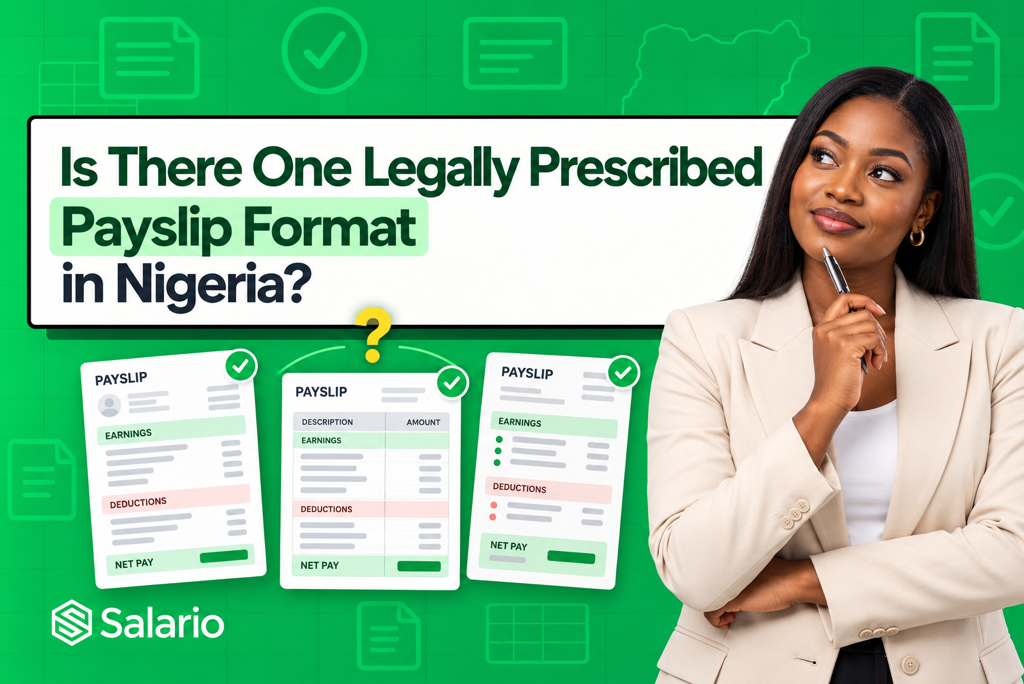
Nigeria does not use one universal statutory payslip template for every employer and industry. Businesses can arrange the information differently, provided the document is accurate, understandable, and consistent with the employment terms and applicable payroll obligations.
The absence of one prescribed layout does not mean payroll can be vague. The Nigerian Labour Act deals with important matters behind the payslip, including:
- Written particulars of the rate of wages and how those wages are calculated
- The manner and frequency of wage payment
- Restrictions on deductions from wages
- The treatment of certain pension, trade-union, and overpayment deductions
- Wage-payment periods that should not exceed one month where a longer period would otherwise apply
The Nigeria Tax Administration Act 2025 also requires employers to deduct applicable income tax from employment payroll and requires relevant books and records to be retained for at least six years after the year of assessment to which the income relates.
For covered employment, the Pension Reform Act 2014 sets minimum pension contributions of 8% from the employee and 10% from the employer.
A well-designed payslip brings these separate payroll facts into one readable employee-facing record. It is good governance even where no law provides a single mandatory visual template.
The Essential Components of a Standard Payslip
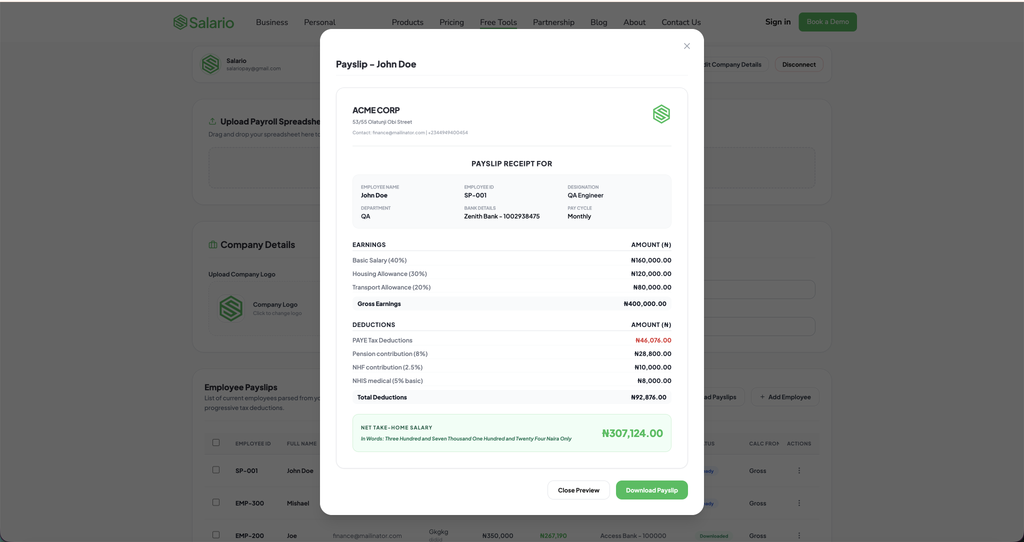
1. Employer details
The top of the payslip should identify the organisation issuing it. Include:
- The registered or recognised company name
- Business address or principal office
- Payroll or HR contact email
- Contact telephone number where useful
- Company logo as an optional branding element
The employer’s identity should be unmistakable. This is particularly important when an employee works within a group of companies or when salary is processed by a related entity.
If the employing entity is different from the brand the employee works under, the payslip should make the legal employer clear. Do not use only a trading name if that could create confusion about who owes the employment obligations.
2. Employee identification
Each payslip should clearly identify the person whose pay is being reported. Include:
- Full employee name
- Unique employee ID
- Job title or designation
- Department, branch, or business unit
- Employment category where relevant, such as permanent, temporary, hourly, or contract staff
A unique employee ID is important because names can be duplicated, misspelled, or changed. The ID connects the payslip to the correct HR and payroll record.
Avoid placing unnecessary sensitive identifiers on the employee-facing document. A full Bank Verification Number, National Identification Number, Tax Identification Number, or Retirement Savings Account PIN usually does not need to be printed on every payslip. Where an identifier is operationally useful, display only a masked version.
3. Pay period
The payslip must state the exact period the payment covers. Examples include:
- 1–30 September 2026
- September 2026
- Week ending 25 September 2026
- Payroll cycle 19, 2026
The pay period prevents confusion when a payment is made early, late, or after an adjustment. It also makes historical records easier to organise.
Do not rely on the file-creation date as the pay period. A September payslip generated in October still relates to September.
4. Payment date
Show the date on which salary is scheduled or recorded as paid. The payment date and pay period are not always the same.
For example:
- Pay period: September 2026
- Payment date: 28 September 2026
If a payslip is prepared before payment, do not label the salary “paid” until the transaction is confirmed. A generated payslip describes the calculation; it does not, on its own, prove that the bank transfer succeeded.
5. Salary basis or payroll basis
Where relevant, state how the employee’s pay was determined. This is particularly useful for employees who are not paid a fixed monthly amount.
The basis may include:
- Monthly salary
- Daily rate and number of paid days
- Hourly rate and approved hours
- Overtime hours and overtime rate
- Commission rate and eligible sales
- Prorated salary for a new hire or departing employee
- Unpaid-leave days
An employee should be able to see why the current month differs from the previous one. A single unexplained “adjustment” line creates more questions than it answers.
6. Basic salary
Basic salary is the core fixed component of the employee’s compensation before additional allowances and variable earnings. It should have its own line.
Basic salary may affect pension, benefits, leave pay, and other calculations, so it should not be hidden inside one combined earnings figure.
The monthly amount shown should match the approved employment terms, salary revision, or prorated amount for the period.
7. Allowances and other fixed earnings
List each allowance separately rather than grouping everything as “other pay.” Common Nigerian salary components include:
- Housing allowance
- Transport allowance
- Meal allowance
- Utility allowance
- Communication or data allowance
- Shift allowance
- Location or hardship allowance
Separate lines make it easier to confirm taxable treatment, pensionable pay, and contractual entitlements. They also help an employee understand which component changed after a promotion or salary review.
8. Variable earnings
Any amount that changes from one payroll period to another should be clearly labelled. Examples include:
- Overtime
- Performance bonus
- Sales commission
- Productivity incentive
- Leave allowance
- Acting allowance
- Arrears from an earlier period
- Retroactive salary adjustment
- 13th-month or end-of-year pay
Where useful, show the quantity and rate behind a variable amount. For instance, “10 overtime hours × ₦2,000” is clearer than “overtime: ₦20,000.”
Arrears should identify the period they relate to. That prevents an employee from assuming that the amount has become part of regular monthly salary.
9. Gross pay
Gross pay is the total of the employee’s earnings before employee deductions.
It may include basic salary, allowances, overtime, commissions, bonuses, and other taxable or contractual earnings for the period. The precise tax treatment of each component can differ, but the payslip should still make the total visible.
Use a bold subtotal labelled Gross Pay or Total Gross Earnings. Do not make the employee calculate it manually from several rows.
10. Reimbursements and expense repayments
Reimbursements should normally appear separately from salary earnings. A reimbursement repays an employee for an approved business expense; it is not automatically compensation for work.
Examples include:
- Approved travel expense
- Client-meeting expense
- Business internet purchase
- Work equipment purchased on behalf of the employer
- Mileage or transport expense supported by company policy
Separating reimbursements helps prevent them from being mistaken for regular salary, pensionable pay, or a recurring allowance. The payroll and tax treatment should follow the facts and the applicable policy.
11. PAYE deduction
Pay-As-You-Earn income tax should appear as a separate deduction where applicable. Label it clearly as PAYE or Income Tax (PAYE).
The Nigeria Tax Act 2025 applies progressive personal income-tax rates after permitted deductions, reliefs, and exemptions. The Nigeria Tax Administration Act requires applicable income tax on employment to be deducted through payroll by the employer.
The payslip does not need to reproduce the entire annual tax computation, but the payroll team should retain the supporting calculation. If employees frequently question their PAYE, consider showing year-to-date taxable earnings and year-to-date PAYE as additional fields.
12. Employee pension contribution
For covered employment, show the employee’s pension contribution as a separate deduction. Under the Pension Reform Act 2014, the statutory minimum employee contribution is 8% of the applicable monthly emoluments.
The pension deduction should agree with:
- The pensionable salary components in the employee’s record
- The payroll schedule
- The pension remittance schedule
- The amount remitted to the employee’s Retirement Savings Account
Do not combine pension with PAYE or label it simply as “statutory deduction.” Employees should be able to see the amount allocated to retirement savings.
13. Other employee deductions
Every deduction that reduces the employee’s take-home pay should have a clear label and a lawful or authorised basis. Depending on the employee and company policy, this may include:
- National Housing Fund contribution where applicable
- Employee health-insurance contribution
- Salary-advance recovery
- Staff-loan repayment
- Trade-union dues
- Cooperative contribution
- Voluntary pension contribution
- Court-ordered deduction
- Unpaid-leave adjustment
- Recovery of a recent salary overpayment where lawfully handled
- Other employee-authorised benefit deductions
Avoid a large unexplained “other deduction” line. If several items exist, list them separately or provide an attached breakdown.
The Nigerian Labour Act restricts deductions from wages. Before adding a deduction to payroll, confirm the legal, contractual, policy, or written employee-authorisation basis.
14. Total deductions
Add all employee deductions and display a bold subtotal labelled Total Deductions.
This lets the employee confirm the calculation:
Gross Pay − Total Deductions = Net Pay
Only deductions taken from the employee’s earnings belong in this subtotal. Employer-funded costs should not reduce take-home pay.
15. Net pay or take-home pay
Net pay is the amount remaining after employee deductions. It should be the most visually prominent financial figure on the document.
Use an unambiguous label such as:
- Net Pay
- Take-Home Pay
- Net Salary
If an approved reimbursement is added after net salary, distinguish between Net Earnings and Total Amount Payable so the employee can reconcile the calculation with the bank credit.
16. Employer contributions shown separately
An employer may choose to show employer-funded contributions for transparency. These can include:
- Employer pension contribution
- Employer-funded health cover
- Group life insurance information
- Other employer-funded benefits
For covered employment, the minimum employer pension contribution is 10% of the relevant monthly emoluments.
Employer contributions must not appear inside employee deductions. If the employer pension is ₦33,000, that amount is an additional employer cost; it should not reduce the employee’s salary.
For a broader view of these costs, read our guide to the true cost of hiring an employee in Nigeria.
17. Year-to-date figures
Year-to-date, or YTD, figures are optional but valuable. They show cumulative totals from the beginning of the payroll year through the current period.
Useful YTD fields include:
- Gross earnings
- Taxable earnings
- PAYE deducted
- Employee pension contribution
- Employer pension contribution
- Net earnings
YTD values help employees track their annual position and help payroll teams detect a figure that suddenly resets or jumps unexpectedly.
18. Leave, loan, or benefit balances
Some employers add supporting balances to the payslip, such as:
- Remaining annual-leave days
- Outstanding staff-loan balance
- Salary-advance balance
- Cooperative balance
- Accrued benefit points
These fields are optional and should be included only when the data is accurate and useful. Do not overcrowd the salary calculation with unrelated HR information.
19. Payment method and masked account reference
The payslip may show the payment method and a masked bank reference, for example:
- Bank transfer
- Zenith Bank •••• 4752
There is rarely a good reason to display a full bank-account number. Masking reduces the harm if the document is forwarded, printed, or viewed by the wrong person.
Do not state that payment was successful merely because a bank name appears on the payslip. Confirm the payout result separately.
20. Payslip reference and payroll contact
Add a unique payslip or payroll-run reference where possible. It helps HR, Finance, and the employee discuss the same record without confusion.
The document should also explain where to report an error. This can be as simple as:
Questions about this payslip? Contact [email protected] within five working days.
A contact route does not weaken the document. It creates a controlled correction process and helps mistakes reach the right team quickly.
Create a Standard Payslip with Salario
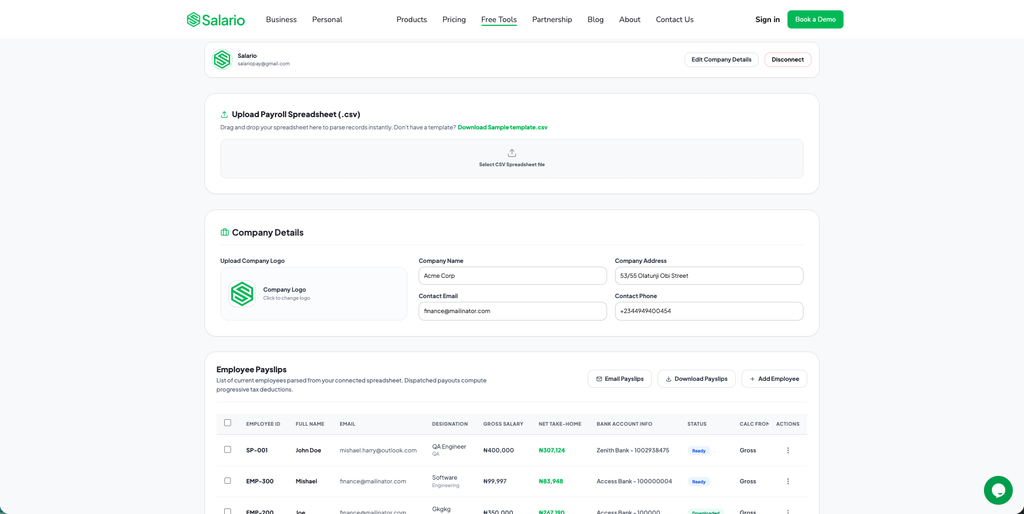
The question “what should a standard payslip contain?” is only the starting point. The employer must also calculate the figures accurately, use a consistent layout, deliver the document securely, and retain the appropriate payroll record.
Salario’s free professional payslip generator helps Nigerian employers create a payslip for one employee or generate payslips in bulk. You can add employer branding, employee details, earnings, deductions, and payroll information, then download or email the completed documents.
Before issuing any payslip:
- Confirm the employee and pay period.
- Review earnings and deductions.
- Reconcile gross pay, total deductions, and net pay.
- Verify the delivery address.
- Retain the approved payroll record.
For a practical walkthrough, read How to Generate Payslips for Free in Nigeria.