
Most Nigerian employers price a new hire by looking at gross salary alone. That number is only the starting point. The true cost of hiring an employee in Nigeria includes statutory employer contributions, onboarding expenses, and compliance overhead that rarely appear on the offer letter. Getting this number wrong before you extend an offer strains cash flow and can leave your business out of step with Nigerian labour law.
This guide breaks down every cost component involved in hiring an employee in Nigeria, walks through a sample calculation, and shows you how to get an exact figure for your business.
What “True Cost” Actually Means
The full cost of hiring an employee in Nigeria has three layers: gross salary, mandatory employer contributions, and indirect costs such as recruitment and payroll administration. Most employers budget for the first layer and get caught out by the second. Employer-side statutory contributions are not optional, and skipping them creates real compliance risk down the line. For the fundamentals of how the pension component works, our guide on payroll and pensions in Nigeria covers the framework in detail.
The Statutory Employer Contributions You Must Budget For
Under current rules, here is what employers pay on top of gross salary:
- Pension: Employers contribute 10% of an employee’s pensionable pay (basic, housing, and transport combined), and employees contribute 8%. This applies to employers with three or more staff.
- NSITF: Employers contribute 1% of total monthly payroll to the Nigeria Social Insurance Trust Fund. This is fully employer-funded and covers workplace injury and disability protection.
- ITF: Employers with five or more employees, or annual turnover of ₦50 million and above, contribute 1% of annual payroll to the Industrial Training Fund.
- NHIS: Companies with 10 or more employees contribute 10% toward the National Health Insurance Scheme.
- NHF: Under the Nigeria Tax Act 2025, National Housing Fund contributions became voluntary for private sector employees. It is no longer a default employer cost, though some businesses still offer it.
None of these show up in a job offer, but every one of them shows up on your payroll bill. Employers who compute PAYE by hand also risk getting the withholding side wrong, which adds its own penalty exposure. If you want a full walkthrough, see our guide on how to compute PAYE tax in Nigeria.
Beyond Statutory Costs: What Else Adds Up
Statutory contributions are the most predictable part of the true cost of hiring an employee in Nigeria, but they are not the only part. Factor in:

- Recruitment costs, including job postings, agency fees, and interview time
- Onboarding, training, and equipment for the new hire
- Payroll software or the staff hours spent running payroll manually
- Leave pay and any 13th month bonus your company offers
- The cost of payroll errors, including ghost workers and salary padding, which quietly inflate what you pay each month
Manual payroll systems are especially prone to that last risk. Our breakdown of salary padding and ghost workers in Nigeria explains how these errors happen and how to catch them before they become expensive.
A Quick Example
Say you hire an employee at a gross monthly salary of ₦300,000, all of it pensionable pay. Your employer-side statutory costs look like this:
- Employer pension (10%): ₦30,000
- NSITF (1%): ₦3,000
- ITF (1% of annual payroll, if your company qualifies): roughly ₦250 per month
That puts your minimum statutory add-on at around ₦33,250 a month, or about 11% above gross salary. Add NHIS if your company has 10 or more staff, and factor in onboarding and admin time, and the real cost of that hire climbs well past the number on the offer letter.
This is a simplified example. Your actual number depends on your headcount, allowance structure, and which levies apply to your business.
Get an Exact Number, Not an Estimate
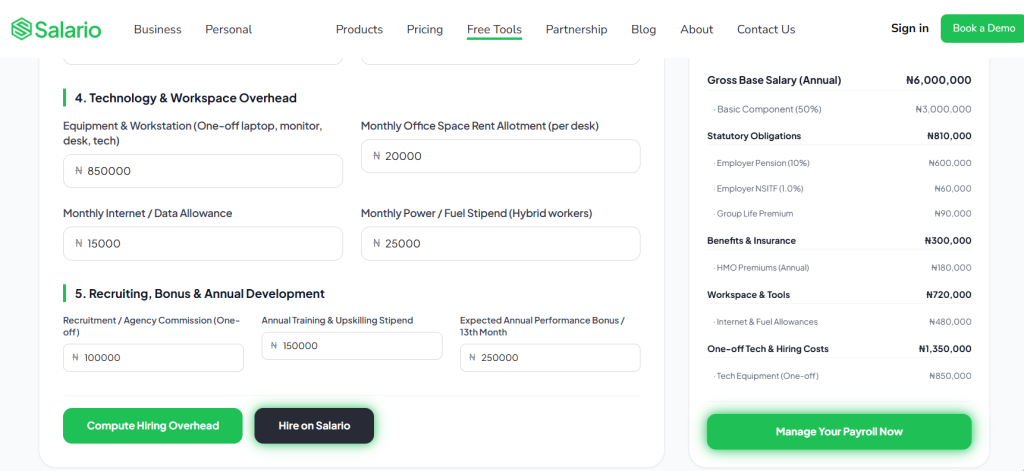
Rough percentages are useful for planning, but they are not precise enough to build a hiring budget on. Every business has a different mix of allowances, headcount thresholds, and applicable levies, and a small miscalculation compounds fast across a growing team.
Calculate the full employer cost of hiring in Nigeria with Salario’s employer cost calculator. Enter your employee’s salary structure and get an exact breakdown of every statutory contribution you owe, so your next hiring decision is based on real numbers, not guesswork.