
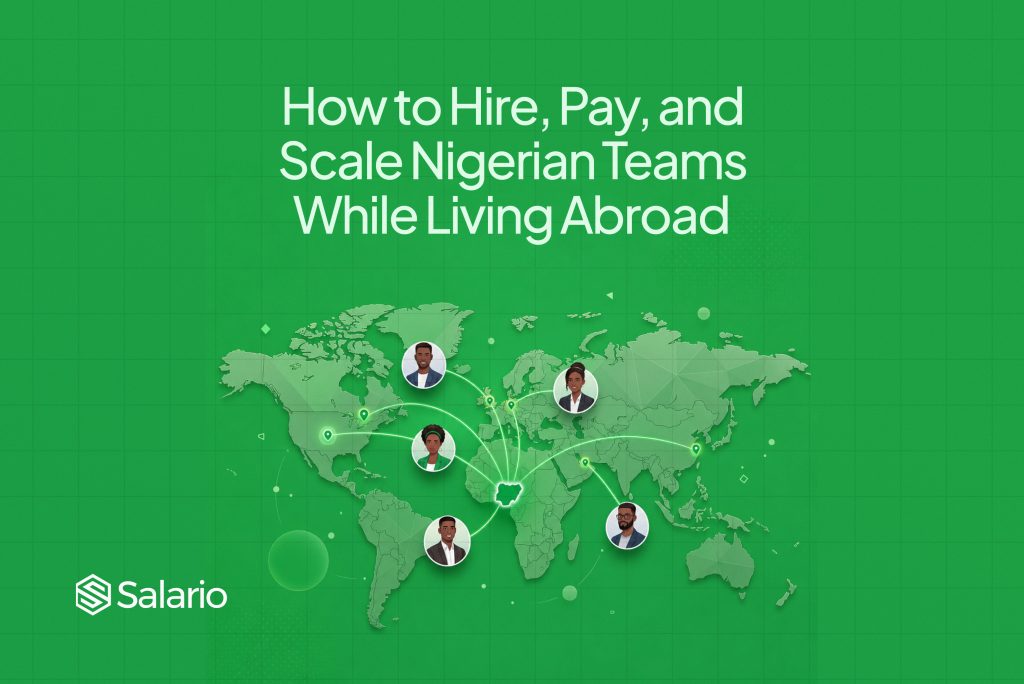
Adaeze built her fintech startup from a two-bedroom flat in Manchester. She hired her first Nigerian employee over a WhatsApp call, agreed on a salary in naira, and sent money through a transfer app. Six months later, she had eight people on the ground in Lagos, a pension compliance violation from PenCom, and no documentation that would hold up to any serious audit. Nobody had warned her that knowing how to scale Nigerian teams and actually doing it correctly are two very different things.
She is not alone. Thousands of diaspora founders are building Nigerian businesses from the UK, the US, and Canada. The talent is there. The market is real. But the gap between “I hired someone” and “I have a compliant, scalable Nigerian team” is where most remote founders quietly struggle. This guide closes that gap.
Why Nigeria Is One of the Best Places to Build a Remote Team Right Now
Nigeria has the largest English-speaking talent pool in Africa. Its tech ecosystem produces world-class engineers, designers, product managers, and operations leads every year, many of them already experienced working with international companies. For a diaspora founder, this is a genuine advantage.
Lagos, Abuja, Ibadan, and Port Harcourt are the top cities for sourcing Nigerian remote talent, particularly in software engineering, product design, content writing, virtual assistance, operations, digital marketing, and customer success roles. Salaries are competitive by global standards but significantly more affordable than comparable hires in Europe or North America.
Nigeria’s population crossed 237 million in 2025, making it the most populous country in Africa, accounting for almost 3% of the world’s total population. That population size means talent supply is deep and recruitment cycles can move fast when you know where to look.
The challenge is not finding people. It is structuring the employment properly once you do.
Step One: Decide How You Will Hire Employees in Nigeria
Before you post a job or reach out to a candidate, you need to decide on your employment structure. There are three realistic options for a diaspora founder.
The first is direct employment through a registered Nigerian entity. This means incorporating a business in Nigeria, registering with the Corporate Affairs Commission, and hiring employees directly under your company. This gives you the most control and is the cleanest structure long-term. It requires more setup time, typically three to six weeks for full registration, but it positions you to scale without legal exposure.
The second is using an Employer of Record (EOR). When you partner with an EOR in Nigeria, the EOR becomes the legal employer and handles drafting compliant employment contracts, processing monthly salaries, calculating and remitting statutory deductions like PAYE and pension contributions, managing benefits, and handling all necessary interactions with regulators like FIRS and PenCom. Your company retains full managerial control over the employee’s work. This is the fastest route if you need to hire employees in Nigeria quickly without waiting for entity registration.
The third is contracting. You can engage Nigerian professionals as independent contractors for project-based work. This carries less administrative burden but also fewer protections and no path to building a stable, loyal team. If you plan to scale, contracting is a starting point, not a destination.
Step Two: Get the Employment Contract Right
Section 7 of the Labour Act requires every employer to issue a written contract to the employee within three months of the commencement of the employment relationship. For diaspora founders, this is non-negotiable. Do not rely on verbal agreements or informal terms set over Zoom. Get everything in writing before the first working day.

A compliant Nigerian employment contract should include the job title and description, agreed monthly salary in naira, working hours, notice periods, leave entitlement, and termination conditions. For roles involving remote or hybrid work, employers should also specify equipment responsibilities, communication expectations, and any policies related to flexible scheduling.
Nigeria’s National Employment Policy (2025) reinforces the importance of formalized employment policies, prioritizing decent work, transparency, and long-term economic growth. Employees are entitled to at least six days of annual leave after one year of service and a minimum of 12 sick days per year. These are floors, not ceilings. Competitive employers offer more.
Step Three: Learn What It Actually Costs to Pay Employees in Nigeria
When diaspora founders talk about salary, they usually think about the number that hits the employee’s bank account. Compliance-minded founders think about the total employment cost. These are not the same figure.
To pay employees in Nigeria correctly, you must understand six statutory deductions and contributions. Missing any one of them puts you in violation.
PAYE Tax runs on a progressive scale under the Nigeria Tax Act 2025. Rates start at 7% for incomes up to NGN 300,000 annually and rise to 24% for incomes above NGN 3.2 million. PAYE remittances are due by the 10th day of the following month. Late remittance attracts a 10% annual penalty plus interest.
Pension Contributions are mandatory for employers with three or more employees. Employers must contribute 10% of an employee’s salary to a pension fund, with employees contributing 8%, giving a combined pension contribution of 18%. The calculation base includes basic salary, housing allowance, and transport allowance. PenCom requires remittance within seven days of salary payment. Late remittance carries a 2% monthly penalty on unpaid amounts.
National Housing Fund (NHF) is a 2.5% deduction from an employee’s basic salary for workers earning NGN 3,000 or more per month.
NHIS requires employers to contribute 10% of an employee’s basic monthly income, with employees contributing 5%.
NSITF is 1% of monthly payroll, remitted to the Nigeria Social Insurance Trust Fund.
ITF is 1% of annual payroll for companies with five or more employees or NGN 50 million or more in annual turnover.
These numbers add up quickly. A founder who agrees to pay an employee NGN 300,000 a month in take-home pay is not spending NGN 300,000. The true cost is closer to NGN 345,000 to NGN 360,000 once employer-side contributions are factored in. Budget for this from day one.
Platforms like Salario automate every layer of these calculations. Instead of manually tracking six different rates, deadlines, and regulatory bodies every month, Salario runs the numbers, flags discrepancies, and generates payslips that show employees exactly what was deducted and why.
Step Four: Build Systems to Manage Your Nigerian Team Remotely
Paying employees in Nigeria correctly is one challenge. Managing a team from thousands of kilometres away is another.

Ghost workers are a real problem in Nigerian organizations. Employee classification errors, including confusing full-time staff with contractors or interns, can result in backdated benefits, legal fines, or forced reinstatement of terminated staff. As a remote founder, you cannot afford to be loose with roles and documentation. Every employee needs a clear contract, a defined role, and a transparent record of their compensation.
Role-based access matters too. A sound HR system lets you define who can see what. Your Lagos operations manager does not need access to your payroll data. Your accountant does not need to edit employee records. Audit trails show you exactly who approved what and when, which protects you if you ever face a compliance review or an internal dispute.
Set a regular payroll calendar and stick to it. Pay employees in Nigeria on the same date every month. Inconsistent payment timing is one of the fastest ways to lose good people. Nigerian professionals, like professionals everywhere, build their financial lives around predictable income. Missing a salary date by even a few days sends the wrong signal about your operations.
Communication structure matters for scale. Establish weekly check-ins, a shared project management system, and a clear escalation path for issues. Remote teams in Nigeria operate with the same professionalism and ambition as teams anywhere. The difference is that your leadership presence is not in the room, so your systems have to do the work your physical presence would normally do.
Step Five: Scale Nigerian Teams Without Scaling Your Compliance Risk
The real test for diaspora founders comes when teams grow beyond a handful of employees. Scaling Nigerian teams is not simply doing more of what worked at team size three. Compliance obligations increase, payroll errors become more costly, and the impact of a mistake grows with every new hire.
Companies must keep payroll records for at least six years, covering everything from basic salaries to housing and transport allowances. While spreadsheets may work initially, they quickly become unreliable as headcount grows. At scale, you need a system built to manage and preserve these records accurately.
Salary benchmarking also becomes essential. As your team expands, clear compensation bands tied to roles and seniority help prevent pay disparities that can later affect morale and retention. Establishing a compensation structure early creates consistency as you grow.
Recent regulatory changes add another layer of complexity. The Nigeria Tax Act 2025 introduced updates that continue to evolve, while PenCom’s PCRS system now validates RSA PINs in real time. Errors in pension remittances can lead to rejected contributions, making manual processes increasingly risky for larger teams.
Salario is built to support this growth. The platform automates statutory deductions, validates RSA PINs, maintains audit-ready payroll records, and supports teams from five to five hundred employees. For diaspora founders managing Nigerian teams remotely, this infrastructure helps scale operations without turning compliance into a full-time job.
The Diaspora Advantage, Used Properly
Building a Nigerian team from abroad is genuinely possible. The talent pool is exceptional, the business opportunity is large, and the technology exists to manage the entire operation remotely. But the founders who build lasting, scalable Nigerian teams are the ones who treat compliance as infrastructure from the first hire, not as a problem to solve later.
That means proper contracts. It means understanding what it actually costs to pay employees in Nigeria. It means systems that track every deduction, every deadline, and every audit trail. And it means a payroll platform that grows with your team without adding to your administrative burden.Ready to hire employees in Nigeria and scale your team with full compliance from day one? Book a free demo with Salario today and see how diaspora founders across the UK, US, and Canada are running compliant Nigerian payroll without touching a spreadsheet. When the backend works, you can focus on building.