
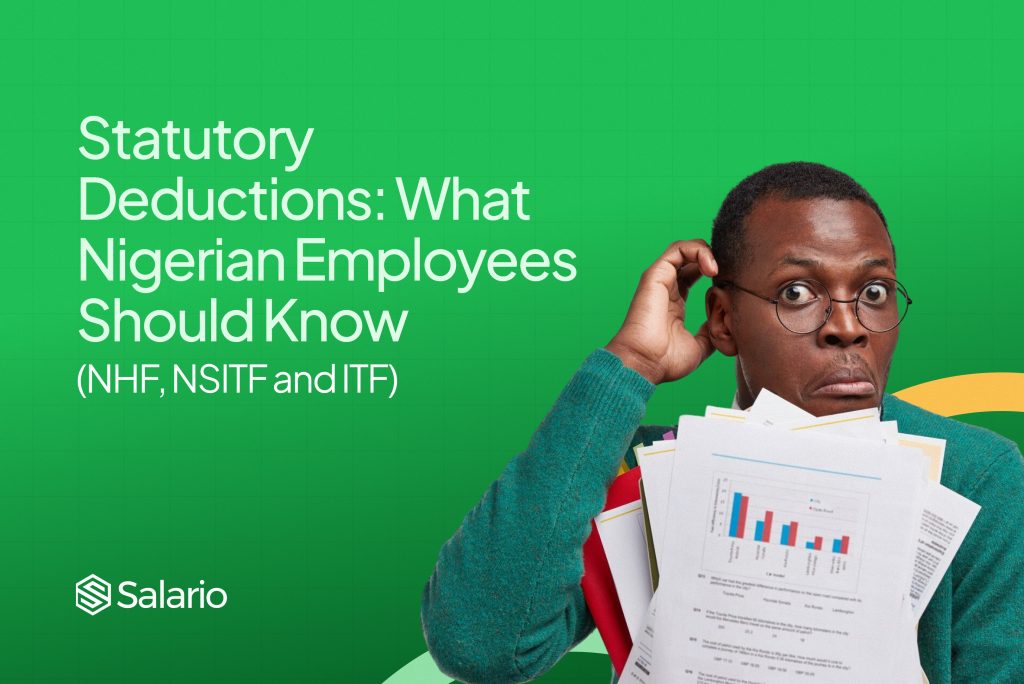
Chioma checked her payslip and paused. Her salary looked right, but the deductions raised questions. NHF. NSITF. ITF. What do they actually mean, and where does the money go?
If you are a Nigerian employee, statutory deductions are part of your monthly salary. They are not optional. They are required by law, and they affect your take-home pay and long-term benefits.
This guide breaks down statutory deductions in Nigeria, focusing on NHF, NSITF, and ITF. You will understand what they are, why they exist, and what happens when employers fail to remit them.
What are statutory deductions?
Statutory deductions are compulsory payments required by Nigerian law. Employers deduct some from your salary and contribute others on your behalf. These deductions go to government-approved schemes that support housing, workplace safety, and workforce development. In simple terms, statutory deductions are how the system ensures you are protected beyond your monthly salary.
Purposes of statutory deductions
Statutory deductions are not random charges. Each one serves a clear purpose tied to your financial security and national development.
- First, they provide access to long-term benefits. For example, NHF contributions allow you to apply for housing loans at lower interest rates.
- Second, they protect you against workplace risks. NSITF ensures compensation if you suffer injury, disability, or death from work-related incidents.
- Third, they support skill development across industries. ITF contributions fund training programs that improve workforce productivity.
- Finally, they enforce accountability. These deductions reduce tax evasion and ensure employers meet compliance standards.
Statutory deductions Nigerian employees should know
Not every statutory contribution comes directly from your salary, but you should understand all of them. It helps you spot errors and hold your employer accountable.

National Housing Fund (NHF)
NHF is one of the most visible statutory deductions on your payslip. Here, employers deduct 2.5% of your monthly basic salary and remit it to the Federal Mortgage Bank of Nigeria.
The goal is simple. It helps Nigerians access affordable housing loans for building, buying, or renovating homes. If you contribute consistently, you can apply for long-term loans at lower interest rates than commercial banks.
There are a few exemptions. Employees earning below ₦3,000 annually and expatriates are not required to contribute.
For many employees, NHF is the closest thing to a structured housing plan.
Nigeria Social Insurance Trust Fund (NSITF)
NSITF works differently from NHF. It is not deducted from your salary. Instead, your employer contributes 1% of total payroll to fund the Employee Compensation Scheme. This scheme protects you when things go wrong at work.
If you suffer an injury, occupational disease, or disability, NSITF provides compensation. It also covers death benefits for your dependents. Think of it as workplace insurance funded by your employer.
Many employees ignore NSITF because they do not see it on their payslip. That is risky. If your employer does not remit it, you may lose access to these protections.
Industrial Training Fund (ITF)
ITF focuses on skills and workforce development. Companies with at least five employees or ₦50 million annual turnover must contribute 1% of their annual payroll to ITF.
This contribution does not come from your salary. It is paid entirely by the employer. The fund supports training programs that improve employee skills across industries. It also allows employers to claim partial refunds if they provide certified staff training.
In the long run, ITF helps build a more skilled workforce. That benefits both employees and employers.
Penalties for Non-Remittance of Statutory Deductions in Nigeria
This is where things get serious.

When employers deduct statutory contributions and fail to remit them, it is not just an administrative mistake. It is a legal offense, one that regulators are increasingly enforcing as Nigeria tightens oversight of employer compliance.
For NHF, late remittance attracts a penalty of ₦50,000.
For ITF, failure to remit on time leads to an additional 5% penalty on the unpaid amount.
NSITF penalties are even stricter. Employers who default may face:
- Fines starting from ₦100,000 for individuals
- ₦1,000,000 for companies
- Possible imprisonment
- Additional 10% penalty on unpaid contributions
Beyond fines, non-compliance affects employees directly. Workers bear the consequences of their employer’s failure through no fault of their own.
You may lose access to housing loans.
You may not qualify for workplace compensation.
Your employer may face issues during audits, funding rounds, or government contracts, and those issues can stall your salary, delay promotions, or cost jobs entirely.
For Nigerian employees, the real risk is silent non-remittance. Your payslip may show deductions, but the funds may never reach the right agencies. This is why it is worth periodically verifying your contributions directly with the NHF, ITF, and NSITF portals, rather than assuming your employer is compliant.
How Salario helps with statutory deductions
Managing statutory deductions manually is where most Nigerian businesses struggle. Spreadsheets get messy. Deadlines get missed. Compliance becomes reactive instead of structured. This is where platforms like Salario make a difference.
Salario automates statutory deductions from payroll calculations to remittance tracking. Instead of manually calculating NHF or tracking ITF deadlines, the system handles it in real time.
For HR teams, this reduces errors and saves hours every month.
For employees, it creates transparency. You can see what was deducted and trust that it was remitted correctly.
For founders, especially those managing teams from abroad, it removes uncertainty. You get visibility into compliance without chasing updates or worrying about penalties.
Salario also keeps records for audit purposes. In Nigeria, where regulatory checks can happen suddenly, this matters.
Conclusion
Statutory deductions are more than line items on your payslip. They connect you to housing opportunities, workplace protection, and long-term career development.
Understanding NHF, NSITF, and ITF helps you stay informed and avoid silent compliance risks.
For businesses, the challenge is not knowing these deductions. It is managing them consistently without errors.
Ready to run compliant payroll without stress? Book a free demo with Salario today and see how automated statutory deductions keep your business aligned with Nigerian regulations. When payroll works the way it should, you can focus on growing your team, not fixing mistakes.